
Robocats
Sergiy Yakovenko and I developed the "robocat" model to address these questions:
- In the absence of sensory input, how well can the spinal locomotor pattern generator and the biomechanical properties of muscles compensate for alterations in locomotor speed, terrain etc?
- How important are simple stretch reflexes?
- What is the nature of the sensory rules that are used to control locomotion over uneven terrain?
Click on the images to view movie clips of the robocat walking with and without sensory IF-THEN rules that trigger a tripping rule and a stance to swing
rule.
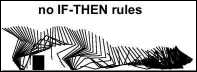
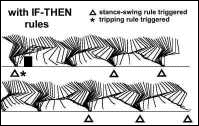
Rule 1: IF the foot contacts an obstacle, THEN lift the leg back and up over
Rule 2: IF the leg is extended and IF it is unloaded, THEN trigger the swing phase. The triangles show the steps in which this rule was triggered. In the other steps, the timing of the centrally generated pattern was correct. The rule was only triggered if the swing phase had not been initiated in time.
Related Files:
PROCHAZKA, A. & YAKOVENKO, S. (2001) Locomotor control: from spring-like reactions of muscles to neural prediction. In: The Somatosensory System: Deciphering The Brain's Own Body Image. ed. Nelson, R.J. Boca Raton, CRC Press, 141-181
PROCHAZKA, A., GRITSENKO, V. & YAKOVENKO, S. (2002) Sensory control of locomotion: reflexes versus higher-level control. In: Sensori-Motor Control, ed., S.G. Gandevia. U. Proske & D.G. Stuart, Kluwer Academic/Plenum, New York.
YAKOVENKO, S., GRITSENKO, V., PROCHAZKA, A. (2004) Contribution of stretch reflexes to locomotor control: a modeling study. Biological Cybernetics
PROCHAZKA, A. & YAKOVENKO, S. (2007) Prochazka A, and Yakovenko S. The neuromechanical tuning hypothesis. In: Prog. Brain Res. Computational Neuroscience: Theoretical Insights into Brain Function, edited by Cisek P, Drew, T. & Kalaska, J. NY: Elsevier, 2007, p. 255-265.
PROCHAZKA, A. & YAKOVENKO, S. (2007) Predictive and reactive tuning of the locomotor CPG. Integrative and Comparative Biology 47: 474-481, 2007b.
Movies:
ROBOCATS : No If-Then rules
ROBOCATS : With If-Then rules