|
Homepage
for Dr. (Last updated: October 19th, 2012) |
||
|
|
||
|
Name: |
John G.H. Dunn |
|
|
Rank: |
Professor |
|
|
Faculty: |
||
|
Area of Study: |
Sport Psychology |
|
|
e-mail: |
||
|
Tel. FAX |
(780)-492-2831 (780)-492-2364 |
|
|
|
||
|
WEBSITE NAVIGATION
Click here to view my (1) 2012/13 teaching duties, (2) information for prospective graduate students, (3) publications, (4) applied sport psychology work, and (5) biographical information & general interests, and (6) considering a career in applied sport psychology? |
||
|
|
||
|
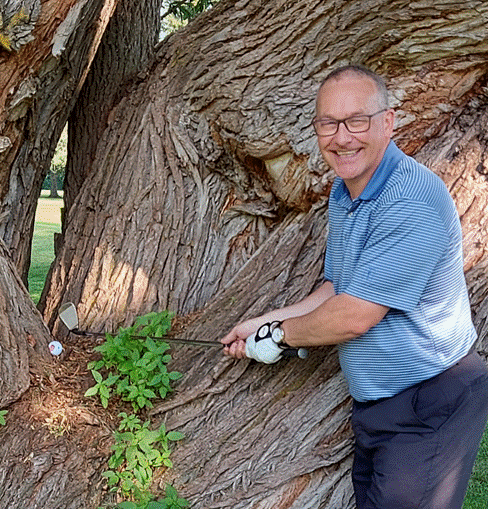
Trying to pretend I’m working at the 2006 Torino Winter Olympics |
||
|
1.
Primary Teaching Duties For Upcoming Year (2012-2013) |
||
|
In the fall semester I will teach two large undergraduate classes: PEDS.303 (Sport Psychology) and PEDS.309 (Statistics). In the winter semester I will teach one graduate class (PEDS.544: Sport Psychology). I typically have no teaching responsibilities from May through August. |
||
|
|
|
2. Information for Prospective Graduate Students At the outset of my career, my research focused on competitive sport
anxiety and worry. However, since 2002 I have been pursuing a research
program that examines the construct of perfectionism and how this personality
trait relates to behaviour, cognition, and affect
in sport. Given this current focus on perfectionism
in sport, I give strong consideration to prospective students who express a
genuine interest in studying perfectionism as part of their research program.
I am also interested in measurement and psychometric is Given my interests in psychometrics and scale construction, I am primarily
interested in taking graduate students who have an interest in conducting
research using quantitative research methodologies as opposed to qualitative
research methodologies. I strongly encourage all of my graduate students to
take a variety of statistics courses that are offered at the Many students ask me if they will have opportunities to work with athletes
as part of their graduate program. All of the research programs that I have
supervised to this point in time have involved "basic" research
aimed at theory development. In other words, I have not supervised any
"intervention" research studies where students have delivered any
type of mental skills training program to athletes. Moreover, it is important
to note that I do not offer Masters students any sort of supervised
practicum-based experiences in the area of applied sport psychology (i.e.,
working on performance enhancement is Lastly, I really encourage graduate students to conduct research that will be worthy of publication. My students have presented their graduate research at national conferences (e.g., SCAPPS) and/or international conferences (e.g., AASP), and most work with me (or should I more accurately say, “I work with them”) in the preparation and submission of manuscripts for consideration by peer reviewed journals. Thus, it is my goal that my students will leave the University of Alberta not only with an outstanding degree, but with a level of training that will have exposed them to the entire research process...beginning with the creation of an idea and ending with the submission (and hopeful publication) of a research paper that they can be proud of. To give prospective students a better idea of the graduate work that I have been involved with, I have included a select list of thesis and dissertation titles of graduate students with whom I have worked. Supervisor for:
Committee member for:
Additional Important Information for Prospective Students: Normally I have no more than two or three graduate students at any one time in my capacity as a supervisor. Given my involvement in other graduate committees across campus, I do not feel that I would have sufficient time to devote to my graduate students if I assumed supervision responsibilities for more than three students at one time. Having said this, I would find it hard to turn away an application from a prospective student who I thought would be an excellent fit with me, but I have never had more than three students at one time. At the graduate level our Faculty only offers a couple of courses that
specifically focus on sport psychology is Entrance Requirements and Procedures: Students who are interested in getting specific information about the formal application process (including deadlines and application materials) should contact Ann Jordan (anne.jordan@ualberta.ca). Ann is the Graduate Programs coordinator in our Faculty. Normally Ann will provide me with a package of completed applications from students interested in pursuing studies in the area of sport psychology sometime in early March each year, although she will also pass me individual files as they arrive. (The application deadline for admission to our graduate program is March 1st. However, students who wish to be considered for scholarships are encouraged to have their applications submitted by January 1st of each year). I generally look at all the applications at one time when making my own decisions about taking a new student (although as stated previously, I will also look at individual applications as they arrive). If I am undecided about a student, I often contact him/her and ask for a copy of a previous term paper to get a sample of the student's writing skills. Ideally, this piece of work would be in the area of sport psychology or the social sciences. If such a piece of work is not available, however, I may ask for a short 3-page paper on a specific topic of the student's choosing. There is no perquisite entrance requirement to our graduate program with respect to undergraduate classes. In general, I like to take students who have demonstrated an interest in, and dare I say "passion" for sport. Consequently, I like to take students who have demonstrated an interest in sport psychology at the undergraduate level. However, I also consider students who come primarily from a psychology background where they may have had few opportunities to take sport psychology classes. In such instances, I particularly look at the student's previous interest in sport (as demonstrated by prior sport experiences as a competitor or coach). In fact, I look at this aspect of all applicants’ backgrounds because I am of the opinion that to study sport psychology, it is highly advantageous to possess a fairly high level of "contextual intelligence" (Sternberg, 1997). Our Faculty will sometimes require students who have no formal educational experiences in physical education or sport psychology to take some undergraduate classes (in physical education and sport psychology) in the student’s first year. Under these circumstances the student is admitted into the graduate program as a qualifying or probationary student. Successful completion of these classes (in addition to some graduate classes) then results in the student being fully accepted in the graduate program. These situations are considered on a case-by-case basis. The minimum GPA that is required for all students who wish to enter our graduate program is 3.0 (on a 4-point scale) over the last 60 credits of coursework. Applications for Fall, 2013. I currently have two graduate students (both of whom in September, 2011). It is unlikely (but not impossible) that I will consider taking any new students in the Fall of 2013. Funding Opportunities for Fall, 2013. Unfortunately, I currently hold no major grants, so I am not in a position to directly fund any graduate students. However, most incoming students receive funding from our Faculty for Teaching/Research Assistantships. Inquiries about TA/RA funding opportunities should be directed to Ann Jordan (anne.jordan@ualberta.ca), graduate programs coordinator in the Faculty of PE & Rec. As a point of interest, the last three MA students that I have graduated have all had their thesis research funded by small grants from the Sport Science Association of Alberta (up to $5,000) to offset their costs.
|
|
Examples of Previous Grants
|
|
Gotwals, J.
K., Stoeber, J., Dunn, J G. H., & Stoll, O. (in press). Are perfectionistic strivings in sport adaptive? A systematic
review of confirmatory, contradictory, and mixed evidence. Canadian Psychology. Dunn, J.G.H.,
Causgrove Dunn, J., & McDonald, K. (2012). Domain-specific perfectionism
in intercollegiate athletes: Relationships with perceived competence and
perceived importance in sport and school. Psychology
of Sport and Exercise, 13, 747-755. Jones, M. I.,
Dunn, J. G. H., Holt, N. L., Sullivan, P. J., & Bloom, G. A. (2011).
Exploring the '5Cs' of positive youth development in sport. Journal of Sport Behavior, 34,
250-267. Sapieja, K.M.,
Dunn, J. G. H., & Holt, N. L. (2011). Perfectionism and perceptions of parenting
styles in male youth soccer. Journal of
Sport & Exercise Psychology, 33, 20-39. Dunn, J. G. H., Craft, J., Causgrove Dunn, J., & Gotwals, J.K. (2011). Comparing a domain-specific and global measure of perfectionism in competitive female figure skaters. Journal of Sport Behavior, 34, 25-46. Gotwals, J. K., Dunn, J. G. H., Causgrove Dunn, J., & Gamache, V. (2010). Establishing validity evidence for the Sport Multidimensional Perfectionism Scale-2 in intercollegiate sport. Psychology of Sport and Exercise, 11, 423-432. Gotwals, J. K., & Dunn, J. G. H. (2009). A multi-method multi-analytic approach to establishing internal construct validity evidence: The Sport Multidimensional Perfectionism Scale - 2. Measurement in Physical Education and Exercise Science, 13, 71-92. Causgrove Dunn, J., Dunn, J. G. H., & Bayduza, A. (2007). Perceived athletic competence, sociometric status, and loneliness in elementary school children. Journal of Sport Behavior, 30, 249-269. Vallance, J. K. H., Dunn, J. G. H., & Causgrove Dunn, J. (2006). Perfectionism, anger, and situation criticality in competitive youth ice hockey. Journal of Sport & Exercise Psychology, 28, 383-406. Holt, N. L., & Dunn, J. G. H. (2006). Guidelines for delivering personal-disclosure mutual-sharing team building interventions. The Sport Psychologist, 20, 348-367. Causgrove Dunn, J., & Dunn, J. G. H. (2006). Perceptions of the motivational climate, perceived competence, and participation behaviors of children with movement difficulties in physical education. Adapted Physical Activity Quarterly, 23, 293-309. Dunn, J. G. H., Gotwals, J. K., Causgrove Dunn, J., & Syrotuik, D. G. (2006). Examining the relationship between perfectionism and trait anger in sport. International Journal of Sport and Exercise Psychology, 4, 7-24. Dunn, J. G. H., Causgrove Dunn, J., Gotwals, J. K., Vallance, J. K. H., Craft, J. M., & Syrotuik, D. G. (2006). Establishing construct validity evidence for the Sport Multidimensional Perfectionism Scale. Psychology of Sport and Exercise, 7, 57-79. Dunn, J. G. H., Gotwals, J. K., & Causgrove Dunn, J. (2005). An examination of the domain specificity of perfectionism among intercollegiate student-athletes. Personality and Individual Differences, 38, 1439-1448. Dunn, J. G. H., & Holt, N. L. (2004). A qualitative investigation of a personal-disclosure mutual-sharing team building activity. The Sport Psychologist, 18, 363-380. Holt, N. L., & Dunn, J. G. H. (2004). Toward a grounded theory of psychosocial competencies and environmental conditions associated with soccer success. Journal of Applied Sport Psychology, 16, 199-219. Holt, N., & Dunn, J. G. H. (2004). Longitudinal idiographic analyses of appraisal and coping responses in sport. Psychology of Sport and Exercise, 5, 213-222. Dunn, J. G. H., & Holt, N. L. (2003). Collegiate ice hockey players' perceptions of the delivery of an applied sport psychology program. The Sport Psychologist, 17, 351-368. Dunn, J. G. H., & Syrotuik, D. G. (2003). An investigation of multidimensional worry dispositions in a high contact sport. Psychology of Sport and Exercise, 4, 265-282. Gotwals, J. K., Dunn, J. G. H., & Wayment, H. (2003). An examination of perfectionism and self-esteem in intercollegiate athletes. Journal of Sport Behavior, 26, 17-38. Dunn, J. G. H., Causgrove
Dunn, J., & Syrotuik, D. G. (2002). Relationship between multidimensional
perfectionism and goal orientations in sport. Journal of Sport & Exercise
Psychology, 24, 376-395. Dunn, J. G. H., & Causgrove Dunn, J. (2001). Relationships among the Sport Competition Anxiety Test, the Sport Anxiety Scale, and the Collegiate Hockey Worry Scale. Journal of Applied Sport Psychology, 13, 411-429. Dunn, J. G. H., Causgrove Dunn, J., Wilson, P., & Syrotuik, D. G. (2000). Reexamining the factorial composition and factor structure of the Sport Anxiety Scale. Journal of Sport & Exercise Psychology, 22, 183-193. Dunn, J. G. H. (1999). A
theoretical framework for structuring the content of competitive worry in ice
hockey. Journal of Sport
& Exercise Psychology,
21,
259-279. Dunn, J. G. H., & Causgrove Dunn, J. (1999). Goal orientations, perceptions of aggression, and sportspersonship in elite male youth ice hockey players. The Sport Psychologist, 13, 183-200. Dunn, J. G. H., Bouffard,
M., & Rogers, W. T. (1999). Assessing item content-relevance in sport
psychology scale-construction research: Is Dunn, J. G. H., & Nielsen, A. B. (1996). A classificatory system of anxiety-inducing situations in four team sports. Journal of Sport Behavior, 19, 111-131. Dunn, J. G. H. (1994). Toward the combined use of nomothetic and idiographic methodologies in sport psychology: An empirical example. The Sport Psychologist, 8, 376-392. Dunn, J. G. H., & Nielsen, A. B. (1993). A between-sport comparison of situational threat perceptions in ice hockey and soccer. Journal of Sport & Exercise Psychology, 15, 449-465. Bouffard, M., & Dunn, J. G. H. (1993). Children’s self-regulated learning of movement sequences. Research Quarterly for Exercise and Sport, 64, 393-403. |
|
|
|
|
|
||
|
|
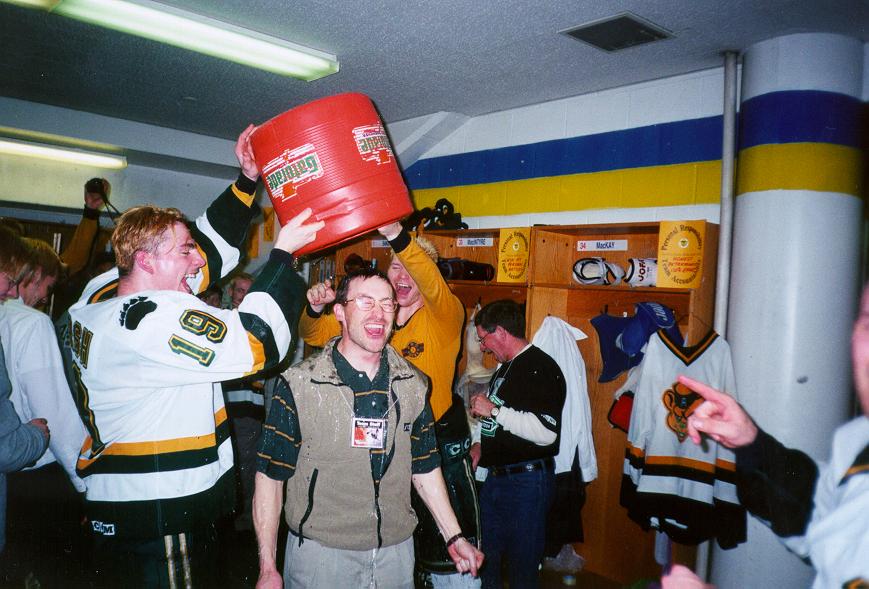
“Cooling Off”
after winning the 1998/99 CIAU hockey national championship in |
||
|
|
|
|
5. Biographical Information & General Interests I was born and raised in I have always had a keen love of sport—hence my interest in the area of
sport psychology. As a schoolboy I represented I have always had a strong interest in coaching too. I hold the English Football Association Prelim coaching award and am a fully certified C-License soccer coach through the Canadian 3M National Coaching Certification Program (NCCP). I also hold tennis coaching qualifications from the English Lawn Tennis Association. I have acted as a Level 4/5 course-conductor teaching sport psychology sections for the NCCP. Although I spend much of my time in the world of high performance sport, I have maintained my connection to “grass roots” developmental sport where I have coached both my daughters in soccer.
|
|
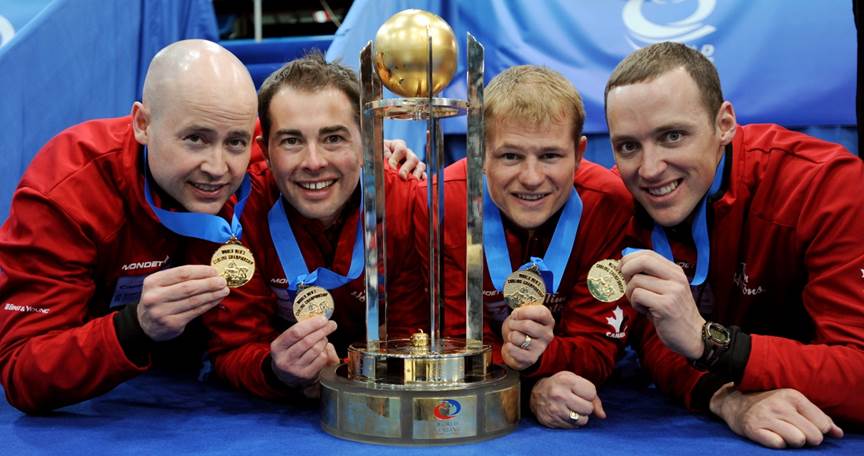
Having fun “cat skiing” in the (I’m second from
the right in case you are wondering.) |
|
|
|
6. Considering a Career in
Applied Sport Psychology? I am frequently asked questions by interested students about pursuing a career in the area of applied sport psychology, and about possible job opportunities in the field. The following is a brief synopsis of my typical response. Please note, however, that these are my opinions and views and they may not necessarily be correct or constitute the answer you would get from another practitioner in my field. I usually start by delivering the bad news. I tell people
that there are relatively few full-time opportunities to work in the area of
applied sport psychology in Education forms a huge part of the sport psychologist’s
training. My own personal training ( To become a registered psychologist who can
deal with clinical/counseling issues, an individual must undergo graduate
training in the area of clinical/counseling psychology. The In Clearly then, individuals have a number of choices to make
in terms of the training/education they choose to pur I always tell people who are interested in working in the field of sport psychology that they should be passionate about sport. While I do not think an individual needs to have been an elite or professional level competitor to work effectively in this area, I honestly believe that it really does help to have an implicit knowledge of the competitive sport environment. In other words, I believe that individuals who have had experiences as athletes (or coaches) are at a huge advantage in the field of sport/performance psychology. If you have competed (or coached) in sport you likely have a much better appreciation of the pressures and challenges that athletes face on a daily basis. Knowing what it feels like to perform in front of an audience, to let your team-mates down if you make a mistake, to be criticized by a team-mate or coach, to deal with the media, to make sacrifices, to stay committed to training for prolonged periods of time, to deal with injuries, to feel the frustration of defeat/failure and to feel the joy of success all help the would-be sport psychologist to better understand her/his client. Thus, experiences as an athlete or coach with higher levels of competition generally make it easier to understand the unique demands that higher competitive levels present. Although I wholeheartedly endorse the need to pur I hope the information contained in the aforementioned paragraphs helps provide some guidance for people who are contemplating a possible career in the area of applied sport psychology. |
|
|
|
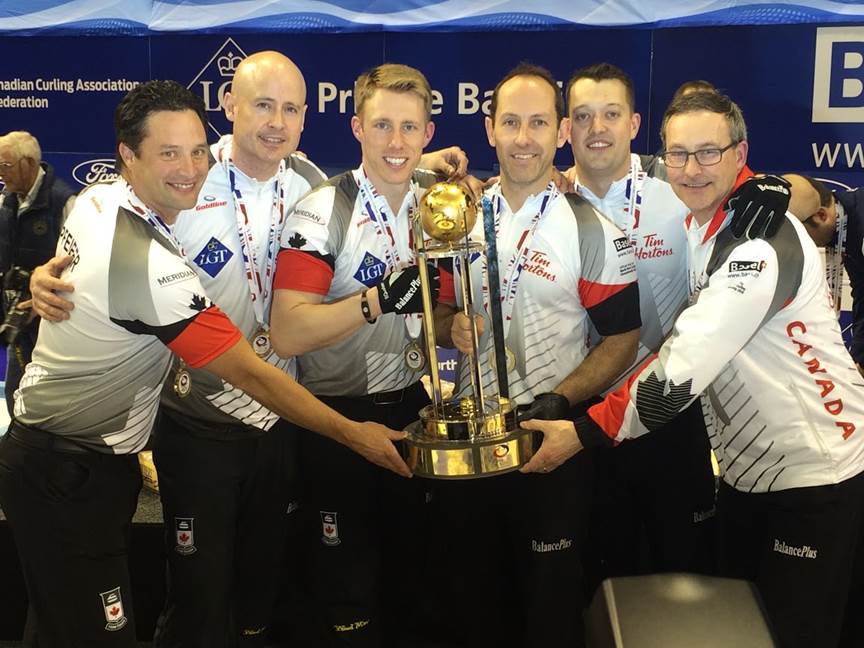
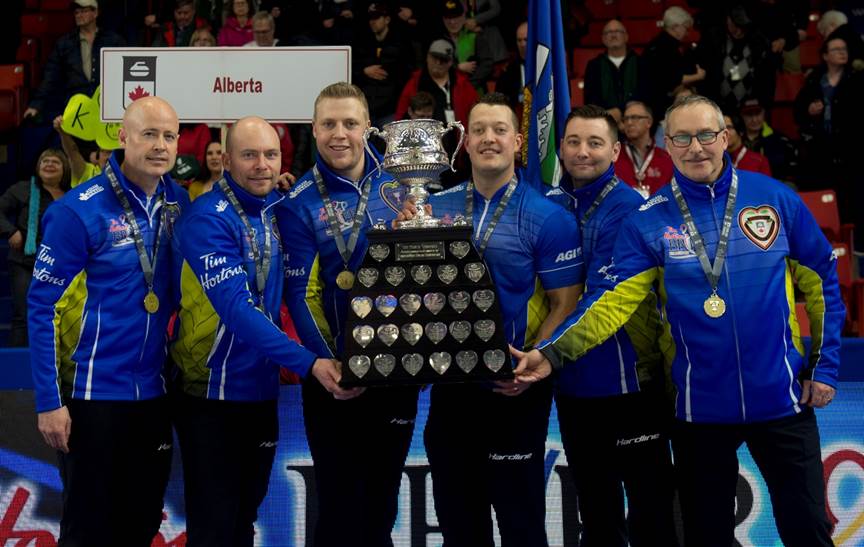
“One of the most memorable moments of my career.” Waiting to do the “Walk of Champions” with
Team Alberta (Koe) before lifting the 2010 Tim Horton’s Brier in Halifax,
Nova Scotia. |