This story is about residential schools, a topic that may be distressing to those dealing with past trauma. A national 24-hour Indian Residential School Crisis Line is available at 1-866-925-4419.
Eleven years after a joint committee of the House of Commons and Senate recommended closing Indian residential schools in 1948, two new schools opened their doors in the Northwest Territories.
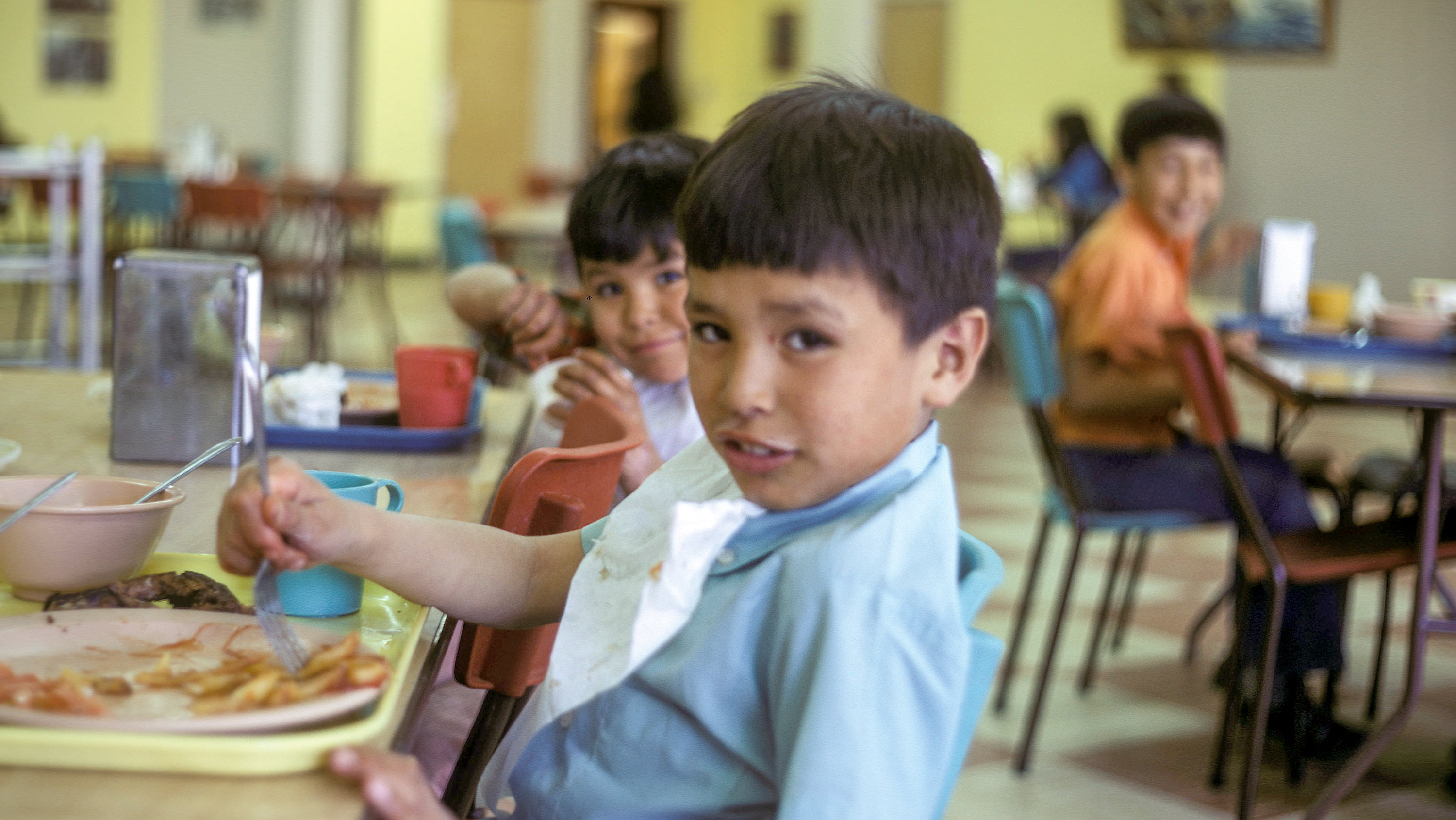
As with their southern counterparts, the damage done by Inuvik’s Grollier and Stringer Halls to Gwichyà Gwich’in and other Indigenous children of the region was traumatic and lasting.
Children as young as nine months old were forcibly removed from their families, severed from their languages and cultures, travelling sometimes thousands of kilometres to be institutionalized. Forbidden from speaking in their own languages, they would be subjected to strict codes of discipline and “just awful people who worked there, some of them criminals,” inflicting multiple forms of physical and sexual violation, says University of Alberta historian Crystal Gail Fraser.
Fraser was spared the pain and abuse of those institutions as a child, although both her mother and grandmother did attend residential schools. Fraser went to a day school across the street.
Grollier Hall didn’t close until 1996, when she was 16. Fraser grew up and trained as a historian and Indigenous studies scholar, now cross-appointed in the Faculty of Native Studies and the Department of History, Classics and Religion. Upon the request of Elders and others in the Gwich’in Nation, she began researching these histories around 2010.
Based on more than 75 interviews with survivors and knowledge keepers, Fraser’s resulting book, By Strength, We Are Still Here: Indigenous Peoples and Indian Residential Schooling in Inuvik, has won the 2025 Governor General’s History Award for Scholarly Research. It stands as one of very few histories written about the North from an Indigenous perspective.
From an early age, Fraser witnessed a system that did its best to eliminate the culture of her people, “sever important familial networks, remove them from Land and forbid cultural practices that had defined their Nations for millennia.”
“The engineering blueprints in construction were modelled after a federal prison, so this is exactly how these institutions were meant to work. It was about surveillance, rules, uniformity and discipline,” says Fraser.
The institutional trauma went on for generations, producing the familiar patterns of addiction, abuse, disproportionate incarceration and the near-extinction of the Gwichʼin language (Dinju Zhuh Ginjik) with fewer than 100 fluent speakers remaining.
Even today, she writes, “because of settler colonialism, genocide, and carceral state and church policies, many Indigenous Peoples do not have access to our knowledge systems, cultural practices, languages, or Lands.”
As the title of Fraser’s book suggests, what stood out more than the patterns of cultural genocide at Grollier and Stringer Halls was the strength of those who dared to resist. Children found ways to break the rules, stealing food, speaking their language in secret and forming bonds with sympathetic teachers, she says, “because not everyone was a bad person.”
Some used recreation and extracurricular activities, such as cross-country skiing, to briefly escape from the school, express their culture and reconnect with the land.