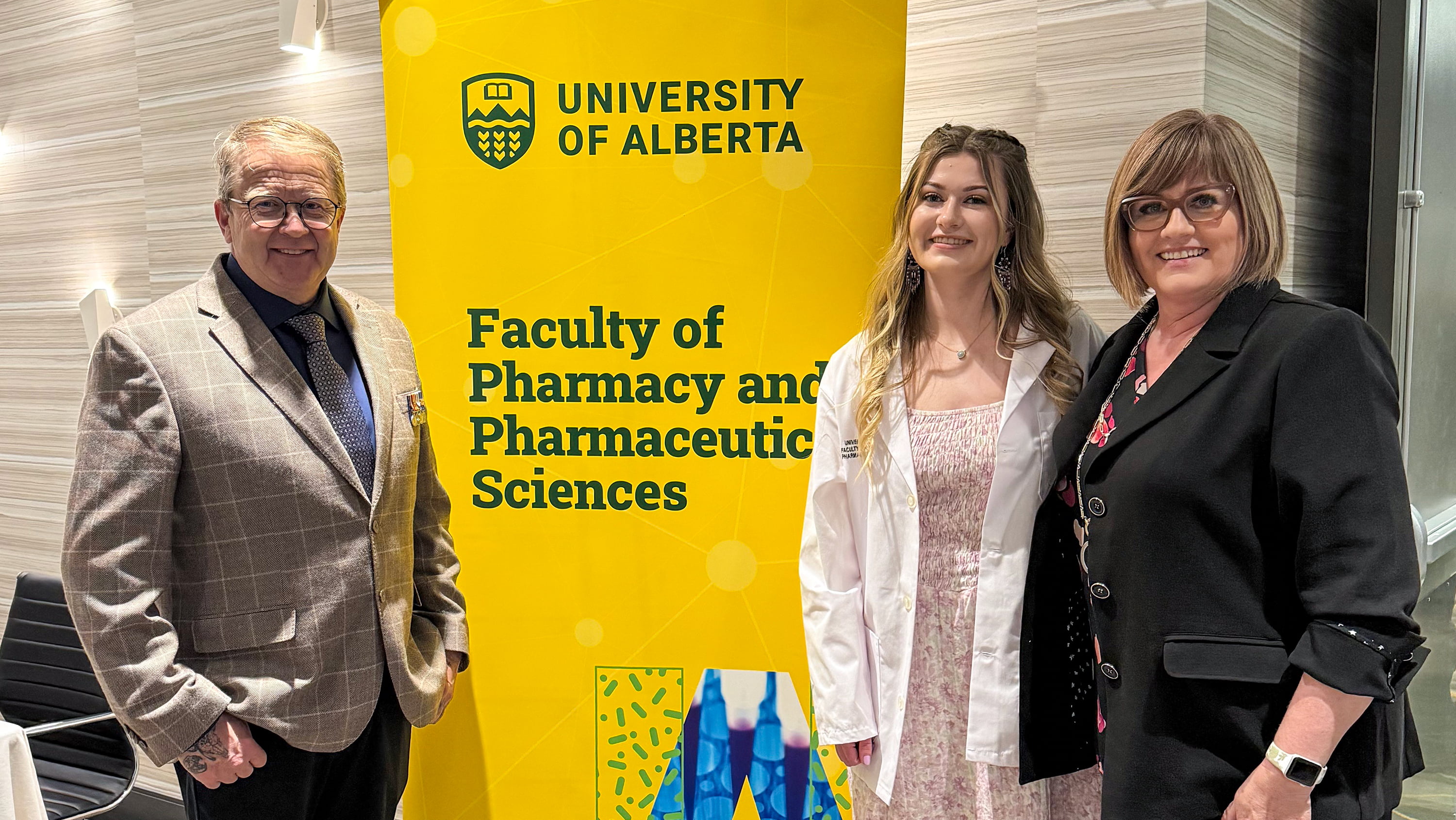
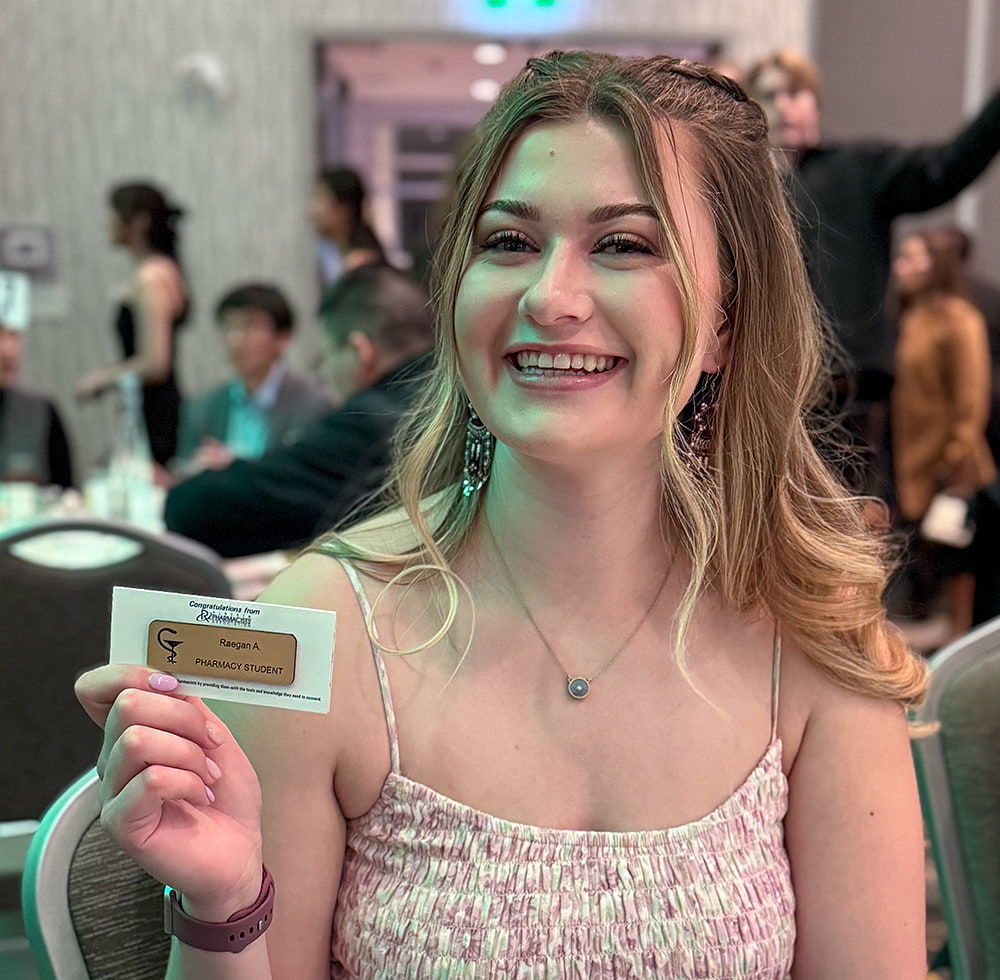
University of Alberta pharmacy student Raegan Abrey’s sense of empathy for her patients is more than just part of the job she’s training for. It comes from hard-won experience with a health scare of her own.
It was a twist of fate that knocked the promising young student off her planned path in life, and then brought her back to exactly where she wants to be — delivering high-quality health care to Indigenous and rural Albertans.
Abrey was just 18 years old, studying science at Concordia University in Edmonton, drawn north from her hometown of Coaldale in southern Alberta with a basketball scholarship. In the spring of 2019, she caught a cold she just couldn’t shake.
One day her vision was blurry and her speech was slurred. She could barely eat or walk. Abrey went to the emergency department, but instead of giving her a diagnosis, the doctors sent her home.
Her mother flew in the next day and took her daughter back to hospital. This time, her story was believed.
Abrey was admitted and eventually diagnosed with Guillain-Barré syndrome, a rare neurological disorder that can lead to paralysis. One or two people in every 100,000 develop the syndrome each year, according to the GBS Foundation of Canada
“Symptoms can be resolved in two weeks or in two years, or you could have lasting effects for the rest of your life,” Abrey recalls. “I went from being a post-secondary athlete to not even being able to walk. I had double vision for six months. It was a tough mental health go for a little bit there.”
The illness brought Abrey’s university studies to a halt. She went home to her parents’ place east of Lethbridge to recover. Then COVID hit, forcing everyone to stay home. She felt like she was in a kind of limbo state.
Abrey was picking up a prescription at the Coaldale pharmacy one day in September 2020 when she was offered a job as an assistant. It seemed like a way to make some money and pass the time, so she took it.
It was nothing less than a prescription to get her future back.
She’d had a vague idea after her time in the hospital that she might like to work in health care, but she hadn’t thought of pharmacy. She soon found she loved making connections with patients, especially the kids. The pharmacist told Abrey, “You interact with patients so well that I think you could be a very, very good pharmacist."
“I got lots of hands-on experience and I just fell in love with what pharmacists do,” Abrey says. “I’m not just providing a service for you. I’m actually making a connection with you and taking care of you.”
Abrey took another year’s worth of science prerequisites at the University of Lethbridge and was “ready to venture off into the world again.”
A proud Indigenous and rural focus
Abrey was admitted as one of three Indigenous pharmacy students at the U of A last fall. She is a member of the Otipemisiwak Métis Nation.
“I’m very proud of my heritage. My grandma was bullied for the complexion of her skin,” Abrey says. “So to come down just a generation to be so proud of who I am, it’s a very big step.
“I’m just very passionate about Indigenous health,” Abrey says.
Nineteen per cent of Albertans live in small towns or rural areas and seven per cent are Indigenous. The U of A’s Faculty of Pharmacy and Pharmaceutical Sciences aims to reflect that diversity in its student population, according to Sherif Mahmoud, associate professor and associate dean academic.
He says it will go a long way toward solving the rural health-care challenges in Alberta.
“Pharmacists are the most accessible health-care practitioners,” he points out. “If you want to speak to a pharmacist, you can just go to the pharmacy and speak to the pharmacist. You don’t need an appointment.”
He points to research showing that health-care professionals who are from rural areas and receive some of their training in rural areas are likely to return to their hometown or a community like it.
“Recruitment is a long-term process, but the eventual goal is to train more pharmacists specifically from rural areas in Alberta in order to increase access to pharmacists in rural Alberta,” Mahmoud says.
Increasing representation, increasing access
Abrey is part of the first cohort for this new effort to attract Indigenous and rural learners. In the past, approximately two-thirds of applicants came from Edmonton and Calgary, according to Mahmoud. The number of rural applicants doubled last year, filling all 10 designated seats for rural students. And there are already several Indigenous applicants for next year.
Rural and Indigenous students must meet the same minimum requirements as all other applicants, including prerequisites and a 3.0 grade point average. The top Indigenous students are eligible for entrance scholarships that cover almost a full year of tuition.
The rural and Indigenous focus is baked into the curriculum as well. All students are expected to take the U of A’s popular online Indigenous Canada course. Fifty per cent of the acute care placements are in rural hospitals. And there are bursaries for students who go rural for at least some of the six placements they must do during the four-year program.
Abrey believes it makes sense to reflect Alberta’s diversity in the student population. “It’s very important for patient care to have pharmacists of all different backgrounds, because you see everything from a different perspective.”
When she arrived on campus, she saw there were already clubs for Black pharmacy students and Muslim pharmacy students, so she and a fellow first-year, Morgan Deschiffart, decided to found the Indigenous Pharmacy Students Club.
They are getting support from the Indigenous Pharmacy Professionals of Canada. Their first event will include speaker Amber Ruben, an Inuvialuk pharmacist who practises at the Misericordia Hospital in Edmonton.
Thankfully, Abrey has fully recovered from Guillain-Barré Syndrome and is back to her active lifestyle that includes playing and coaching volleyball, basketball and slo-pitch. She’s headed to Fort Macleod for her first practical rotation this summer.
She is determined to live and work near her home community of Coaldale once she graduates.
“I have big dreams,” she says, including owning her own pharmacy to deliver both rural and Indigenous care with an approach stemming directly from her own experience within the health-care system.
“I think the biggest thing is taking everybody’s symptoms seriously. I went from just having a little bit of a cold to not being able to walk or eat or speak or see properly,” she recalls. “To be brushed off and told, ‘You’re probably fine, just go back home,’ was very frustrating.”
“I will be an advocate for people and put my foot down and take everything they say very seriously.”