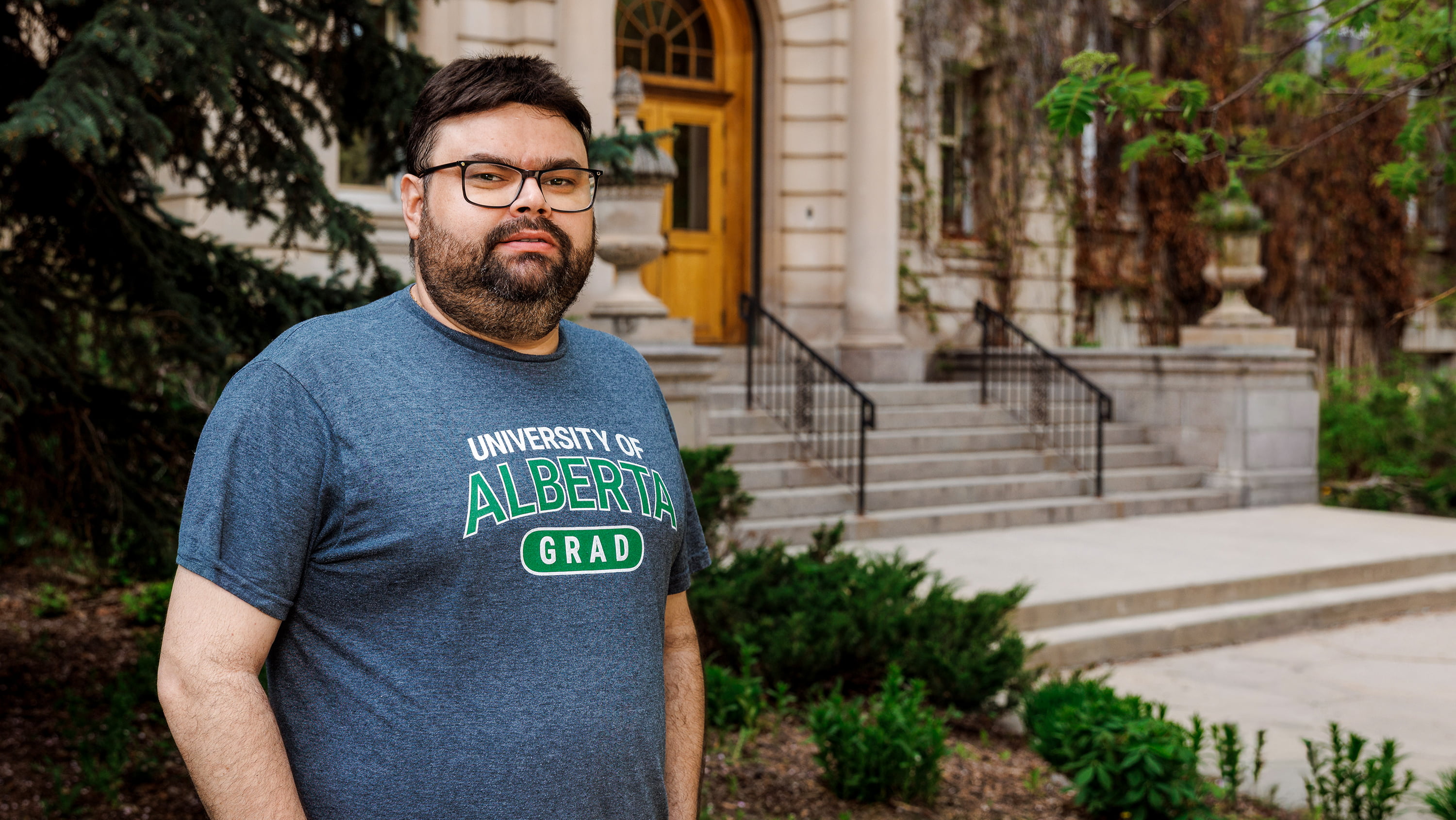
Shortly after Francerlândio Macena da Cruz arrived at the University of Alberta to begin a master’s degree in digital humanities, his 10-year-old son started having problems adapting to the new school.
Gabriel had been diagnosed with attention deficit/hyperactivity disorder in Brazil, but in moving to a foreign culture, his condition worsened and he had difficulty integrating socially. The ordeal was agonizing for both he and his wife Betânia, but for Cruz, it was incapacitating.
“Gabriel got stressed out so easily,” says Cruz. “There were some really tough episodes, and my wife and I took it on ourselves. I totally got lost and couldn’t organize my thoughts.”
Cruz’s academic work screeched to a halt, and he found himself in a confounding state of mental paralysis. That’s when he was also diagnosed with ADHD and realized he was experiencing what’s called “executive dysfunction.”
“I was in crisis and couldn’t do anything, at school or at home,” he says. “As much as you have things to do — as much as you constantly think about them — your body just shuts down.”
That was 2022, the year ChatGPT was released, so Cruz turned to it for help. He fed the AI-powered bot research materials and a few ideas for a paper. His first prompt: “Where do I begin?”
The response came as a revelation. It provided a roadmap to move forward, suggesting outlines for assignments and clarification of his ideas.
“It helped me immensely,” he says. “I have millions of ideas all the time running through my mind. When I get interested in one, I can’t stop thinking about it. Sometimes I can’t sleep at night. AI helps me give form to those ideas.”
The success of that dialogue with what he calls his “saviour” became the focus of his subsequent master’s degree capstone project. Cruz ended up creating an app called NeuroBridge, based on his own research journey and designed to help neurodivergent students overcome their inertia and cut through distraction.
Neurodivergent students can become overwhelmed by complex academic tasks, says Cruz, particularly when “forced to jump between disconnected digital tools for planning, reading, writing and citation management.” It’s a predicament that produces what he calls a digital “fragmentation tax,” a cognitive drain that “exhausts working memory before learning begins, ultimately triggering executive paralysis,” says Cruz.
Cruz describes his solution as “an AI-powered, single-pane-of-glass web application that unifies the entire academic workflow into one neuro-affirming interface,” working as an “active executive scaffold rather than a ghostwriter.”
“NeuroBridge is a fantastic example of person-centred design,” says Kenzie Gordon, Cruz’s supervisor. “Rather than starting with the technology and wedging in the user, Francerlândio has designed outwards from the needs of neurodiverse learners, developing a tool that fits a variety of learning needs and addresses academic integrity concerns in a way that many university accommodations tools fail to do.”
He has now started a business called BridgeLabs Solutions and was recently accepted into the Lab2Market Validate Alberta incubator program, in addition to receiving the GPS Graduate Student Elevation Award. He is also applying to the University of Alberta Innovation Fund to further commercialize the app.
While the prototype is designed specifically for the U of A environment — with plans to connect, for example, to the university’s library system — it can be customized for any environment, including other post-secondary institutions or even businesses looking to organize workflow.
Part of Cruz’s research — inspired by two courses he took from AI expert Geoffrey Rockwell on the ethics of information and AI — involved examining U of A policy on accommodations for neurodivergent students. He was surprised to find there was no mention of the potential of AI to help with academic work in a responsible and legitimate way.
“It essentially treats AI as an automatic violation, completely ignoring its potential to act as a vital support for neurodivergent students,” he says. “But without it, I couldn’t have done 10 per cent of what I have done—and that is due to physical incapacity, not intellectual capability.”
To address academic integrity concerns, NeuroBridge also contains a “transparency ledger” that logs all human-AI interactions to generate a compliance-ready “statement of AI use.”
Developed specifically for neurodivergent students, says Cruz, the tool could also be useful to anyone. “It was born of the difficulties I had — that a lot of neurodivergent people have — but it could also be used by undergraduates just out of high school who don’t have much experience writing academic papers.”
He cautions that any use of chatbots must include rigorous fact checking. One way to avoid hallucinations and misinformation is to limit prompts to research material provided, so the bot doesn’t search the internet for questionable content.
“It works with the documents you feed it, and if you don’t have the materials yet, it will help search for those in your university library.”
Cruz’s initial struggles with ADHD meant his first degree took two years longer than expected. But in the end, it has been well worth it, he says. Besides providing fodder for an innovation that could help countless others, his diagnosis shed light on struggles in his past that had long perplexed him: “I finally had explanations for things that happened in my life.”
He credits the U of A for helping him through his crisis, both financially and with academic and mental health support. He regards his work on NeuroBridge as a way to give back.
As for Gabriel, now 13, Cruz says he is doing much better at school, experimenting on different computer and cellular operating systems, and occasionally offering advice and feedback to his father.
“When I showed Gabriel the app for the first time, he said, ‘The interface is intuitive and simple. I like the fact that the AI doesn’t write the text for you; the user writes it based on the AI’s research findings.’”