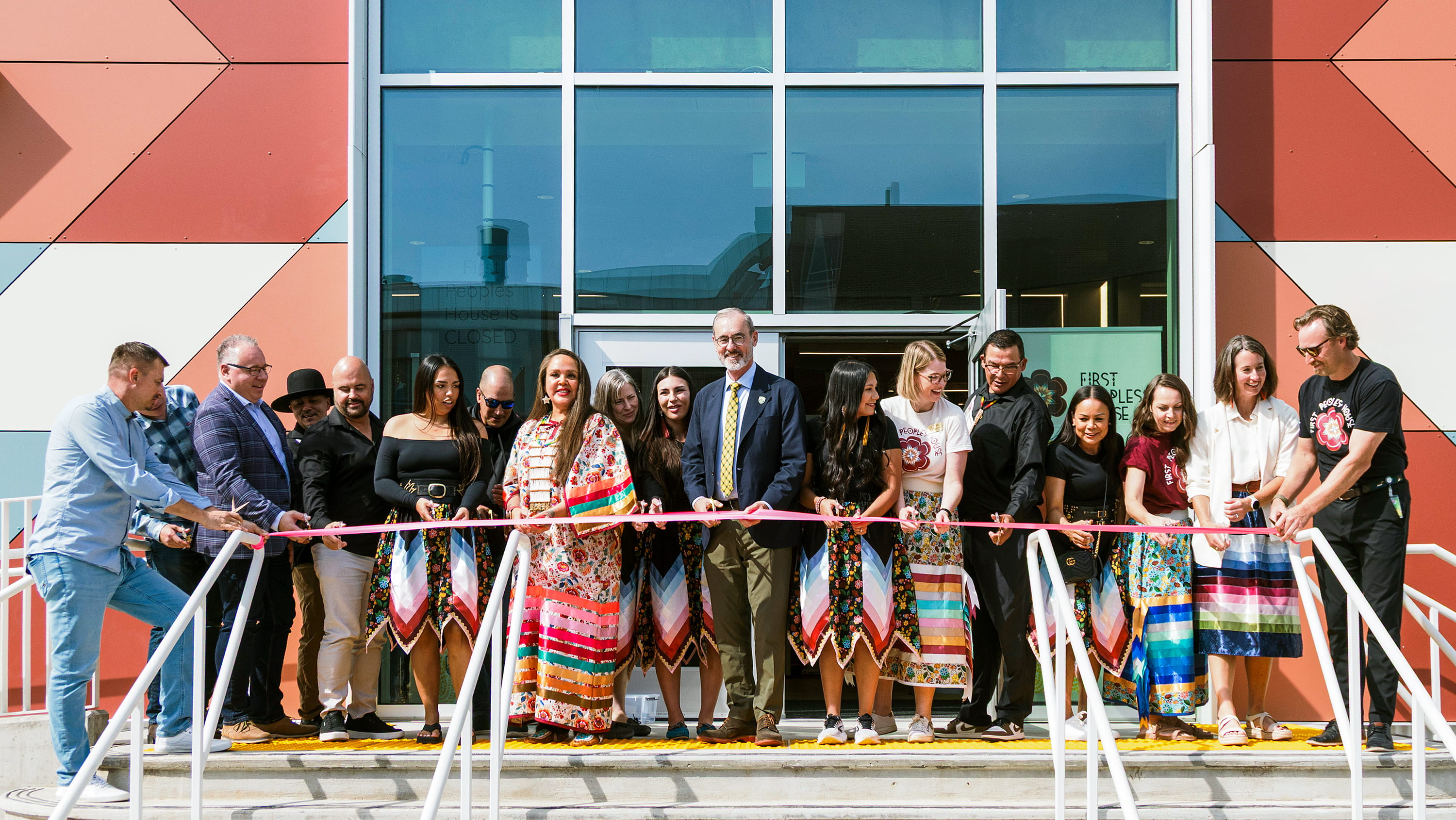
The University of Alberta officially ushered in a new chapter for First Nations, Métis and Inuit students on Monday with the grand opening of the reimagined First Peoples’ House.
Opened to coincide with the 150th anniversary of the signing of Treaty 6, the state-of-the-art, $16.8-million facility represents a massive step forward in the university’s commitment to institutional reconciliation. The expansive 40,000-square-foot gathering place replaces a long-outgrown space and significantly scales up the university’s capacity to support its rapidly growing Indigenous student population.
For over 40 years, First Peoples’ House has served as the heart of the First Nations, Métis and Inuit student community on campus. However, its previous space was limited and could accommodate only 50 students at a time.
“We have more than 1,900 First Nations, Métis and Inuit students currently enrolled at the U of A; the new First Peoples’ House can hold all of them,” says Shana Dion, assistant dean of First Nations, Métis and Inuit students and the driving force behind the project.
“We are setting a university experience for First Nations, Métis and Inuit students unlike any other in Canada. It's an honour to be a part of this legacy.”
When students cross the threshold of the new building, they are greeted by the Cree word tawâw, meaning, “Welcome, there is room for you.”Dion says that teaching is built into every corner, as the space is about much more than bricks and mortar.
“This building is about creating a legacy of love,” she says. “It honours those who came before us, embraces those who are here today and creates possibilities for those who have yet to arrive.”
Dion describes the new space as more than a building. It is a living expression of holistic wellness, thoughtfully designed to nurture every aspect of student life. Beyond providing academic support and spaces that foster meaningful social connection, there is a dedicated gymnasium and dance studio celebrating movement as medicine, while tipis offer places for reflection and quiet restoration. Modern study spaces equipped with advanced learning technologies empower academic success, while dedicated areas for moms and neurodivergent learners affirm that every student deserves to be seen, supported, and able to thrive.
“Every First Nations, Métis and Inuit student who walks through these doors should know they are deeply loved.”
The building will house the university’s renowned Transition Year Program – along with other crucial academic access initiatives – alongside writing mentors, learning specialists and elders-in-residence.
University leadership notes that the opening of the new building represents a shared responsibility to dismantle systemic barriers in post-secondary education for First Nations, Métis and Inuit students. By integrating cultural knowledge systems directly into the fabric of the campus layout, the university aims to elevate the visibility and strength of First Nations, Métis and Inuit learners.
“Today marks a defining moment in our university's history. The new First Peoples' House stands as a tangible commitment to the First Nations, Métis and Inuit students, staff and communities who call the University of Alberta home,” says Bill Flanagan, president and vice-chancellor. “Reconciliation is an ongoing practice, and this building reflects the university's responsibility to walk that path with intention, humility and care. I am deeply grateful to Shana Dion and everyone whose vision and dedication brought this space to life."
The opening follows on a highly successful fundraising campaign launched in late 2023, which drew widespread support from community members, alumni and philanthropic donors who rallied behind the vision of an expanded cultural and academic sanctuary.
“This is part of the reconciliation calls to action – action that loves, action that cares, elevates and uplifts the voices of First Peoples,” says Dion.