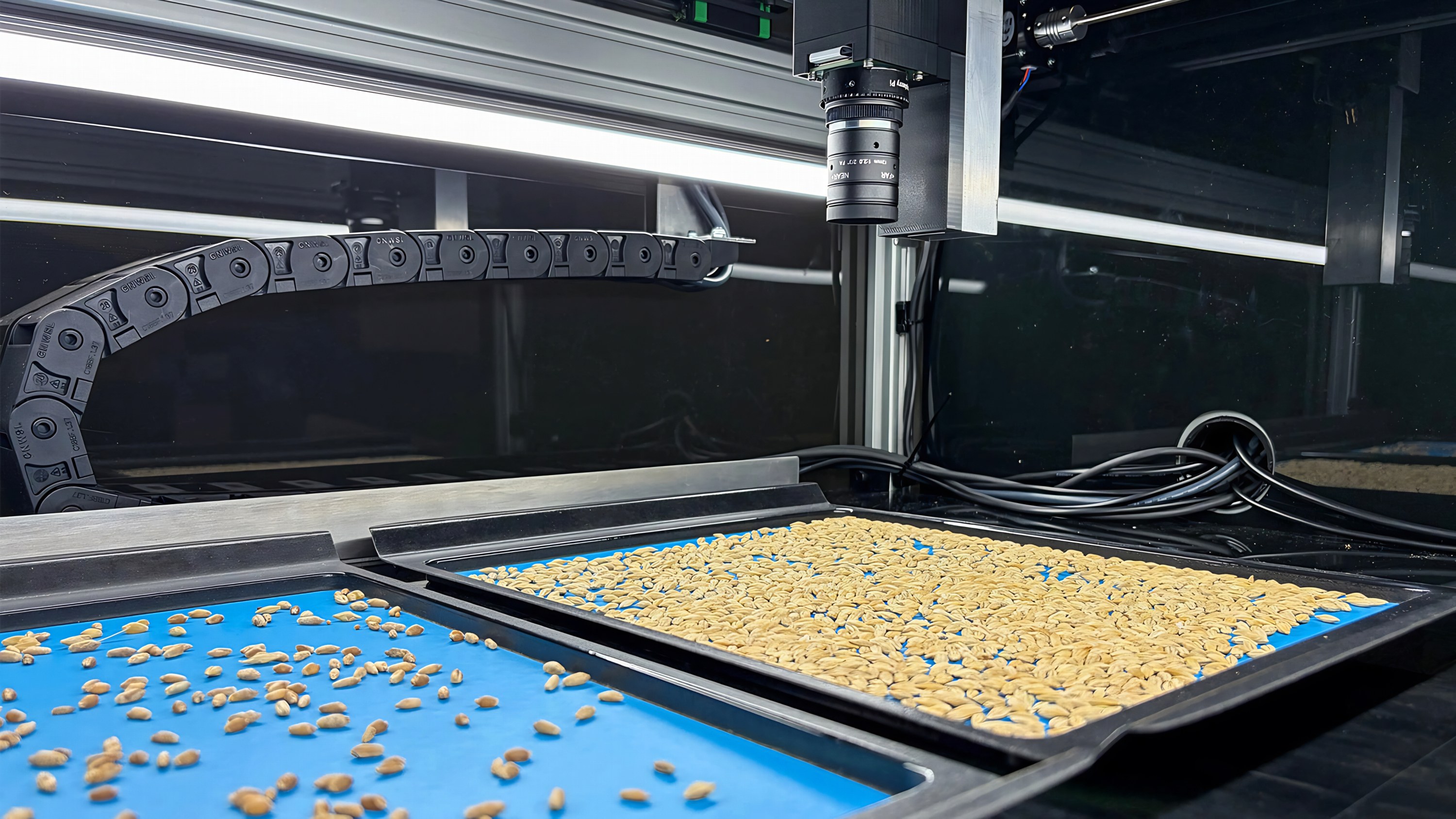
About three years ago, a local company, 20/20 Seed Labs, came to University of Alberta plant biologist Dr. Glen Uhrig with a problem. To certify that seeds are safe for domestic use and export, their quality assurance inspectors examine random seeds — one at a time — under a microscope. It’s a slow and time-consuming process, so the company asked whether there was a way to speed up the process.
At Uhrig’s request, computing science master’s student Curtis Kennedy took up the challenge, recruiting two undergrads — third-year mechatronics and robotics engineering student Nate Stork and fourth-year computing science student Luke Yaremko. What they came up with has spun out of the Uhrig lab into Rosette Robotics, and offers to drastically increase the speed of inspection, saving the seed industry time and money.
Combining robotics and artificial intelligence, their platform uses a high-resolution camera on a robotic arm to scan trays with potentially thousands of seeds, instantly analyzing and displaying crucial information for each one. Inspectors can easily isolate individual seeds manually with a laser for added assurance, ultimately protecting the food supply from contamination and agricultural crops from harmful invasive species.