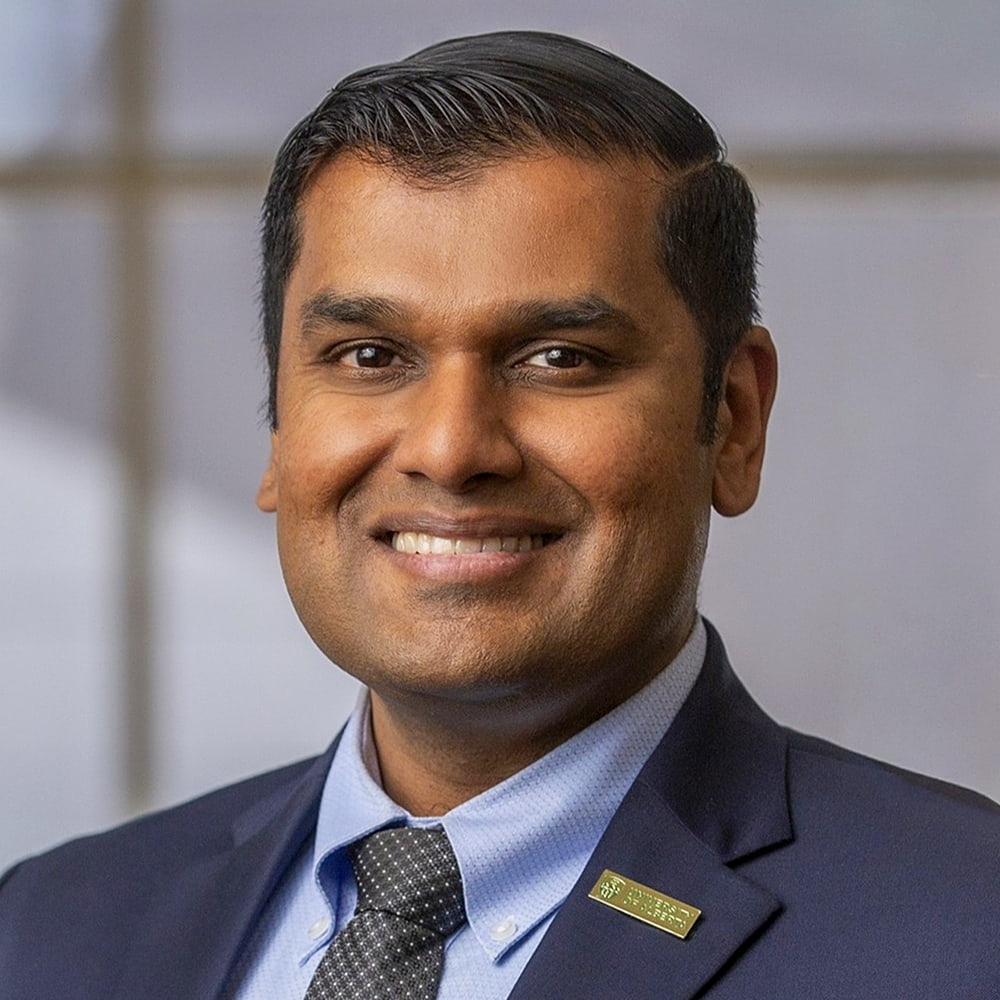
In 2023, University of Alberta electrical and computer engineering professor Dr. Ashwin Iyer set sail aboard a Royal Canadian Navy frigate as part of an immersive experience to strengthen bonds between the Canadian Armed Forces and academia. They were given uniforms and put to work.
By the end of the three-day trip, Iyer had a new calling.
“It was incredible how hard they work and how well known our navy is. We don’t talk about it, but we are world experts in many aspects of warfare.”
Since then, Iyer has participated in other exercises with the Canadian Armed Forces, including the Canadian Army's Cold-Weather Operators – Leaders course at CFB Shilo, observing how soldiers operate in harsh Arctic climates, and most recently Exercise COLLABORATIVE SPIRIT at CFB Petawawa, where he suited up for weapons training and observed a simulated ground-assault exercise.
“This is about defending Canada, and it’s all hands on deck,” says Iyer. “How do we, as researchers, contribute to the safety of those who do? We do what we know — innovation and technology — to make operations safer for our troops.”
As it was, Iyer says many of his colleagues were already doing defence work without really knowing. “Defence and dual-use applications were always an inspiration to our research pursuits. We just thought it was part of what we were supposed to do.”
What began as informal research has transformed into the Centre for Applied Research in Defence and Dual-use Technologies (CARDD-Tech), Canada’s first university defence-focused innovation centre. Co-directed by Iyer and mechanical engineering professor Dr. James Hogan, CARDD-Tech has generated more than $25 million in research projects across two years, and anchors the university’s $120-million DEFENDS initiative.
Within DEFENDS, Iyer is spearheading the creation of a facility to test and develop technologies to build resilience against all forms of electronic threats. This builds on the research he conducts in the Microwave, Millimetre Wave, and MetaDevices (M3) Laboratory, which is home to Edmonton's only radiofrequency anechoic chamber — a specialized room designed to absorb electromagnetic radiation and eliminate outside interference.
For Iyer, whose team had been perfecting ultra-compact antenna designs for a decade, the availability of this facility closes a sovereign capability gap in Canada that will enable Canadian-made technologies – like those he and his defence-industry partners are building — to be rapidly operationalized for contested environments.
Unlike consumer GPS, which can tolerate minor position errors, Iyer says military navigation demands total resilience against electronic warfare — specifically jamming, or blocking signals, and spoofing, which is the broadcasting of fake coordinates to hijack navigation systems.
“Spoofing is arguably worse,” Iyer notes. “You can systematically throw something off course while the whole time it thinks it’s on course. We’re building antennas resilient to those types of denied and contested environments.”
About 14 months ago, Iyer partnered with Ottawa-based Calian GNSS to incorporate his lab's research into the development of mission-critical GPS antennas engineered for mobile platforms like aerial drones and land vehicles.
The collaboration leverages Calian’s satellite ground station expertise dating back to 1965, when it spun off from the University of Saskatchewan. In 2020, Calian acquired Tallysman Wireless — a global leader in GPS antennas and receivers — forming Calian GNSS, which today has over 168 satellite ground stations and antennas deployed worldwide.
“There is this tight coupling between what our academic institutes are inventing, developing and pushing on the boundaries of the next generation of technology, and the need that Canada has to turn that into industrial capacity,” says Chris Pogue, Calian’s president of defence and space. “We saw the University of Alberta as pushing that boundary, particularly in areas that could shape the next generation of defence antennas and operational systems.”
Pogue, who used to fly C-130 Hercules in the RCAF and started his Air Force career in Edmonton, adds that the U of A’s research into “metamaterials” — the design and integration of new functionalities into existing materials — could help enable new kinds of antennas, leading to enhanced operational capability.
Calian already supplies anti-jam GPS-equipped systems and antennas for applications around the world. Pogue points to uses ranging from autonomous systems to precision navigation, including antennas that help guide SpaceX’s Starship during landing.
“We believe that in working with the University of Alberta, we can develop the next generation of antennas — antennas that can operate in unimaginable places like the High Arctic. That’s why the University of Alberta is a logical partner for us.”
Pogue notes that as we face the challenges of defence globally and in Canada, Calian is embracing Prime Minister Mark Carney’s Defence Industrial Strategy, which includes “building a Canadian industry that can deliver Canadian sovereign defence capability.”
For Iyer, the U of A’s contribution enhances national sovereignty. “These are fertile areas for intersections between civilian and defence applications.”