As a scholar of ephemeral popular culture — I literally wrote the book on bubblegum comics — one of my favorite courses I’ve ever taught is Film Studies 203: Television from Broadcasting to Screen Cultures. The course covers a history of television from an experimental technology in the 1930s to the present world of convergence culture and omnipresent screens. One challenge in teaching a television studies course is the huge amount of possible material: defined since the 1940s by the need to fill hours and hours of programming every day, television has produced a colossal backlog of programs to study. Some tough questions: do you only discuss the most important shows, the most well-regarded, the most popular? And how to keep in mind that we should ideally teach some Canadian content?
Fortunately the solution to all these problems is SCTV, a television show that isn’t only Canadian, but filmed (for a time) in Edmonton and even (a few times) on the University of Alberta campus itself. A TV analogue to the Toronto theatre company Second City, drawing on many of that troupe’s writers, directors and actors, by 1981 SCTV was functionally a co-production, financed both by the CBC in exchange for half hour episodes, and a deal with NBC for 90-minute long episodes (usually aired in the early hours of the morning). Though the early seasons were filmed in Ontario, after Toronto’s Global cancelled the show, a new financing deal moved production to Edmonton, where independent station ITV had a studio at what is now 5345 Allard Way. Now the local Global studio, it is in fact the building in the opening credits of (many versions of) SCTV. In 1980 and 1981, 44 episodes of the show were filmed at the ITV studio, as well as in the city and nearby communities.
One distinct part of SCTV was the show’s premise: every episode purports to digest a programming day of the titular TV station, a local independent station in a small town called Melonville. In the words of writer/star Dave Thomas in the book SCTV, “[W]e were children of television. We had been absorbing TV culture like sponges until, having reached saturation point, we were ready to squirt out ideas” (33). Made by the first generation of comedians to have watched TV for their entire childhoods, SCTV’s level of affection for meta pop-culture detritus sets it apart from shows that present sketches as though they’re “really” happening. We only see the fictional city of Melonville through its TV offerings.
The show is, therefore, a great subject for a television course. References abound: Joe Flaherty’s Count Floyd is the awkward host of the station’s sub-par horror movies, but he’s also a composite of a thousand local Shock Theater hosts who were often the news anchor wearing cheap makeup. Andrea Martin’s Mrs. Falbo, the kids show host who blunders into inappropriate situations (in her first appearance interrupting a BDSM scene between dolls), draws on and exaggerates a long history of anxieties about televisions serving as babysitters. The show’s imitation of TV rhythms lets the cast indulge their wide set of impressions, but it also lets them satirize mass media itself.
In one episode, the station’s detergent sponsor makes increasingly obnoxious demands. Thomas’ Bill Needle, an outraged commentator whose principles collapse after one phone call with corporate, appears in a commercial where he accidentally reveals the product is mostly filler. Sunbright pulls their money, and the station owner (Flaherty’s Guy Caballero) flips again to be against corporate manipulation. The episode won an Emmy for writing.
In that context, it’s not surprising that SCTV came to the University of Alberta to film a commercial parody. “Dr. Shekter” (embedded below) is a spoof of the “I’m a Pepper” commercials from the late 70s, where David Naughton bounced around in a vest singing the virtues of Dr. Pepper. In the parody, Eugene Levy (in the same vest, plus a neck brace) sings an earworm about how much he likes his back doctor, Dr. Shekter (Rick Moranis). The serious part of the joke is advertising medical practitioners like they were soft drinks; the less serious part is seeing people fresh out of the hospital dance around. And that hospital is played by North Campus’ Corbett Hall, still the site of a physical therapy clinic.
SCTV's "Dr. Shekter" sketch was filmed in front of Corbett Hall at the University of Alberta
For the most part, the makers of SCTV were not too fond of Edmonton. But not only did filming in Edmonton save the show, the years here produced some of its greatest moments. In the infamous “Polynesia Town,” a spoof of Chinatown that ran over budget thanks to a crane shot that required renting one in Calgary and driving it to 81st Avenue, the cupola of MKT — then the Strathcona Canadian Pacific Railway Station — looms in the background while John Candy agonizes.
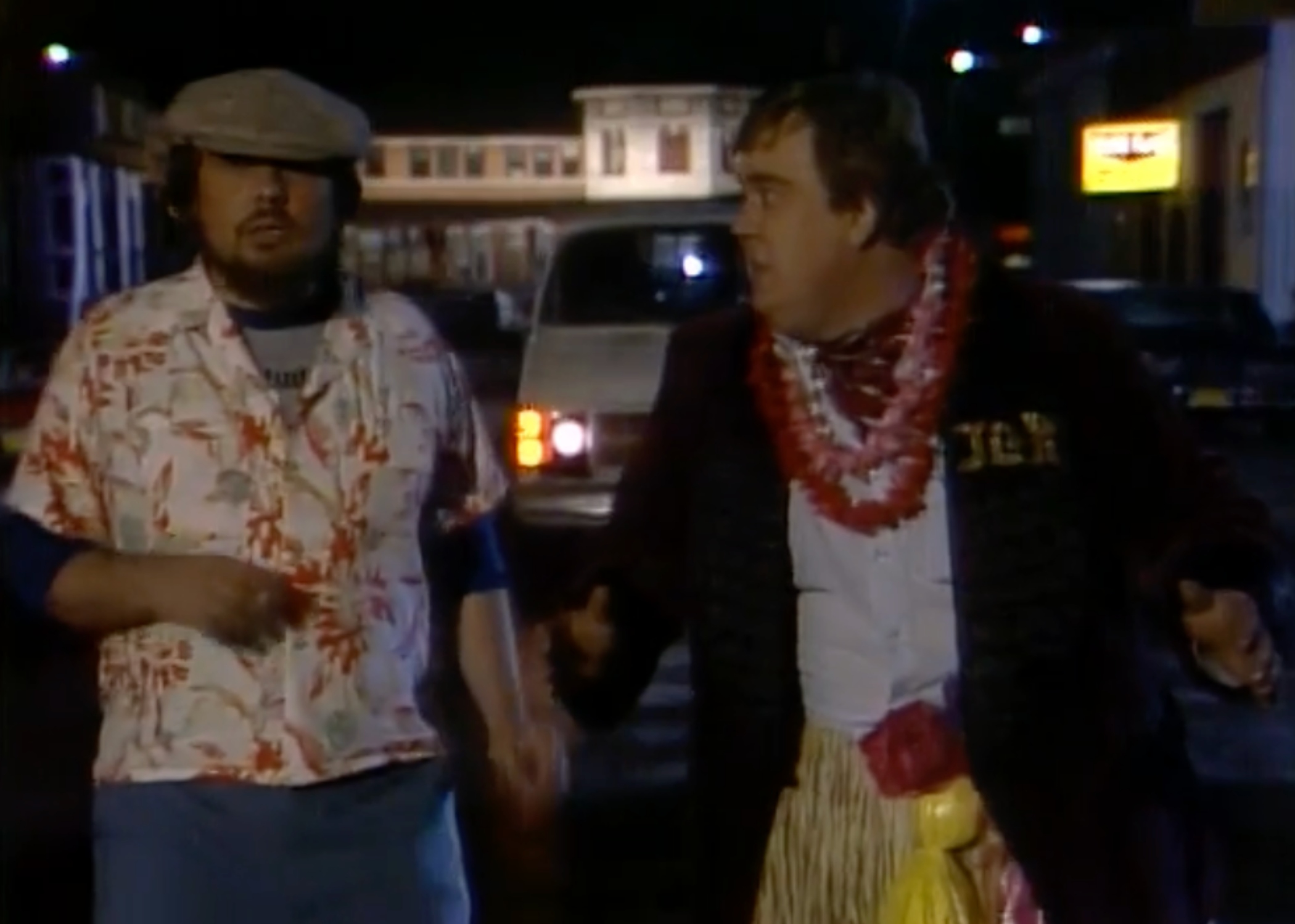
Dr. John and John Candy in the "Polynesia Town" sketch from SCTV, filmed in Edmonton in front of the Strathcona Canadian Pacific Railway Station.
What is the legacy of SCTV? Is it launching the careers of beloved Rick Moranis, the supernaturally amiable John Candy, stars of Schitt’s Creek Catherine O’Hara and Eugene Levy, or Martin Short (who joined the show just after the Edmonton years)? In another challenge specific to television courses, it’s difficult to even view the show legally now. Since they were making television at a time when the medium was still basically ephemeral, the creators used whatever music they wanted for their many parodies without clearing the rights for home video; as a result SCTV has never been on streaming and only about half the episodes ever came out on DVD. That’s why most images of the show are digitized from VHS tapes, making it even harder to see the details of 1980 Edmonton in the background. When you add in the bewildering variety of formats and airings across channels and countries, it rapidly starts to feel like a messy early chapter in the history of beloved icons.
And speaking of that Canadian content, the real answer has to center around Bob and Doug McKenzie. When the CBC’s version of the show was coming up a few minutes short, they asked these Canadians working in Canada if they could put some specifically Canadian content into the program. Indignant, Moranis and Thomas railed: “What do you want us to do? Throw up a map of Canada and sit there wearing tuques and parkas?”
And so they did. The two actors would costume up in the Allard studio and improvise for two minutes, over and over again, taking the most watchable ramblings and sticking them in the show. The results are endearingly shaggy, as the two talk over each other and essentially frustrate their own attempts to talk about anything. Somehow the stereotypical hoser brothers ended up on the NBC broadcasts.
Both countries loved them. Moranis and Thomas were asked to guest at a Saskatchewan Roughriders game, and were stunned when they were besieged at the Regina airport. By the second year of filming in Edmonton, the McKenzies were famous, with an album and a movie in their future. That was the peak of the show’s influence, right when production moved back to Toronto, the cast moved into their bigger careers and SCTV began to recede into a tumultuous battle over home video rights.
In Film Studies 203, we look at the cultural significance of television historically. There might be shows that are funnier, or more important, or made more money (there definitely are), but none of them were filmed at the U of A or in Edmonton, and there isn’t any other TV show where they have statues of the characters downtown. Is SCTV the greatest television show ever made in Edmonton? I don’t know, but if you said it was, people wouldn’t laugh at you.