
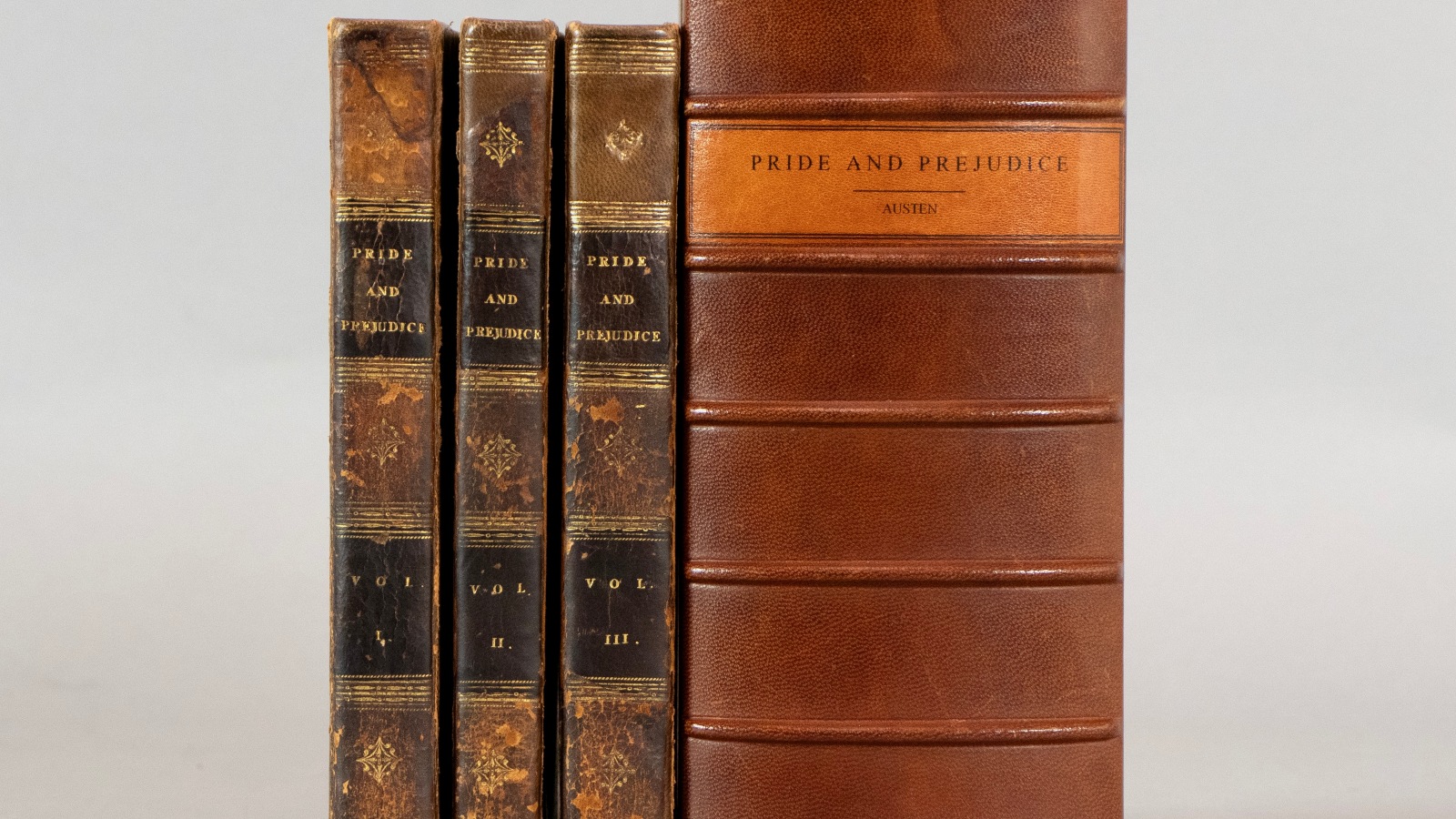
One of the many volumes housed in Bruce Peel Special Collections is a first edition copy of Jane Austen’s Pride and Prejudice, the iconic novel published over 200 years ago on January 28, 1813. However, the interest in Austen’s world hasn’t waned in the centuries since the novel first began circulating in 19th century lending libraries — it remains one of the most requested books in Bruce Peel Special Collections.
The book is currently on display through March 31, 2026, in the Forgers, Fakers, and Publisher-Pirates exhibition at Bruce Peel alongside the Library’s first edition copy of Sense and Sensibility. Together, the tomes serve as examples of anonymous authorship — while the author of both works is now a household name, Sense and Sensibility was first published simply as “by a Lady,” while Pride and Prejudice was released as a novel “by the author of Sense and Sensibility.”

Cover page of the first edition copy of Pride and Prejudice (Photo: Jeff Papineau).
The lack of Austen’s name is a unique feature of the first edition, which was published in three volumes, a common publishing practice in Britain at the time according to Robert Desmarais, Head of Special Collections (Library & Museums). An estimated 1,500 copies were printed, and they could have been purchased for about 18 shillings at the time of publication — the equivalent of approximately £82, or $150 CAD, today, explains Desmarais.
“However, a lot of those went into circulating libraries, so they were literally handled to pieces,” he says.
The U of A acquired their edition in around 1967 based on the accession number on the book. Merrill Distad’s The University of Alberta Library: The First Hundred Years, 1908-2008 notes that the library’s landmark 500,000th acquisition was in April 1966, with the first edition Pride and Prejudice listed as the 537,030th acquisition in the university’s collection.
Despite its age, it didn’t immediately go into special collections. Desmarais draws attention to a leftover fragment of a due date slip affixed to the end paper in one of the volumes. “This book was actually circulating in the open stacks for years,” he says.
The U of A’s edition has a contemporary binding with calf leather on the spine and marbled boards. Despite passing through student and faculty hands in those early years, it remains free of any markings and in very good condition. And, since the book was published during the hand press period, when movable type was used to print books, it’s truly one of a kind. “When a book historian compares first edition copies of books printed in this period, there will be slight variations between copies — no two copies are exactly the same,” says Desmarais.
While the book has been digitized by the U of A, allowing Austen enthusiasts to flip through it from anywhere in the world, there’s still something thrilling about the opportunity to actually handle the physical copy, which can be done by making an appointment at Bruce Peel Special Collections.
“It’s an opportunity to really touch history,” says Desmarais. “This is how the work was first encountered by the author’s first readers. Handling the book offers a tangible link to the past.”
“You learn very different things about a book when you have it in your hands,” says Sarah Severson, Digitization & Special Collections Librarian. She notes that looking through the digitized version tells you nothing about scale, the three-part format or the feel of the paper under your (freshly washed, as per handling protocol) fingertips.
While volumes housed in the regular library stacks are subject to varied environmental conditions and handling, conditions in the Bruce Peel Special Collections are consistent and optimal for book preservation. The temperature is kept between 18 and 20 degrees Celsius, the humidity at 40 to 60 per cent and rare book storage areas are in total darkness unless a staff member walks in, ensuring the books aren’t affected by constant light shining on their delicate pages. When someone requests access to the book, a reading room supervisor sets it up, properly supported on pillows.
“Having these conditions in place pretty much guarantees that collections will live on for hundreds of years,” says Desmarais. Staff and students another 213 years from now could potentially flip through the very same edition.
The library’s preservation extends beyond climate control — the edition also features a bespoke storage case created by local bookbinder Alexander J. McGuckin. The protective housing was funded by The Friends of the University of Alberta as part of a 2007 ceremony held in Bruce Peel Special Collections to dedicate the first edition in honour of Bruce Stovel, a professor emeritus at the U of A who was a scholar of 18th century literature with a particular penchant for Austen.
The history of Pride and Prejudice is just as interesting as the physical quirks that comprise the first edition. Before it ever hit readers’ hands, the book went through a title change. Katherine Binhammer, a Professor in the Department of English and Film Studies whose research and teaching focuses on 18th century literature, says that First Impressions was an early title of the novel, which Austen later changed to the one we know today — one that Binhammer says was inspired by/borrowed/stolen, depending on how you interpret it, from author Frances Burney.
“Burney deeply influences Austen, and her novel Cecilia repeats the phrase "pride and prejudice" as a major theme,” says Binhammer. “Austen clearly got the title from that.”
Additionally, despite the success of her first published novel, Sense and Sensibility, Austen clearly didn’t know she had an enduring classic on her hands — she sold the copyright for Pride and Prejudice to her publisher for £110. While not an insignificant sum, the first print run sold out very quickly, Binhammer explains, with the publisher making more than the amount paid to Austen.
Over the years, in addition to numerous reprintings of the book in countless languages, there have been stage adaptations, televisions and film adaptations, books that bring in the characters or setting in different contexts and more. A new adaptation will arrive on Netflix later this year. The appetite for the world Austen created doesn’t ever seem to be sated, and it all comes back to the original text, says Binhammer.
“We share our cultural markers. There’s comfort in being on the same page, literally. All those fantastic interpretations and adaptations, we know them because we all know this first story.”
Even for an Austen fan, there’s always something new to discover in the original. “I’ve read Pride and Prejudice probably 20 times in my life, and every time, I find a different detail, I read a sentence a different way,” says Binhammer. “I think it’s that complexity of Austen’s writing that allows for the infinite rereadings, the infinite recirculations.”
In addition to the first edition of Pride and Prejudice, Bruce Peel Special Collections is home to first editions of all Austen’s major novels as well as some published correspondence and modern editions of short works, a collection the Library continues to build as interest in the author remains strong, even so many years later.
“I think one of the reasons for Austen’s persistent popularity is that she is eminently rereadable,” says Binhammer. “Not only is she incredibly popular today, she has been a favourite of every generation since her time.”
“Every time you read her, you get something else out of it. There’s another layer, more depth.”