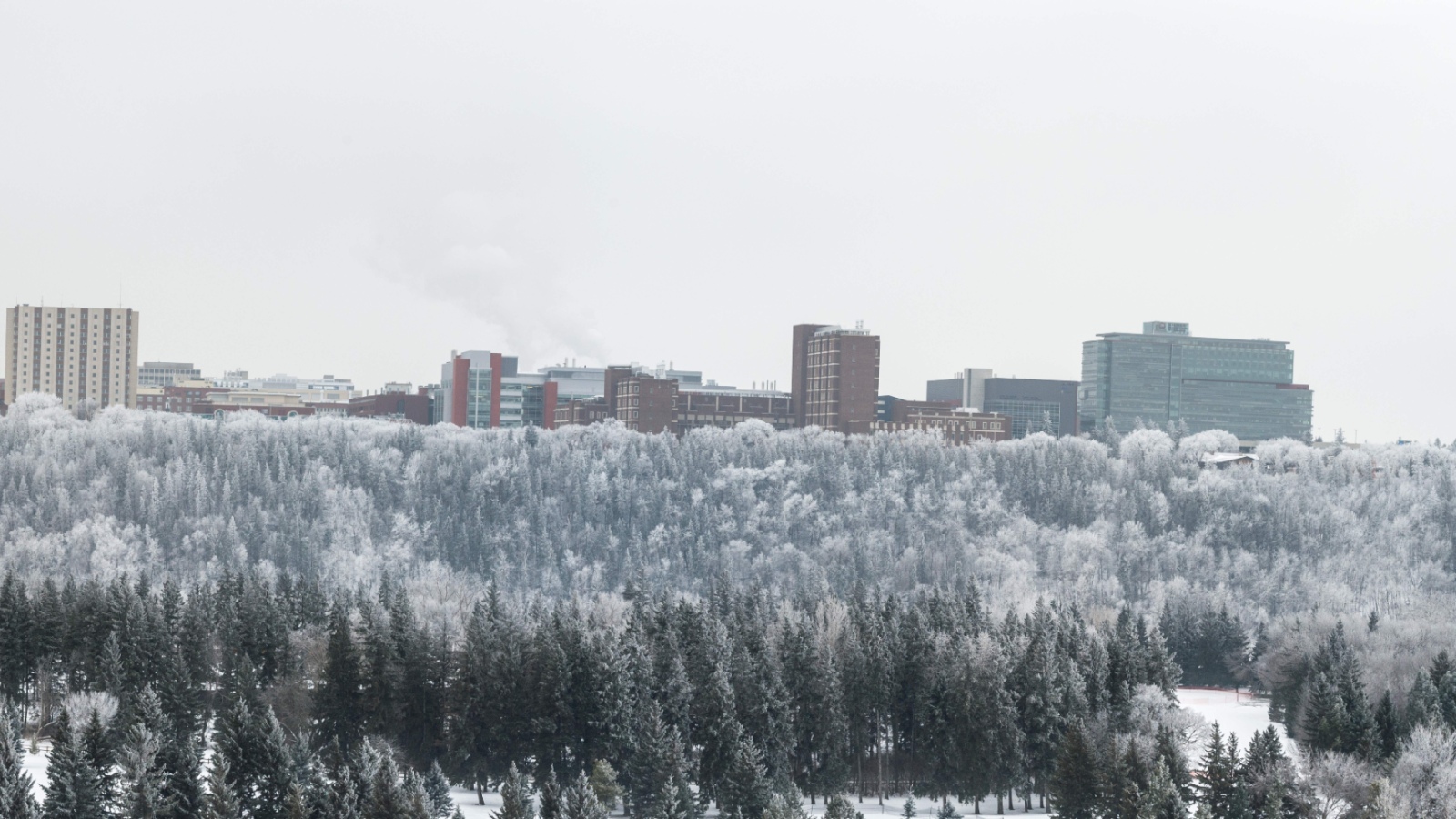
In June 2021, I arrived in Edmonton’s summer; the heat had just begun as I dragged my bags to Lister Centre, where I quarantined for 11 days after spending three days in Toronto. With the pandemic, I had resumed my doctoral program in the U of A Department of English and Film Studies remotely from Nigeria, my research focusing on rural crossings in African migration narratives. In Lister, I could not see much of Edmonton, but I liked watching the sun snailing across the indigo sky through the window. The neighbourhood was also quiet because classes had not resumed. I left Lister after quarantine for a basement room on Whyte Avenue and later got a free bike from my Canadian-Portuguese landlord that I often rode through the neighbourhood to learn about my new place.
For a newcomer like me, knowledge of the city was necessary, so I spent June through August of 2021 experiencing the nooks and crannies of the city. Edmonton’s summer, short but also rewarding, revealed so much about its cultural life as it got smoldering from July onward. The people were out on Whyte Avenue, drinking and chatting vivaciously. It turned out the fiery sun of Edmonton’s summer was not only a time to learn about social life and the vibrancy of urban and country life, but also about the ruptures of global climate change and wildfires in Canada. Summer is a brief breath in Canada, and the real culture of the north is its winter.
In Canada, I realized that season or seasonality is something you can’t leave behind. It is an imminent atmosphere of winter life that interpellates you. As a migrant, Canada’s seasonal lifeworld helped me remember a great aspect of African literature scholarship I had forgotten, and with fewer critical gestures in critical scholarship. Even as I continued my research on the city and the country in African migration narratives, I realized that the circulations of African subjects today between the city and the village are ordered, in part, by the seasonal experience. In terms of labour, there is what is called seasonal migration which is about oscillation of migrants between rural homes and the city during festive seasons by the end of the year. In Nigeria, the weather is not a thing in public conversation; it is a warm and tropical country. The weather does not fall below zero even during the windy, flaky harmattan season when it is also cold in December.
Yet, a closer attention to the weather imaginary of African literature reveals many insights scholars are yet to pay attention to – this includes how colonial forces instrumentalized the season in the administration of the colonies. Of diasporic encounter, Leopold Sedar Senghor’s poem Paris in the Snow, first published in 1957 in Black Orpheus issue one, registers strong weather memory in the encounter of the persona with the metropole (Paris) as a migrant African intellectual. More importantly, Senghor blends effectively the harshness of the season and colonial attrition.
This is the turn in my work to examine the seasonal imaginary in the Afro-Canadian context. In 2022, the weather went below -50 degrees Celsius, and I received an emergency alert from the city warning that no one must go out – a necessary winter holiday spent at home. Since my arrival, I have been paying attention to how seasonal appeal and winter-induced struggles shape our understanding of Black experiences in Canada. I am referring here to some of the scenes I paid attention to, including the death of a Nigerian migrant who died in an Ontario encampment while waiting for the immigration decision. I am also alluding to that podcast I listened to of an asylum seeker whose hands were amputated because he was exposed to the harm of the weather. In Canada, beyond literary facts, we are confronted with the statistical facts of winter damage.
If the weather means everything in Canada, how can we study Black subjectivities, histories, struggles and pluriversality by paying attention to weather memories and extreme seasonality in the Afro-Canadian diaspora? What economic, social and cultural contexts does this experience expand for us in terms of understanding? These questions turn my attention to my present postdoctoral work, Subzero Life. Subzero Life is a study of Afro-Canadian poetry with deep attention to its historical contexts and currents. I have been looking at the meteorological role of winter during the Underground Railroad and the success that the freedom seekers recorded in entering Canada in its frigidity. I am also invested in the history beyond the 18th century, examining the seasonal details of Canadian life and how the weather was retooled as an ecological force to dominate enslaved people. All these contexts lead up to the new diaspora, which I would loosely trace back to the early 1960s in Canada. In my archival interaction so far, I realize the weather serves a political purpose in anti-migration sentiments, and many policies draw on seasonal appeal to discriminate against the mobility of Black bodies. I will be treating the Afro-Canadian poetry archive to understand these many issues and their implications.
As a poet, weather imagery has remained a huge feature of my poetry. I love Edmonton, and a number of poems in my new work Contraband Bodies provide a profound view of the beauty of winter and the monstrosity of the weather as seen from below. What this means for me as a poet interested in the weather imaginary is to expand the Afro-Canadian poetry archive by telling more snow stories, constellating more images, manufacturing more metaphors, and innovating language that foreground new order of knowledge, consciousness and meanings in how we understand migration in Canada. I will be expanding the Afro-Canadian writing archive through a poetry anthology entitled Black Psalms of the Shivering Ones that dedicates attention to seasonal poetics, struggles and resilience in atmospheric realities. This anthology is under contract with Wilfrid Laurier University Press, with publication scheduled for 2027.