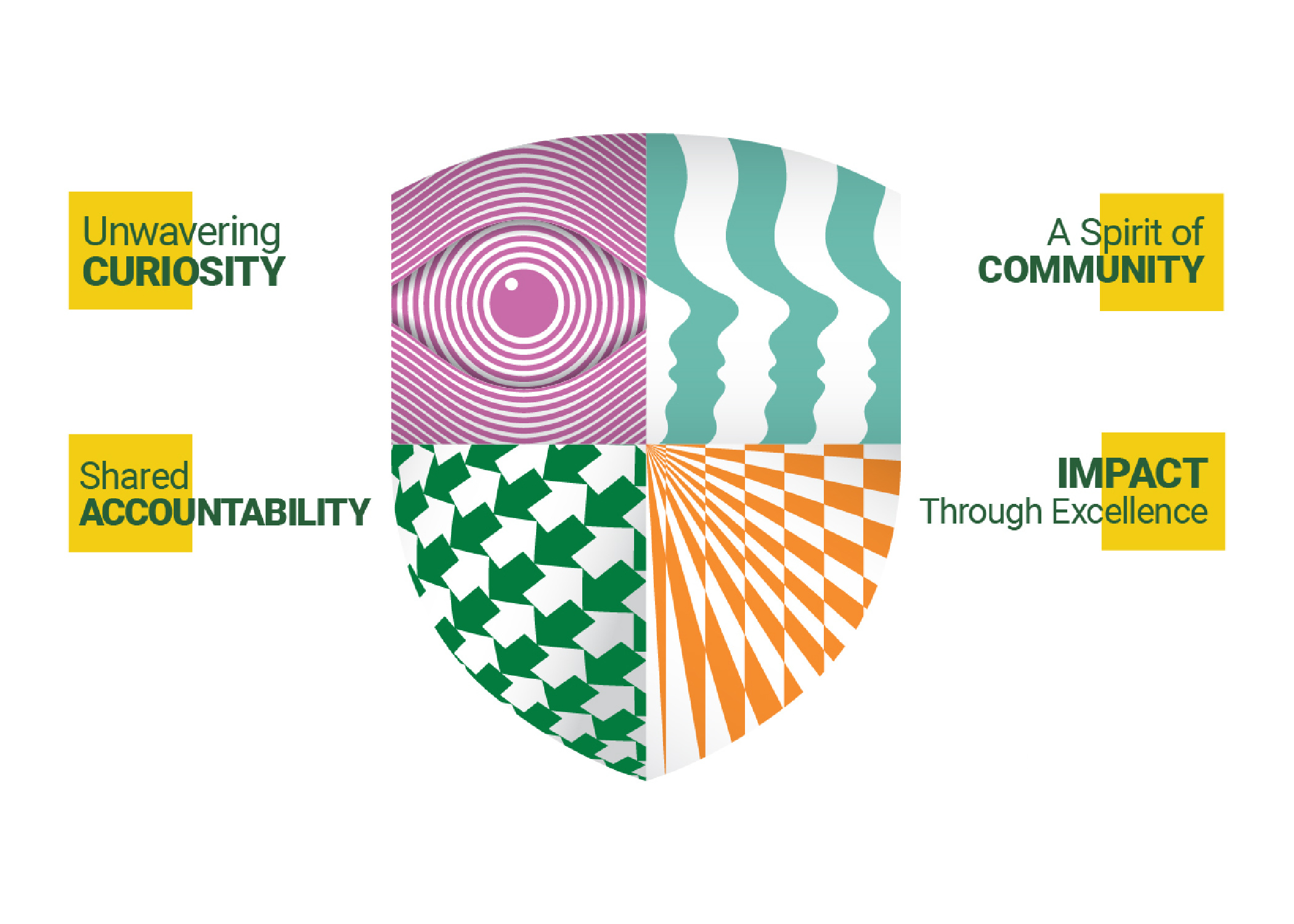
The U of A’s institutional values — unwavering curiosity, a spirit of community, shared accountability and impact through excellence — serve as a guiding light for everything we do. In this series, we meet the people whose daily dedication brings these values to life.
When an institution introduces new values, two predictable responses often accompany them: applause or, more likely, fatigue. I am less interested in either. What matters to me, as I have moved from dean of the Faculty of Native Studies (FNS) into the role of dean and vice-provost of the College of Social Sciences and Humanities (CSSH), is whether these values can help us think more clearly about the work in front of us.
As many of you know, for most of my career, I led an academic unit "on the edge" of the U of A and later, thanks in part to President Flanagan's leadership, outside the college structure, reflecting its unique place within the university. The FNS is a stand-alone faculty with its own history, responsibilities and relationships. Its work is explicitly grounded in our commitment to community, particularly in Treaty 6 and Métis territory. The scale may have been smaller, but the stakes, at least for FNS, certainly were not.
Now our CSSH office team and I work at a different scale. The college brings together Arts, Business, Education and Law. The question I have been asking myself since I saw the values formally laid out at a leadership meeting several weeks ago is simple: How will these new values change the way I and our college team make decisions and, more importantly, what are the ways that the values are already embodied in so much of the work our people within the CSSH faculties already do?
Take “Unwavering Curiosity.” In the way I have practiced humanities and social sciences, curiosity is not — and has never been — a slogan. It is a disciplined practice of asking better questions. At the college level, that means working to design infra/structures that allow questions to "travel", as it were. Do our policies enable students to move across programs without unnecessary barriers? Do our research supports encourage collaboration rather than competition?
An example of unwavering curiosity already embodied in our work comes from a recent story on Faculty of Arts alumnus Chris Dodd, whose work in theatre and Deaf performance challenges us to rethink accessibility not as accommodation, but as creative and institutional design. His career reflects what can happen when we ask not only what we study, but who our structures are built for.
If curiosity is a value we are legitimately committed to, it needs to be visible in how flexible — and how brave — our academic architecture is.
Second, as anyone who has worked with — or in — community knows, “Spirit of Community” is a phrase always in danger of drifting into abstraction. For me, its meaning has always been at once concrete and productively uncomfortable. It means relational accountability. In Native Studies, that meant long-term partnerships and being answerable to communities beyond campus. In the college, it means being explicit about how decisions are made, whose voices we are listening to and how we handle tension and disagreement. Community does not (necessarily) mean consensus; treating it as a verb rather than a noun (as we should all aspire to do) means it should include the ongoing work of staying in relationship while we argue about priorities.
In this spirit of community, the Faculty of Law runs the “Low-Income Individuals and the Law” program, which places students in community organizations to work directly with clients facing systemic barriers. It embeds accountability into legal education itself — requiring not only practical service, but structured reflection on power, poverty and responsibility. It is community as sustained, reciprocal engagement.
Third, I hold a longstanding scholarly belief — earned through bitter experience — that as much as we might wish it, good numbers don't produce good relationships. But good relationships can produce good numbers. Thus, for me, “Shared Accountability” for a sustainable future demands more of us than ensuring efficiency. It asks whether we are willing to align resources with our stated commitments, even when that requires difficult trade-offs. It is about building systems that protect intellectual risk-taking and belonging over the long term.
The Faculty of Education course EDU 211 is a mandatory Indigenous education course created and sustained through deep faculty collaboration. It represents a structural commitment to changing how future teachers understand history, responsibility and their relationship to Indigenous communities. The course is demanding for students and faculty alike, and sustaining it requires institutional will. That is what shared accountability already looks like in action: aligning curriculum, staffing and resources with what we say matters.
Finally — and perhaps ironically— “Impact through Excellence” requires restraint. The global rise of university metrics notwithstanding, not everything meaningful can be counted. In our fields, impact may look like a reframed public debate, a new generation of critically trained graduates or a policy shift shaped by careful research. Our task is to create conditions where that kind of work is legible, without reducing it to metrics alone.
The Alberta School of Business’s Impact Series offers one illustration: Civic challenges embedded directly into the undergraduate curriculum through partnership with the City of Edmonton. Not every proposal will be implemented. The impact lies in the habit of mind it cultivates — graduates trained to translate analysis into action, and public partners willing to think differently as a result.
Our institutional values are new, but our habits are not. My invitation — to myself first, and to colleagues across the college — is to treat the values as working tools rather than wall art. When we face a difficult decision, we might ask: Which value is actually at stake here? What would it look like to take it seriously?
If the answers change how we design programs, allocate resources or tell our collective story, then the values will have done their work. If not, they will remain decorative.
The responsibility for that outcome is ours.