
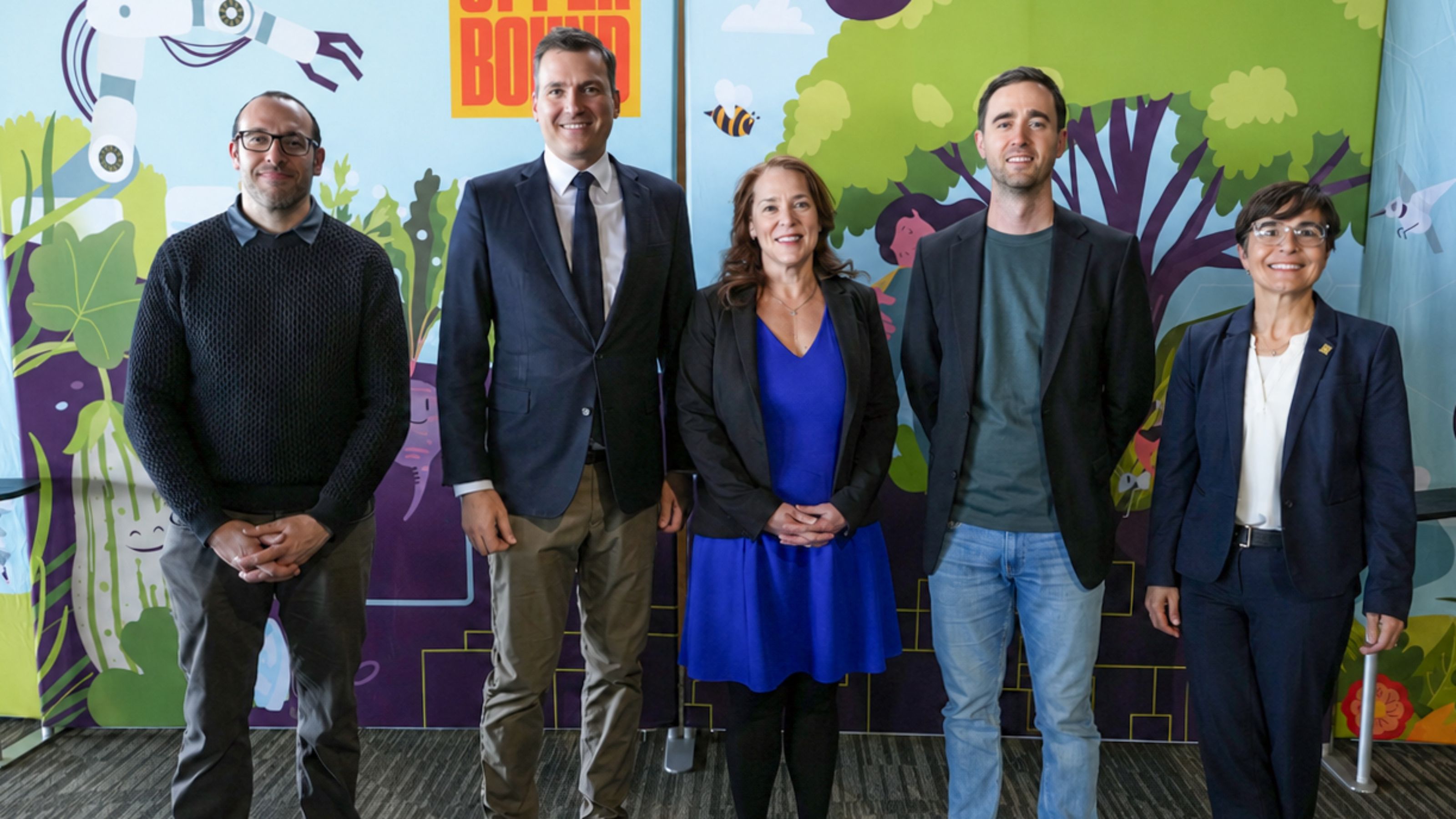
Artificial intelligence is no longer a niche field contained within STEM disciplines; it has become a central force in nearly every area of human experience. In response to this seismic shift, the University of Alberta has decisively stepped forward, positioning itself to help shape the future of AI transformation.
A landmark $30-million investment from the Alberta Machine Intelligence Institute (Amii) in 2023 has enabled the U of A to recruit 25 new AI researchers (including four current researchers who were retained through this funding) from around the world. This funding, made possible by support from the Canadian Institute for Advanced Research (CIFAR) and the Government of Canada as part of the Pan-Canadian AI Strategy, represents a major expansion of AI expertise and promises to cement both the university's and Alberta's reputation as global leaders in AI innovation and next-generation education.
With a strong foundation in transformative AI research, which includes 32 Canada CIFAR AI Chairs — including A.M. Turing Award recipient Dr. Richard Sutton, one of the founders of reinforcement learning — the message of this cohort hire is clear: The U of A intends to lead the global conversation on AI.
Each of the hires brings dual strengths in specialized AI + X knowledge — a strategic integration of machine intelligence into the world’s most critical domains, such as health, energy and space. Together, they are part of a chorus of research insight and innovation, driving interdisciplinary discovery across the university.
Joining the U of A last July, Dr. Blair Attard-Frost, an assistant professor in the Department of Political Science, brings a unique, trans-feminist lens to a traditionally STEM-focused field. Her research, which spans Canadian and international jurisdictions, addresses challenges of power, participation and justice in AI governance.
“The value of social sciences and humanities research is in reconfiguring AI and its governance and policy as a fundamentally human-centric enterprise, rather than a technology-centric one,” she says, adding that AI policy is reorienting the debate around how people use the technology.
Dr. Lazar Atanackovic, who joined the U of A in March as an assistant professor in electrical and computer engineering with a cross-appointment in biochemistry, believes we are at an inflection point in the life sciences.
“AI can fundamentally transform how we approach biological research and drug discovery,” says Lazar. “Building accurate virtual models of cellular systems will enable us to simulate and predict biological behaviour at a scale and precision that traditional methods struggled to achieve, ultimately helping us develop better treatments for diseases with unmet medical needs. With the U of A’s established reputation as a global hub for AI research, we are uniquely positioned to advance this challenge at the intersection of AI and the life sciences.”
Dr. Abigail Azari, an assistant professor jointly appointed in the departments of physics and electrical and computer engineering, says the U of A is one of the few places in the world that enables such interdisciplinary work.
“It’s a unique opportunity — my research work is collaborative and interdisciplinary by nature through multiple centres including the Institute for Space Science, Exploration and Technology (ISSET) but also through Amii,” says Abigail. “My focus is on the use of machine learning for scientific insight and exploration of the space environments of solar system planets, and I look forward to continuing to build my research group at the U of A and Amii."
By working closely with deans and chairs to transcend traditional faculty boundaries, this coordinated recruitment initiative has mobilized shared institutional resources to assemble a “cluster hire” of leading AI researchers, specifically targeting strategic areas of growth. This collaborative model not only secures top-tier talent but also attracts a community of scholars who are fundamentally driven by the prospect of working within a deeply integrated, cross-disciplinary environment.
Numerous network and support initiatives previously established or under development, including the Research Partner Network (RPNet) within the Office of the Vice-President (Research), strengthen and streamline this “ecosystem of innovation” across the university, as noted by president Bill Flanagan, with impacts seen in the community and beyond.
The successful integration of this strategic cluster hire was guided by Dr. Verna Yiu, provost and vice-president (academic). "This coordination of a unified recruitment vision ensures that the new cohort of scholars is not only embedded within their specific disciplines, but is also positioned to drive the cross-faculty collaborations that will profoundly shape the rapidly expanding global AI landscape," Verna says. Dr. Matina Kalcounis-Rueppell, college dean and vice-provost of the College of Natural and Applied Sciences, worked closely with Amii fellows at the U of A, including Dr. Mike Bowling and Dr. Adam White, faculty deans and chairs to help facilitate a complex, multi-layered collaboration across the university’s diverse faculties.
A primary example of this streamlined innovation in action is the recent launch of the College of Health Sciences AI + Health Hub, which fast-tracks solutions to health-care challenges through improvements in preventive medicine, accessibility for remote and underserved populations, and support for innovative research through digital health and AI.
To ensure this innovation ecosystem remains sustainable, the university is offering specialized credentials that reflect and foster this collective AI expertise.
Admissions are now open for the fall 2026 launch of the online graduate certificate in data science and artificial intelligence, coordinated and led by the CNAS and guided by collaboration, ideas and input from an advisory committee with representation from 11 faculties across all three colleges along with three standalone faculties.
Also set to launch in fall 2026 is the College of Health Sciences’ online graduate certificate in AI and health, which targets both current and emerging leaders — from clinicians and engineers to policymakers — aiming to translate AI literacy into tangible improvements for modern health systems.
“These certificates embody a forward-thinking approach to graduate education, emphasizing systems thinking, problem-focused learning and ethical AI deployment across diverse sectors and industries,” says Matina. “They are groundbreaking educational initiatives that address critical workforce needs.”
The U of A’s rapid growth in AI educational capacity marks a pivotal shift that is effectively redefining the standard for institutional AI literacy. This multi-year initiative not only directly supports this expansion; it is also representative of the objectives outlined in Forward with Purpose: A Strategic Plan for Research and Innovation, which identifies artificial intelligence as one the university’s three areas of global excellence.
“AI must be shaped by trusted institutions that place people at the centre,” says Matina. “Our faculty are the primary engines of research and education at the U of A, cultivating a landscape where the next generation of Canadian AI leaders can thrive. From arts to agriculture to medicine and beyond, this investment in the faculty members that educate our students and drive our research forward means U of A students will share classrooms and lab space with the world’s top minds.”
AI + X Cluster Hire
Over the past three years, this initiative has facilitated the hiring of 23 new researchers and the renewal or appointment of four internal faculty as Canada CIFAR AI Chairs: Dr. Carrie Demmans Epp, Dr. Bei Jiang, Dr. Xingyu Li and Dr. Geoffrey Rockwell.
Dr. Ife Adebara – Faculty of Arts, Department of Modern Languages and Cultural Studies
Dr. Mohamed Abdalla – Faculty of Medicine & Dentistry, Department of Medicine
Dr. Lazar Atanackovic – Faculty of Medicine & Dentistry, Department of Biochemistry
Dr. Blair Attard-Frost – Faculty of Arts, Department of Political Science
Dr. Abigail Azari – Faculties of Science and Engineering, Departments of Physics and Electrical and Computer Engineering
Dr. Jacob (Terence) Blaskovits – Faculty of Science, Department of Chemistry
Dr. Dieter Buechler – Faculty of Science, Department of Computing Science
Dr. Jocelyn Chen – Faculty of Science, Department of Computing Science
Dr. Russell Dinnage – Faculty of Science, Department of Biological Sciences
Dr. Erin Grant – Faculty of Science, Department of Psychology
Dr. Jun Jin – Faculty of Engineering, Department of Electrical and Computer Engineering
Dr. Craig Jones – Faculty of Medicine & Dentistry, Department of Biomedical Engineering
Dr. Bailey Kacsmar – Faculty of Science, Department of Computing Science
Dr. Majeed Kazemitabaar – Faculty of Science, Department of Computing Science
Dr. Quinn Lee – Faculty of Science, Department of Psychology
Dr. Marlos Machado – Faculty of Science, Department of Computing Science
Dr. Amber Simpson – Faculty of Medicine & Dentistry, Department of Radiology and Diagnostic Imaging
Dr. Tian Tian – Faculty of Engineering, Department of Chemical and Materials Engineering
Dr. Bahareh Tolooshams – Faculty of Engineering, Department of Electrical and Computer Engineering
Dr. Zhou Yang – Faculty of Science, Department of Computing Science
Dr. Xi Ye – Faculty of Science, Department of Computing Science