
On June 4, June 9-12 and June 15-17, the U of A community celebrated the academic achievements of its 2026 spring graduates. Congrats and well done, everyone!
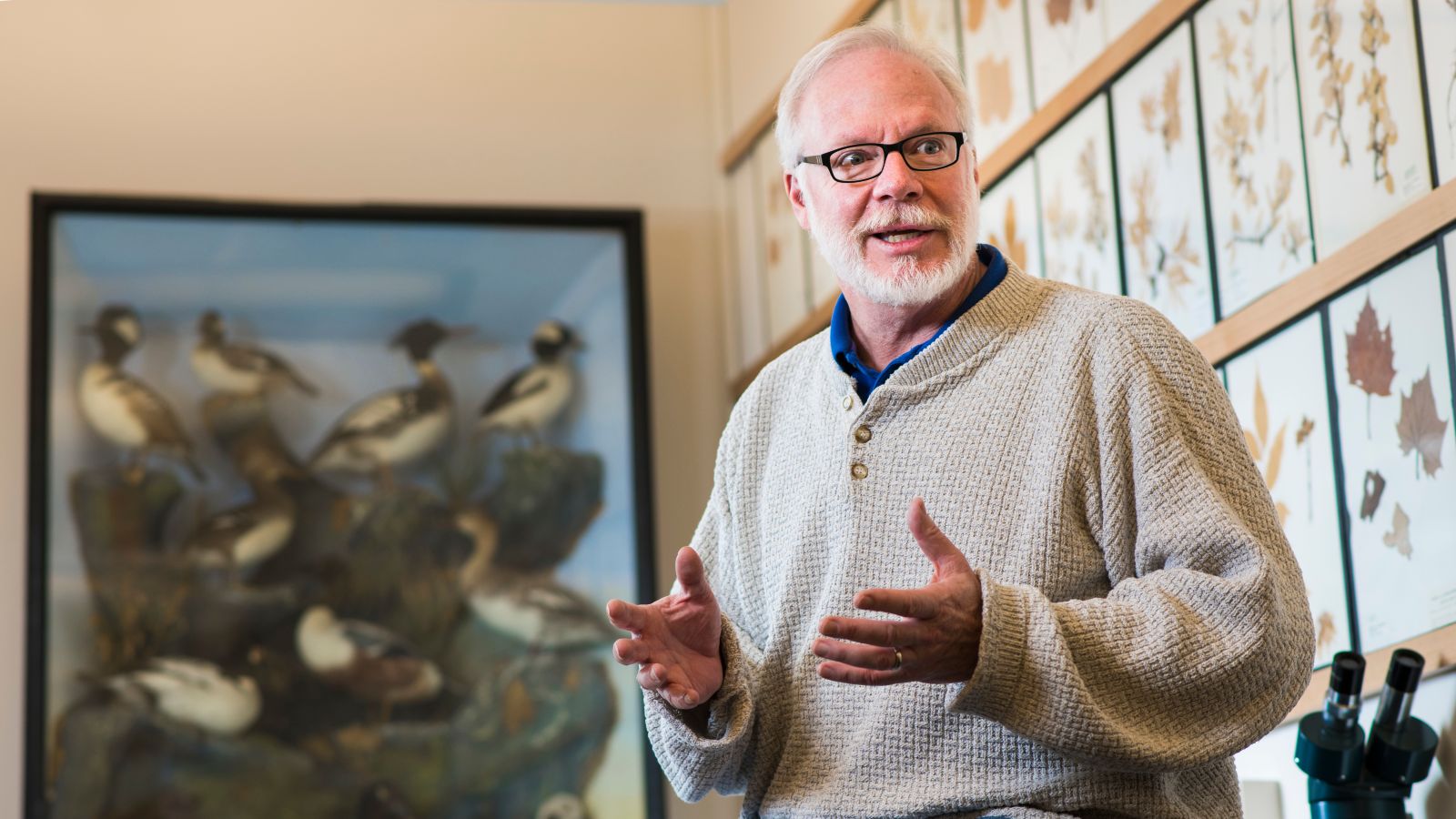
During the June 17 afternoon ceremony, John Acorn received an honorary Doctor of Laws degree. John is a renowned entomologist, author and broadcaster who has had a lasting impact on public science literacy. For nearly 30 years, he has served his alma mater as a faculty service officer and lecturer, mentoring countless students in the Department of Renewable Resources.
He is widely celebrated as the host of the TV show Acorn the Nature Nut from 1994 to 1999, and the author of influential field guides such as Birds of Alberta. An avid naturalist, he is deeply involved in community leadership, co-founding the Alberta Lepidopterists’ Guild and serving as president of the Entomological Society of Alberta and patron for Nature Alberta.
Eminent chancellor Somji, president Flanagan, representative of the Board of Governors, graduands, family and friends. It is so great to be here with you today. What a wonderful, auspicious and triumphant day. I'm especially happy to be speaking to the convocation for the Faculty of Science, because I'm a proud alumnus of that faculty myself, and I continue to enjoy my relationship with the faculty.
So I want to talk to you about science communication. You are all now scientists. Let that sink in for a sec. This is great. And anyone with a science education will be called upon either formally or informally to occasionally explain the views of science and science communication. I've spent a lot of my time doing science communication. I mean, yes, I do science myself.
I research and publish papers and go to conferences, but I've also spent a considerable amount of time adjacent to science, communicating the science. So I'm often asked to talk about science communication and, when I am, I start with a story that I call the story of the time I was standing in a pond.
Here's how it goes: when I started my television program a long time ago, I suddenly found myself as a recognizable public figure. So, I'd be grocery shopping or walking in the River Valley and people would just come up to me and start talking to me and it was flattering. It was a little bit of an encroachment on privacy, but that was okay. Nobody recognizes me anymore. I don't look like I did when I did the television show. They might recognize my voice.
Anyway, the point is that these conversations started to form a pattern and here's how they would go. Typically, it would go like this. Someone would say, "Oh, you're that guy! I saw you on TV last night. That was great. I really enjoyed it. Keep up the good work." And I would thank them. And then, just to be nice and because I was curious, I would ask, "What episode did you see?" And this question baffled most people.
I said, "No, you know, everyone has a different theme. Was it about bird watching or was it about wild flowers or animal tracks?" And they go, "Oh, man. I don't know. It was really good. “Oh, I know. I know. It was the one where you were standing in a pond.” And I was standing in a pond wearing chest waders and I would explain, "Oh, yeah. That was the frog episode.” And they go, "Really?" And they had no clue that the program had been about frogs. They had watched the entire program or at least enough of the program to enjoy it, recognize me the next day in public and pay me a compliment. And they really like the idea of a grown man standing in a pond talking about something.
But it completely missed them that the entire program was about frogs, toads, tree frogs, spadefoot. It was about amphibian biology. And I took the time to get my facts right. And I think I presented it clearly, but I don't know. I'll admit to you that, at the time, I thought maybe these people were lacking in intelligence of some sort.
And then I started working here, at first part-time, and I started marking exams and I realized no, it's not that they're unintelligent, it's just that they didn't study and why would they? It's a television program. And that helped me to see that in science communication, it's not just about educating the public.
There are two big goals here. The educational goal is one thing and it's tricky. But if you've got a willing audience, an audience that's willing to bring some cognitive effort to trying to understand what you're saying, then you know your job is to be clear and organized, avoid unnecessary jargon, deliver your message with a certain amount of enthusiasm because enthusiasm is contagious. And to get to know your stuff to get it right. Quaecumque vera, right?
And that should work. But that's not all that we do in science communication. The other thing that happens in science communication is – let's just call it inspiration. And inspiration is a valid goal as well. And I think that those ‘standing in a pond people’ were maybe inspired. They had positive feelings about ponds and about me and about whatever it was I was talking about. And that's great.
For me, the most pleasant thing in my career has been receiving messages or hearing from people that something that I did inspired them to make science into part of their life. Whether it's a career or a hobby or they started bird watching or whatever they did. It's just so wonderful to know that you're having an impact. The tricky part, though, is that impact is unpredictable.
You just never know when something you do or say, and this applies to all of us, is going to spark another person and send them in some interesting direction. Do you know what my favourite scientific idea is? Maybe I shouldn't say this. It's called complexity theory. Do you know about complexity theory? It's not as popular as it should be. Partly because it predicts unpredictability. And if there's one thing that scientists really like, it's predicting things accurately.
But complexity theory talks about complex systems. I got interested in it, because ecosystems are complex systems or complex adaptive systems, but so are economies, so are societies, so are human minds and human bodies. These are all complex systems and, according to complexity theory, those sorts of systems will behave in a kind of a semi-predictable way but with all sorts of quirky left turns.
And I think that's another message I really want to share with you today: science tells you that your careers are to an extent unpredictable. And I'm not saying that to scare you. I'm saying that to inspire you, because when I was in your place at convocation years / decades ago, I pretty well thought I knew what I was going to do for my whole career, and it turned out completely different in so many wonderful ways. So I hope the same is true for you that the various unpredictable changes in path for you leads you to a career that is just so much more rewarding and more wonderful than you can possibly imagine. Even though your imagination is full of wonderful dreams today, let's hope they're even better when it happens when it actually happens.
I think the trick is to learn to say yes to the good opportunities and, as you succeed further and further, it's also really important to learn to say no when something doesn't look like it's maybe going to work out as well as it could. I'm very very proud of you. I wish you all the best. And I have one more message for you and it's a musical message. Oh, look. There's a guitar.
Pardon me. I have to switch microphones here. I've never played in robes before. I'm going to play for you the theme song from my television program which was called “Acorn the Nature Nut.” And let's face it, the subject matter of science is, in a sense, nature. Or the nature of nature. I'm trying to accommodate the mathematicians and computer science people and I'm glad you're here. Anyway, I think there's something here for everybody. If you know the words – and I'm talking to the parents and the grandparents here – sing along. Otherwise, feel free to clap in at least the same rhythm as me. And here we go.
Well, I'm a nature nut.
I'm not afraid to admit.
I'm wild about the wild things and I'm proud of it.
I'm just a simple case open and shut.
No doubt about it. I'm a nature nut.
Today, we'll go to Washington. Tomorrow, we’ll catch toads. The next day to take photographs of bugs along the road.
But I never get the feeling that I'm in a rut.
That's why I'm a nature nut. Well, I'm a nature nut.
I'm not afraid to admit. Wild about the wild things and I'm proud of it. I'm just a simple case open and shut.
No doubt about it. I'm a nature nut.
Same time each and every week. Uncensored and uncut.
No doubt about it. I'm a nature nut.
Thank you and congratulations.