
Each June, Canadians celebrate and honour the histories, heritages, languages and diversity of First Nations, Métis and Inuit as part of both National Indigenous History Month and National Indigenous Peoples Day (June 21).
The University of Alberta’s Supporting Indigenous Language Revitalization (SILR) initiative is continuing to gain momentum through community-led and -driven projects, growing the international language revitalization movement. By building networks between language champions, advocates, educators and youth, the collaborative collective supports the U of A’s commitment to the United Nations' Sustainable Development Goals (SDGs), including #3: Good Health and Well-Being, #4: Quality Education and #10: Reduced Inequalities.
Grounded in holistic language revitalization that brings together language, land and cultural-spiritual connection, SDG #3: Good Health and Well-Being is a foundation of SILR’s work, including evidence-based research projects exploring how ancestral languages are connected to wellness, and immersive language camps on the land developed by and for community members.
The latter is underpinned by the pedagogical and research philosophy “Living in the Language” from Elder Dr. Elmer Ghostkeeper, which recognizes that language learning can happen in many different spaces, from the home to on the land around a fire and the classroom. “We're not replicating the same ways of doing things; we’re bringing community voice into research and evaluation to ensure the project is making an impact,” says Pamela McCoy Jones, executive director in the Office of the Vice-Provost (Indigenous Programming & Research), who leads the U of A’s SILR initiative.
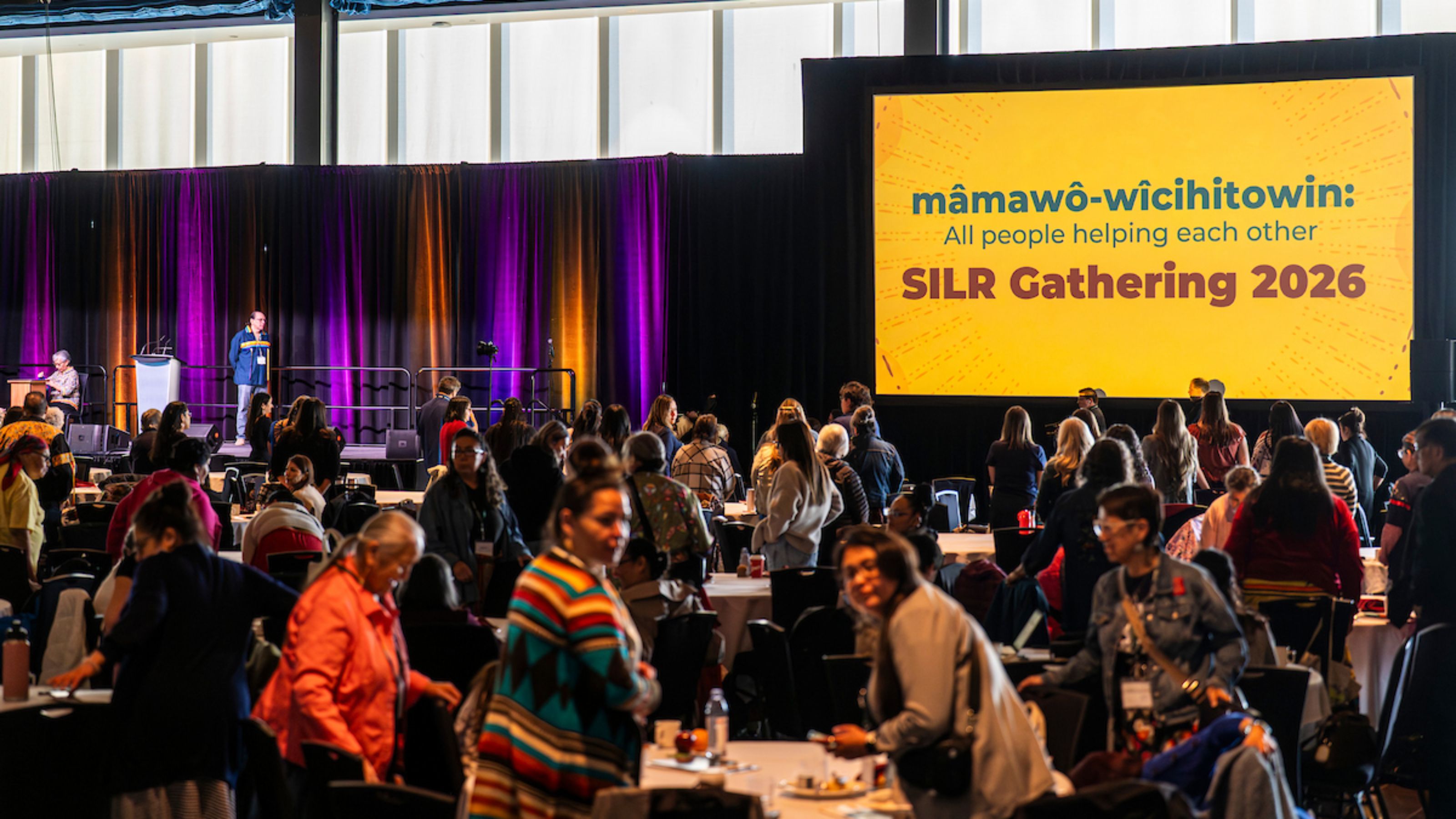
This power of language in well-being was celebrated at the three-day 2026 SILR Gathering in Edmonton. True to the tradition of previous years, the gathering began in ceremony and held a dedicated space for an Elders' wellness room. A private spiritual ceremony (followed by a feast) and pipe ceremony, led by SILR advisor and Elder Lyndon Aginas of the Alexis Nakota Sioux Nation, served as a respectful opening to the event. The gathering featured an opening and closing by the local River Cree Drum Group and the lighting of the qulliq, a traditional oil lamp with deep cultural significance, by Inuit Elder Myna Manniapik.
“Not only are we trying to bring ceremony into these spaces, but we’re also trying to recognize that all nations are not the same,” says Pamela; Treaty Six territory alone – stretching from western Alberta through to eastern Saskatchewan – encompasses 50 First Nations. A SILR challenge is that many Nations are working to strengthen their language alone through classes, curriculum development and community events, says Pamela, and the Gathering is an opportunity to learn from one another and make meaningful connections from coast to coast.
In Alberta, the initiative has helped fund a multitude of small-to-large projects, supporting SDG #4: Quality Education. One of these projects is the nêhiyawêwin (Cree) language learning boxes for the Maskwacîs Education Schools Commission (MESC). The language learning boxes were developed by a team of mostly fluent speakers at Maskwacîs schools, with SILR assisting by printing documents and covering this cost. Boxes contain syllabics (used as an alternative to Roman orthography) in the form of everything from flashcards to fridge magnets.
“They had a community event, which I was invited to, and they distributed those language boxes to all the members,” says Pamela. “That's really unique and beautiful, because SILR isn’t leading the projects: it’s supporting the work already going on in recognition that all knowledge stays within the community; it does not belong to us as a project partner, and we recognize the importance of Indigenous Data Sovereignty and protecting intellectual property of language holders.”
Much of the work already happening focuses on SDG #10: Reduced Inequalities, including creating safe spaces for building relationships with youth, particularly young Indigenous women. As part of the SILR initiative at the U of A, Cree/Métis educator Dr. Trudy Cardinal works relationally with young women, supporting them to recognize themselves as researchers, storytellers and carriers of important knowledge, while Métis researcher and educator Dr. Cindy Gaudet works with Métis women collectives (inclusive of Indigenous young women and students) to advance community-engaged scholarship, methodologies and Michif place-based language resources.
“A lot of our fluent language speakers are older,” explains Pamela. The largest respondent group at the 2026 SILR Gathering were attendees aged 65+, followed by those aged 45-54 and then 55-64. Most attendees were over the age of 45. Respondents represented a wide range of language proficiency levels, with the largest group identifying as understanding well or speaking fluently. “Elders in the community are often tapped on the shoulder to be involved in many different projects, so we’re fortunate and so grateful they choose to work with us at the University of Alberta,” says Pamela.
Getting teenagers interested in the language is a challenge, she acknowledges, adding that fostering identity is essential. “A lot of us didn't grow up and still don't grow up feeling proud of being First Nations, Métis or Inuit,” says Pamela. “Jumping to learning your language can be a big leap for someone.” Reclaiming language and cultural practices, such as ribbon skirt making, hide tanning and beading, is a way to create comfortable spaces and learning opportunities.
Engaging youth also requires creative and collaborative methods, something proven at the 2026 SILR Gathering, which included volunteers from amiskwaciy Academy and Ashmont School. One of these methods is technology skills development for language learning: a workshop at the conference, “Digital Tools and Technology: The Path to Intermediate Fluency”, had such a large turnout that the room was full of standing participants, including youth, recalls Pamela.
An animation video, “Our Story, Our Data” by acclaimed Mi'kmaw graphic artist Brandon Mitchell also received a lot of engagement from younger attendees. The video highlights the significance of a Data Sovereignty Declaration and Caretaking Directives utilized by SILR at the U of A, ensuring that research participants retain control over the language knowledge and recordings they share. It has been uploaded to Aviary, the U of A Library's dedicated platform for streaming media, oral histories, podcasts and other audiovisual collections. While Aviary is an Open Access database, “Our Story, Our Data” is available by providing information on use and an email identifier.
By bridging the language gap between youth and Elders to reduce inequalities, strengthening education through funding practical hands-on language tools and other resources, and bringing together language, land and cultural-spiritual connection to promote well-being, SILR is making massive strides towards achieving the UN's Sustainable Development Goals (SDGs).
Since receiving a five-year grant from philanthropic non-profit organization BHP Foundation in 2021, SILR surpassed its initial 2026 targets of reaching more than 1,000 youth, 2,000 students, 400 teachers and 100 language speakers, and facilitating 30 collaborations – all by 2024. This incredible success is only the start of SILR’s work.
Focusing on preserving, protecting and reclaiming First Nations, Métis and Inuit languages, the U of A’s Supporting Indigenous Language Revitalization (SILR) project is grounded in the Truth and Reconciliation Commission of Canada 94 calls to action, the UN Declaration on the Rights of Indigenous Peoples and the UN Permanent Forum on Indigenous Issues.
SILR aligns with the Government of Canada Indigenous Languages Act and the UN International Decade of Indigenous Languages (2022–2032), a global call to action for governments and communities to support linguistic diversity and empower Indigenous speakers.
The project also reflects the U of A's strategic plan for research and innovation, Forward with Purpose: Connections to Shape, and the U of A's Indigenous strategic plan, Braiding Past, Present and Future.
For more information on Supporting Indigenous Language Revitalization, please email silr@ualberta.ca.