
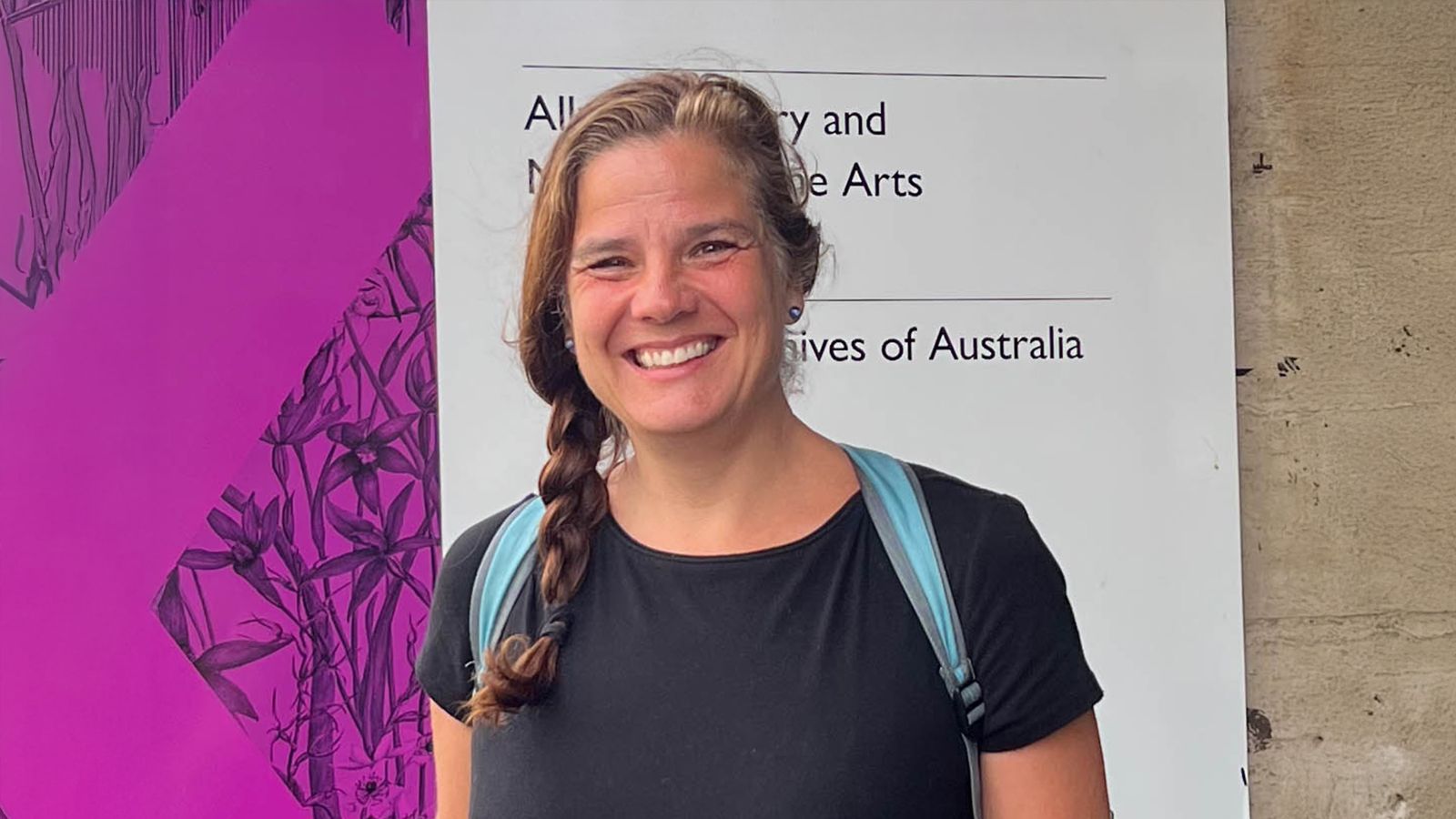
Teaching and Learning at the U of A spotlights instructors in the classroom and beyond. Through these stories, we hope to inspire others in our shared commitment to teaching and learning.
For Mélanie Méthot, studying history isn’t about memorizing a collection of dates and events. It’s a lens through which she teaches her students essential skills for academic success.
“Canadian history, or interdisciplinary studies, are for me vehicles to hone students’ skills in researching, communicating, thinking and collaboration,” says Méthot, a professor of History at Augustana who has been teaching for over 30 years.
Though she teaches primarily in the Law, Crime and Justice Studies program, she has taken students through courses that cover everything from pre- and post-Confederation Canadian history, legal history, the history of women, as well as the history of marriage in the British empire. “It’s never about the content,” says Méthot. “It’s about the skills the students will develop.”
Her main focus for any course, regardless of the era she’s covering or the particular facets of history she’s exploring, is to transform her students into knowledge creators. “I prioritize creation of knowledge (doing original research) over memorization,” she explains. “In all the courses I teach, students “do.” They are not receptacles to be filled. They are active participants who are encouraged to discover, try, fail and try again.”
This philosophy begins with how she designs her assignments. Instead of starting with an eye on the content she wants to cover in a class, she determines the particular skills she wants students to master. Then, she creates a list of general topics — from the 1976 Olympics to the 1947 wedding of Princess Elizabeth — that she hopes will pique their interest, often selecting topics that she herself finds fascinating. “I cross my fingers that my own passions will be contagious,” she explains.
Then, rather than simply recounting the facts about their chosen historical subject or event, her students are prompted to dive deeper.
“They need to tell me about the public discourse. They use newspapers, analyze them, come up with their own observations,” she says. “That allows them to cultivate research skills, analytical and critical thinking skills and communication, because they’ll often have a presentation component in addition to a written paper.”
Though Méthot gives them freedom to explore, she also builds “scaffolding” into her classes, giving students feedback throughout every stage from the proposal to the first draft and the final paper. “If they’re taking the wrong path, I can redirect them earlier,” she says.
This approach transforms her students into researchers who emerge from her class with a refined set of skills they can carry forward in any of their future courses. And, the focus on methodology rather than content alone has been the catalyst behind the creation of several unique course offerings, including one in progress that’s tentatively titled Capital Punishment.
Méthot’s own academic research focuses on the history of bigamy, and she knew from her own work that there was a multitude of Australian news and archival data available on a variety of topics. Capitalizing on the fervent interest in all things true crime, she got the idea to swap out textbooks for cold cases. The course centres on a specific murder, one that was a sensation in the press but largely ignored by academia or other sources. The rich Australian database means she could theoretically use a different case each time the course is offered, keeping things fresh if it becomes a curriculum staple.
For that class, she tasked students with analyzing five newspaper articles related to the case, transforming them into archival detectives looking for threads of interest and hidden meaning in media coverage. When they see the tidbits their classmates have unearthed, often quite different from their own research based simply on the articles that were selected, they learn another important lesson: “I want them to remember that they have to be critical towards the information they consume,” she explains, noting how integral that mindset is in today’s era of misinformation.
For Méthot, that’s the ultimate goal — shaping her students into critical creators of knowledge who are engaged with the world around them. “I love seeing students grow into better citizens because they honed their research, communication, thinking and collegial skills,” she says.