
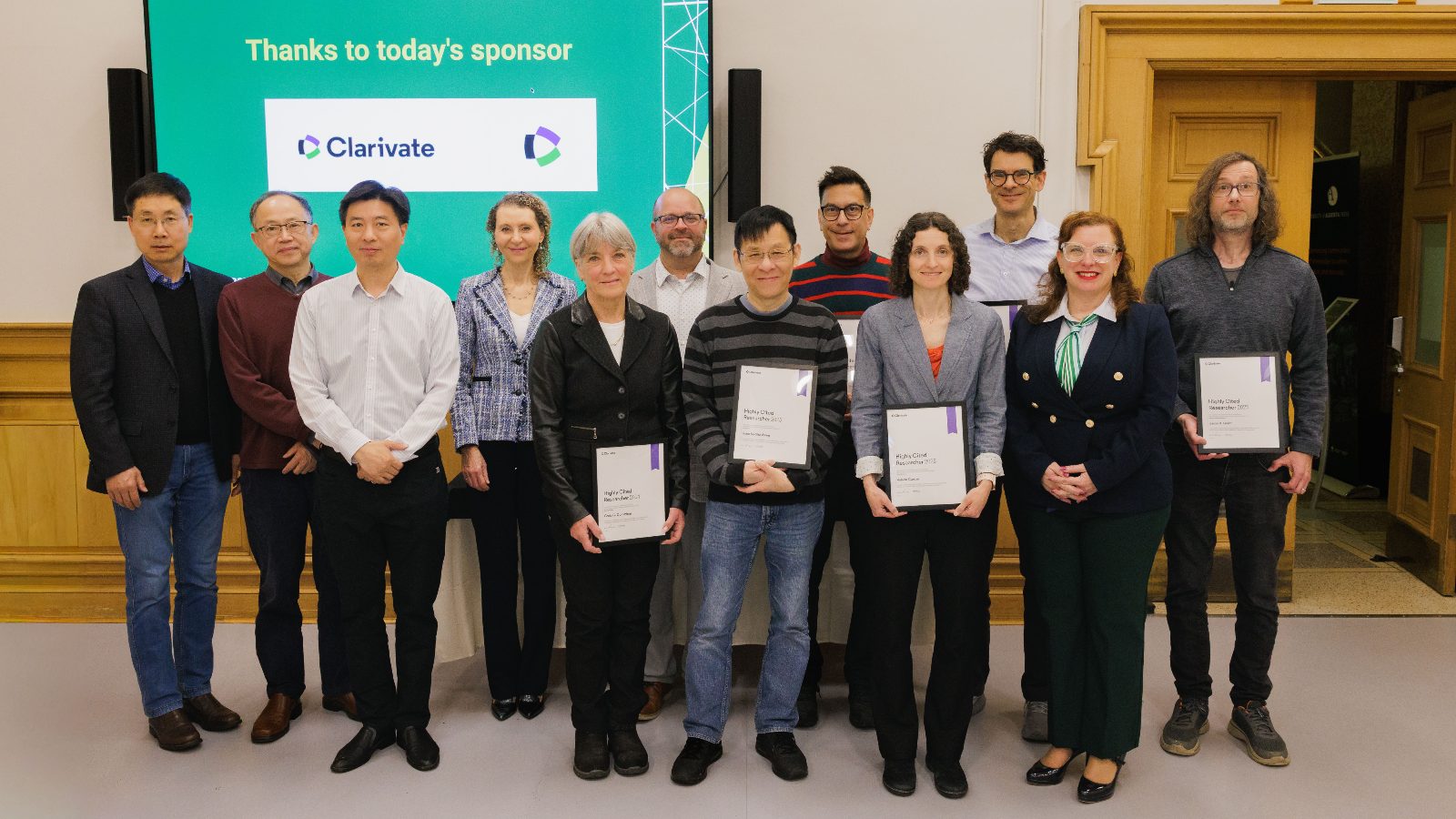
At the intersection of academic excellence and global service lies the work of the University of Alberta’s Highly Cited Researchers (HCRs). These leaders are not only producing science that crosses disciplinary boundaries, they are also pioneering the best practices of the digital age — from selecting high-impact open access journals to managing data in ways that invite replication and citation. Guided by the U of A Library’s support, these scholars provide a blueprint for influence, demonstrating how a strategic digital presence and a commitment to open data can amplify a researcher's voice on the world stage.
“Developing rigorous scholarship is crucial, and it’s important to study big problems in the world that people care about,” says Dr. Michael Lounsbury, A.F. (Chip) Collins Chair, professor and chair of the Department of Strategy, Entrepreneurship and Management at the Alberta School of Business. “But it is equally important to ensure that your research has wide relevance to many different audiences, not only advancing theory in your academic field but also generating practical insights that are broadly applicable.”
Michael, a 2025 Royal Society of Canada inductee who pioneered a new global field of scholarly study — cultural entrepreneurship — that looks at how entrepreneurial processes are fundamentally shaped by cultural practices and beliefs within society — has made multiple appearances in the HCR list and has been cited by articles in 137 different journal subject areas.
Clarivate’s HCR list is an annual recognition of the top one per cent of global scientists and social scientists whose work over the previous 11 years has significantly influenced their fields. This group, Clarivate highlights, contributes disproportionately to extending the frontiers of knowledge and to innovations that make the world healthier and more sustainable and drive societal impact. Annually, only a few thousand researchers meet the stringent criteria to appear on this list.
Each of the 21 U of A researchers on the HCR list are deliberate in managing their research data to ensure maximum accessibility.
Dr. Valerie Carson, professor, Faculty of Kinesiology, Sport, and Recreation, says that strategic journal selection — based on novelty, study design, sample size and target audience — informs every publication decision. Her research, primarily focused on understanding how to effectively and equitably promote a healthy balance of physical activity, sedentary behaviour and sleep in children, is by nature, multidisciplinary. The potential for citation across a broad range of fields that her research touches on, including public health, sports sciences, pediatrics, psychology, education, environmental sciences, health services and transportation, is substantial. Valerie’s publications influence research in 175 different subject areas.
“When we’re looking at publishing in journals, we do quite a bit of background work, looking at the kind of papers they are likely to accept, what the journal’s focus is on, if they've published similar papers in the areas that we're presenting in our paper, and so on,” she says. “It never hurts to aim high at the beginning to see where that might go.”
Beyond traditional peer-reviewed journals, Valerie and her team actively explore alternative avenues for dissemination, including infographics, non-academic presentations and press releases to tailor their approach to reach the specific audiences most impacted by the work.
“I’m always thinking about other ways to get the research out so that it’s viewed by individuals who could best utilize it,” she says. “We may choose what would be considered a lower-impact journal, because it might have a better ability to inform practice or policy, or we might target a journal where we know health practitioners, like pediatricians or public health nurses or educators, are more likely to be reviewing that journal. Choices are weighed in terms of ensuring the work is getting to the right audience.”
Thane Chambers, a U of A librarian leading the Research Impact Services team, highlights the library’s ability to help researchers quantify their impact — not just through traditional citations, but across policy documents, clinical guidelines and patents.
“My responsibility is to help the university understand the impact of the research being done on campus; for instance, what is being cited at other institutions, who is using our research to inform decisions and how they are using it,” she says. “We help researchers answer those questions.”
Thane says that the U of A Library actively facilitates open access (OA) publishing, including support for processing charges and helping researchers find appropriate OA journals.
“OA increases the chances of your research being cited,” she says. “More people will be able to see it and use it. But, and this is especially true with early career researchers, it can be a confidence thing: about being confident in yourself and your contributions. You need to be a little bit brave.”
Dr. Shinichi Nakagawa, professor, Faculty of Science, Canada Excellence Research Chair in Open Science and Synthesis in Ecology and Evolution, views the U of A Library as a vital partner in helping to equip the next generation of scientists with the skills to navigate large databases and OA best practices.
An evolutionary biologist, Shinichi’s focus is in meta-science, often referred to as “the science of science” — which draws connections and patterns between the tens of thousands of papers on a topic. Since joining the U of A in 2024, he has been leading the first meta-science project in ecology and evolution by building global networks to synthesize vast datasets and modernize research reporting standards.
“With that much data, you can ask amazing questions,” he says, noting that his work studying open-science practices is inherently interdisciplinary, a quality he views as essential for amplifying research reach and ensuring broad dissemination across diverse fields. His meta-analysis work also captures non-English literature — including Portuguese and Chinese sources — using the example of his recent study, published in Nature, regarding climate change vulnerability in 5,000 amphibian species.
“For a long time, interdisciplinary researchers faced a cost,” he says, adding that even his own work was overlooked for awards or global recognition because it didn’t fit neatly within the silos of a single academic society. The landscape shifted significantly about seven years ago, explains Shinichi, when major bibliometric platforms, such as Clarivate’s Web of Science, introduced "cross-field" categories. This change finally allowed for the systematic tracking of influence that spans multiple disciplines. For researchers whose work bridges various subjects, this structural shift in publishing data has been the catalyst for their formal recognition as global leaders, proving that interdisciplinary research is no longer a barrier to visibility, but a recognized pathway to high-impact status.
Data tracked by the U of A Library shows that Shinichi’s articles appear in 47 different journal subject categories, and the articles that cite his work are in 239 different journal subject categories. Since 2020, 87 per cent of his articles are open and 100 per cent of his highly cited papers are open.
Citation counts are not just a reflection of scientific rigour, but a direct result of accessibility. By prioritizing open access, these researchers ensure that the impact of their findings are available to those who need it. It’s a commitment to democratizing discovery that allows impactful research to transcend traditional paywalls and maximize global reach.
As Thane notes, “If your research can benefit the world, and you have a way to make it available, why wouldn’t you do it?”
University of Alberta Highly Cited Researchers
Paul Armstrong, Faculty of Medicine & Dentistry
Valerie Carson, Faculty of Kinesiology, Sport, and Recreation
Scott Chang, Faculty of Agricultural, Life and Environmental Sciences
Tongwen Chen, Faculty of Engineering
Dr. Greta Cummings, Faculty of Nursing
Dr. Carole Estabrooks, Faculty of Nursing
Dr. Mike Flannigan, Faculty of Agricultural, Life and Environmental Sciences
Dr. Michael Gänzle, Faculty of Agricultural, Life and Environmental Sciences
Dr. Jason Grant, Faculty of Agricultural, Life and Environmental Sciences
Dr. Royston Greenwood, Alberta School of Business
Dr. James Hammond, Faculty of Medicine & Dentistry
Dr. Yunwei Ryan Li, Faculty of Engineering
Dr. Michael Lounsbury, Alberta School of Business
Dr. Shinichi Nakagawa, Faculty of Science
Dr. Witold Pedrycz, Faculty of Engineering
Dr. Carla Prado, Faculty of Agricultural, Life and Environmental Sciences
Dr. John Spence, Faculty of Kinesiology, Sport, and Recreation
Dr. David Wishart, Faculty of Science
Dr. Gane Ka-Shu Wong, Faculty of Science
Dr. Hongbo Zeng, Faculty of Engineering
Dr. Lonnie Zwaigenbaum, Faculty of Medicine & Dentistry
Related articles:
- View detailed instructions on how to register for a free ORCID
- How using a unique identifier increases the visibility of your research
- Consider this: Stand out with Research Impact Services
While being an HCR is a significant indicator of influence in the scholarly publishing world, the absence of a name on that list is rarely a reflection of a researcher's impact on the world, the community or their field of study. The HCR list and others like it are optimized for classical ways of publishing and do not take into account non-traditional forms of research such as clinical (Standard Operating Procedures), arts, Indigenous and community-based research, which often emphasize relational and/or community impact over citation. The real impact of the university’s research landscape is found in its diversity of thought, its collaborative spirit and the collective drive to deliver impactful research, in whatever form it takes.