quot editores, tot Propertii / quot auctores, tot Odyssea
There are as many (versions of) Propertius as there are editors / there are as many Odysseys as there are authors
Stories are told to entertain, stories are told to teach and stories are told to commemorate. Some stories, such as the Odyssey, do all three.
So why is the Odyssey so popular? Certainly, it tells an exciting story, but it is also an examination of the human condition: What does it mean to be human? What is family? What is home? And, ultimately, who am I? As Odysseus discovered, if he could not return home, he was Nobody. In the first four books of Homer’s Odyssey, Odysseus is merely the lost man, whose unexplained absence posed a serious threat to his home, family and kingdom. When we finally meet him, he’s weeping, alone, a kept man in the home of the powerful goddess, Calypso, who offers him immortality if he agrees to stay with her.
Odysseus had already survived many dangers before reaching the seeming safety of Calypso's island, including the threat of death at the hands of the Cyclops, monstrous for his refusal to adhere to the human conventions of how to treat a guest; the fatal song of the Sirens that lures all who hear it to their deaths; the threat from the Lotus-Eaters who would make everyone forget their desire for home. And yet, he refuses Calypso’s gift and chooses instead to risk death on the high seas for the chance to return home. Yes, the voyage home, alone, on a rickety raft, over the sea ruled by a hostile god, was full of danger, but the reward was worth it. Is Odysseus Odysseus if he’s the concubine of a goddess? Do his great deeds matter if no one knows of them, and no one sings of them? No. He must perform those great deeds and be sung of for them in his community for those deeds to have meaning.
Being honoured and celebrated for one’s great deeds was, of course, the focal point of Achilles’ dilemma in the Iliad: should he have a long and unmemorable life, entirely forgotten after his death? Or a short life filled with danger that wins him immortal fame? Suffering and death are the only two things the gods guaranteed to mortals. But it’s in the suffering that the human is revealed, and that suffering needs a story to be told and a community to hear it. And that is the Odyssey.
After ten years of war, the Greek forces defeated the Trojans, sacked the city of Troy and then dispersed to return to their respective homes. Some, like Menelaus and his wife, Helen, the cause of the Trojan War, made it home safely to live happily ever after. Agamemnon, the commander of the Greek forces, made it home only to be killed by his wife and her lover. Many others never made it home at all, having been destroyed along the way by angry gods, grievously offended by their behaviour during the sack of Troy. The lost epic Nostoi told the stories of these successful and unsuccessful returns.
Odysseus’ 10-year voyage home, through obstacles both natural and supernatural, to his wife, family and kingdom is the subject of its own epic, The Odyssey, currently making headlines thanks to Christopher Nolan’s screen adaptation released in July 2026. Nolan’s Odyssey isn’t Homer’s Odyssey, and that’s OK! Nolan’s take is a beautifully shot and powerful re-use of the myth to question the world around us, one of the most important purposes of myth.
After 10 years, Homer’s Odysseus does, eventually, make it home successfully, having lost all of his companions along the way. Once home, he faces his final trial: how to deal with the hordes of suitors who had descended on his home in his absence and were eating him out of house and home as they waited for his wife, Penelope, to decide which of them she’ll marry.
Odysseus slaughters the suitors, executes the enslaved women he deemed disloyal and is reunited with his faithful wife. In the process, he triumphantly sheds the identity he had adopted along the way, Nobody, to reveal himself as husband of Penelope, father of Telemachus and king of Ithaca. Unfortunately, this is not a permanent homecoming: having angered the god Poseidon along the way, Odysseus cannot stay to enjoy his restored home and family but must set out, again, on one more long journey.
Odysseus’ journey inspired the historian Xenophon, whose Anabasis (ca. 370 BCE) told the story of the march home of the 10,000 Greek mercenaries, through hostile territory, having failed to put Cyrus on the Persian throne. The highpoint of the Anabasis is the cheer “the sea! the sea” raised by the Greek soldiers when they finally spot the Aegean, signifying they’ve made it back to the Greek world. This in turn inspired Sol Yurick’s 1965 novel The Warriors (adapted to film by Walter Hill in 1979) about a gang stranded in hostile territory, trying to fight their way through New York City over the course of one night to the safety of their own turf. Star Trek: Voyager (1995-2001) shows us that ‘boldly going where no one has gone before’ isn’t as much fun when you doubt you’ll ever make it back home yourself. Shades of the Odyssey can be found in Andy Weir’s books The Martian (2011) and Project Hail Mary (2021), where the stories of humans stranded alone in hostile territory make all too real the human need for home and community.
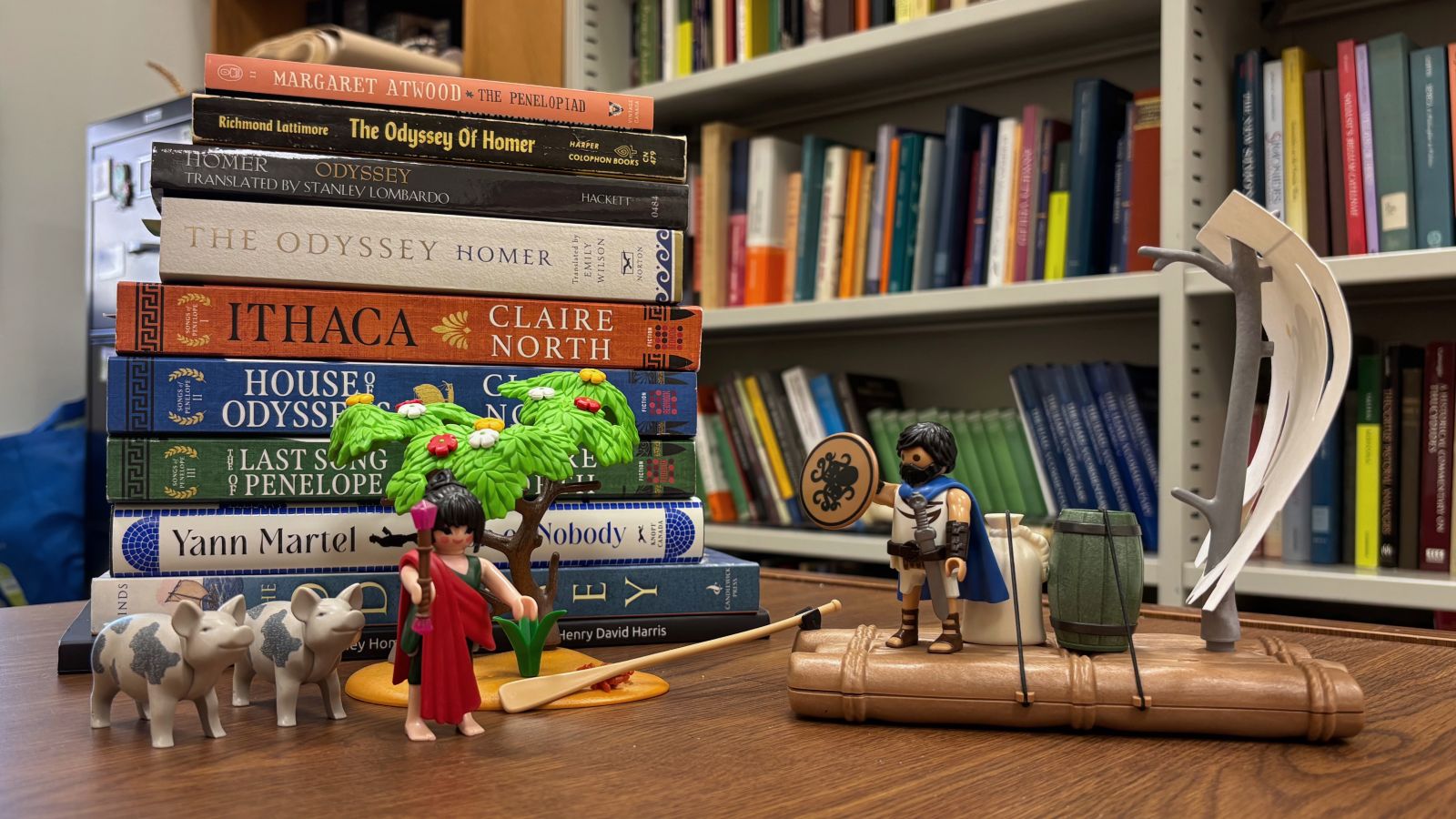
The rich content of the Odyssey itself has inspired many retellings, reimaginings and revisionist takes. Nolan’s Odyssey envisions Odysseus as a battle-scarred general, traumatized by his role in the Greek sack of Troy, and unwilling to return home with his ghosts. Suzanne Vega’s song “Calypso” (1987) shows an empowered goddess choosing to let Odysseus go home while embracing the loneliness of her own existence. Margaret Atwood’s Penelopiad (2005) gives voice to Penelope, haunted by the ghosts of the executed enslaved women and her own complicity in their deaths. Zachary Mason’s The Lost Books of the Odyssey (2007) plays with the ever-changing and often contradictory world of myth, presenting what purports to be papyrus fragments containing 44 variations of Odysseus’ story. Madeline Miller’s Circe (2018) turns the witch, Circe, originally an obstacle defeated by Odysseus, into an exploration of female independence. Claire North’s Penelope trilogy (Ithaca [2022], House of Odysseus [2023], Last Song of Penelope [2024]) reimagines Penelope seeing her way through the dangers she faced at Ithaca during the long years of Odysseus’ absence.
What happens to the little folk when the great folk do their heroic deeds? Henry David Harris’ Odysseus and Kev, the Long Journey Home (2026) teams up the great hero Odysseus with Kev, a displaced-in-time Australian lad, and shifts the focus from the great hero to lesser mortals. In Yann Martel’s Son of Nobody (2026), a PhD student from the Canadian prairies, lost in the weeds of his dissertation, abandons his home and family for a year-long fellowship at Oxford, where he finds inspiration working with the fragments of a long-lost epic about a common soldier during the Trojan War. Can he jumpstart his career with his newly discovered epic, and at what cost to his family?
These retellings, from the first ancient Greek authors who reacted to the Odyssey and the stories it told to Nolan’s most recent recreation, show us why literature matters, why a story is never just a story.
Stories are told to entertain, to teach and to commemorate. The Odyssey endures because it still does all three. More than that, it invites each generation to tell the story again, in its own voice, for its own audience, and in doing so discover that Odysseus' journey home was never only his.