

Walk through any bookstore today and you may see various special or limited editions of books with colourful or stenciled edges. While these eye-catching additions to your bookshelf are visible from across the room, tucked away in Bruce Peel Special Collections is a different kind of magic — works of art hidden in plain sight that you have to get a lot closer to see.
In the 10th century, artists began to add decorative flourishes to the area of books called the “fore-edge,” the exterior section opposite the spine. By the 17th century, fore-edge painting developed as a hidden pictorial art form. Robert Desmarais, Head of Special Collections (Library and Museums), notes that a Yorkshire-based company called Edwards of Halifax is thought to have elevated fore-edge paintings as an art form during the late 18th century.
The fore-edge is a unique type of canvas, and the process of creating one of these images requires precision and painstaking attention to detail. As Robert explains, “there’s a special kind of press that holds the text block in place. The artist paints the scene on the fore-edge, and then it vanishes when the text block rests in its natural position.” Typically, gilt was applied to all three edges of the book as a final decorative detail, which would be the only addition visible when looking at the book from afar. The painting itself remains hidden until you slightly fan out the pages — then, all of a sudden, a detailed scene emerges.
The Works of William Shakespeare. Macmillan & Co.1884. Call # PR2753 M33 1884. The fore-edge painting of the Globe Theatre occupies ⅔ of the area and a portrait of William Shakespeare occupies the other third. Artist unknown.
While a single image stretched along the fore-edge of a book is the most common example, there are a few variations of this type of art. When all three edges of a book are decorated, it’s called a panoramic fore-edge painting. With thicker volumes, there can often be split scenes, where different images run parallel on either half of the fore-edge. Popular subject matter included pastoral landscapes, cityscapes, coats of arms, literary scenes, Biblical scenes and military scenes.
These paintings were normally commissioned by the owners of books, the same way they’d select material details such as the binding or paper. “It was a way of making their own particular volume distinct from other volumes, and it allowed them to complement the content of the book with something that’s very unique on the fore-edge,” says Robert. “And, I think a lot of owners were intrigued by that element of surprise.”
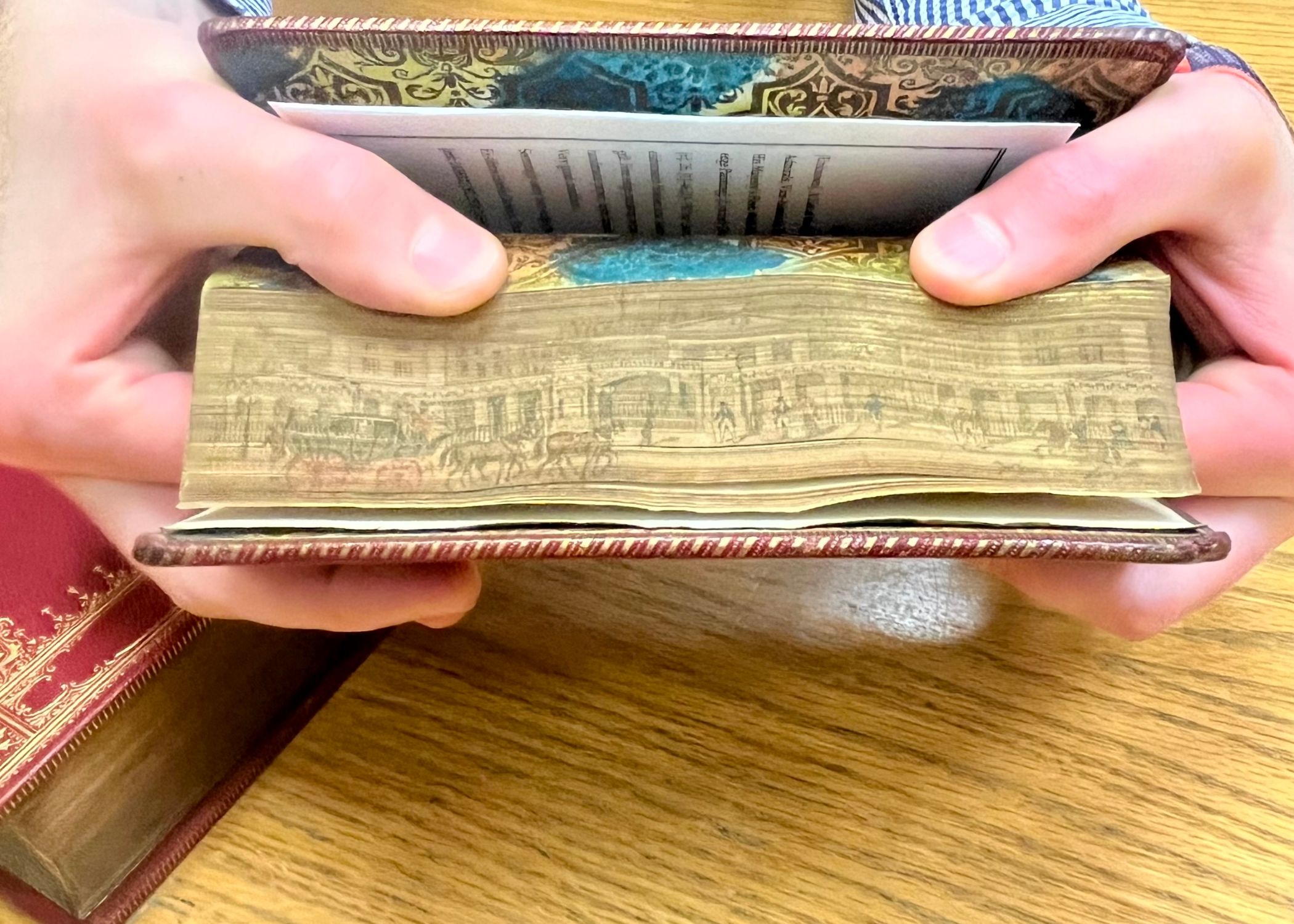
These hidden works of art continue to surprise viewers to this day. "I've heard stories from book dealers who said that showing fore-edge paintings often drew gasps of astonishment from the audience when the artwork appeared," says Robert. For historians, the paintings can offer evidence of book ownership, insight into aesthetic taste at the time and other compelling details about the afterlife of books after printing, he adds.
“You’ll never show somebody a fore-edge painting and not see them break a smile,” adds Jeff Papineau, Special Collections Coordinator (Library and Museums). “It always delights people.”
Those itching to see some of these masterpieces for themselves should turn their attention to the notes section of a book’s listing in the U of A catalogue, explains Jeff, where you can find additional details on elements like the book’s size and type of binding. “We’ll add the description that this volume has a fore-edge painting and usually describe what the scene is,” he says.
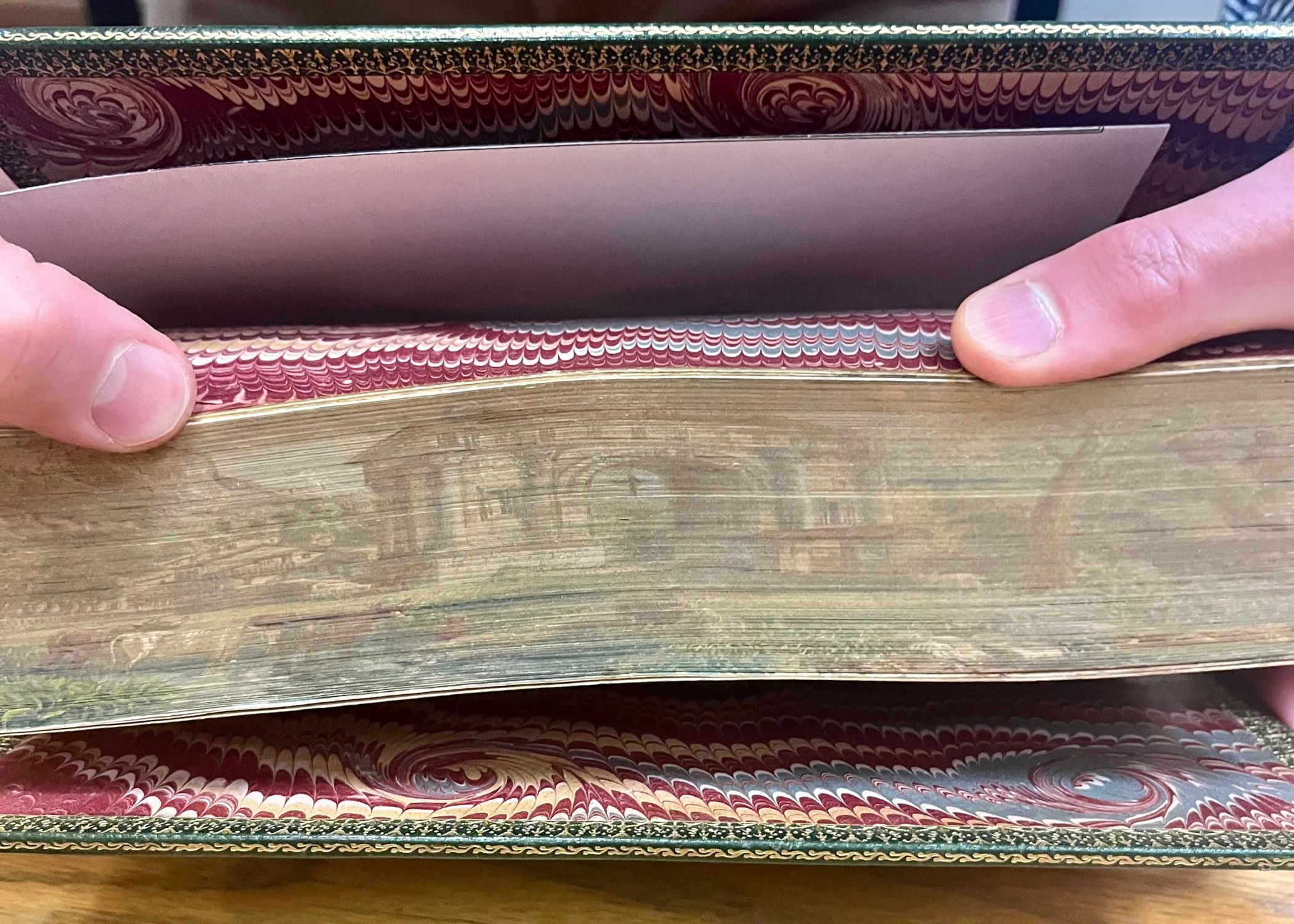
The most popular example of a fore-edge work of art in the library’s holdings can be found in Paul Kane’s Wanderings of an Artist among the Indians of North America, a volume from the A.C. Rutherford Collection on which a landscape of Fort Edmonton is depicted. Jeff managed to capture the image by scanning the fore-edge while holding the book in the fanned out position, something you’d normally have to handle the book yourself to see. However, revealing the secret masterpiece does put a fair bit of pressure on the book, both Robert and Jeff explain, and the Kane tome has been rebound and fixed once already.
“That’s part of what makes them so much fun, though,” says Jeff. “They’re there, and then they’re gone.”
For a time, the volume formerly owned by Rutherford was one of only six examples of fore-edge paintings found in Bruce Peel Special Collections. Recently, though, the university acquired 15 additional works with fore-edge paintings, allowing them to build out a collection of the unique art form.
Learn more about fore-edge paintings during the workshop Hidden in Plain Sight: The Secret World of Fore-edge Paintings on Sept. 9 and 15, 2026. Additional information on Bruce Peel Special Collections Workshops available here.