
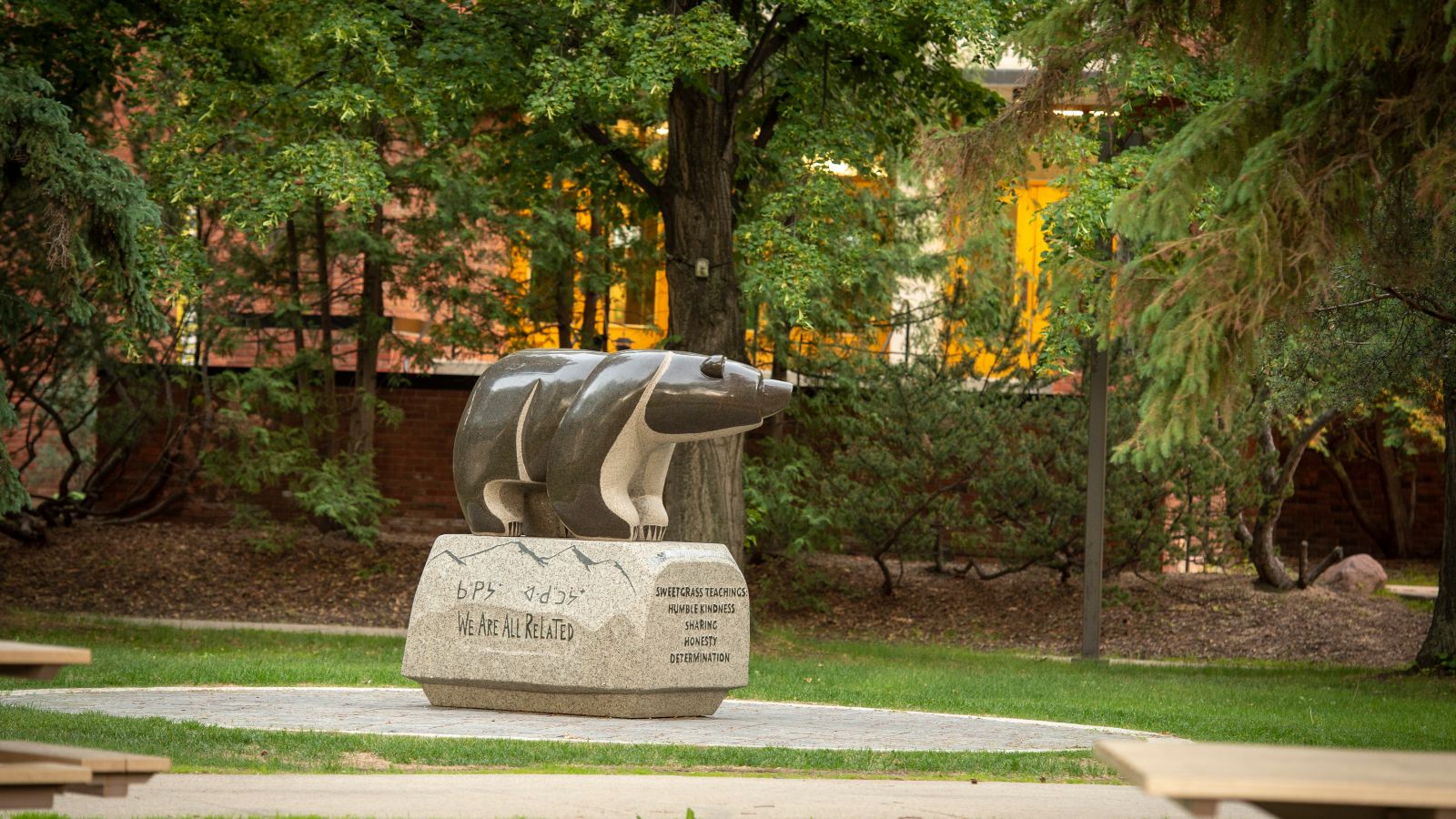
In honour of the 150th anniversary of Treaty No. 6 in 2026, we reflect on one of the University of Alberta's Treaty 6 Markers and its impact on the U of A community in the many years it has stood watch over the Quad on North Campus.
For more than 10 years, thousands of people going about their day across North Campus to get to classes, meetings or the myriad of other tasks that take us from building to building have passed a figure among the trees that offers a comforting familiarity, whether we consciously notice it or not. It’s Stewart Steinhauer's sculpture "Treaty Six Territory Marker: Bear Spirit."
Among the many public art pieces around the U of A campuses, few are as imbued with as much significance as the silent form that watches over the Quad on North Campus. Colloquially known as the Sweetgrass Bear, the artwork immediately established its place as an iconic North Campus image, de facto wayfinding tool and a steadfast reminder of our commitment to the work as Treaty peoples.
“'Treaty Six Territory Marker: Bear Spirit' has been an integral part of the U of A Museum’s Art Collection for the past 10 years,” says curator Dr. Nadia Kurd. “The sculpture critically draws attention to the history and obligations of Treaty No. 6 on campus. As a public artwork, it is one of the most accessible pieces of art in the collection, and the Cree teachings that accompany it, such as kindness, honesty and determination, are important lessons for us all.”
In a The Quad article from 2016, Steinhauer wrote: “Indigenous knowledge, passed generation to generation, has been preserved and recorded in a specific format, both in form and in practice: in granite. The objective of this form of recording is to create an experiential moment for observers, transforming them from observers into participants.”
Since its addition to the U of A’s public art collection, the community’s interactions with the Sweetgrass Bear are visible throughout the year. “The campus community at the U of A has heartily embraced Stewart’s sculpture. It’s evident in our public art programming on campus to the way students, staff and visitors interact with the work, particularly during convocation week, and how it is used in various celebratory events,” says Nadia.
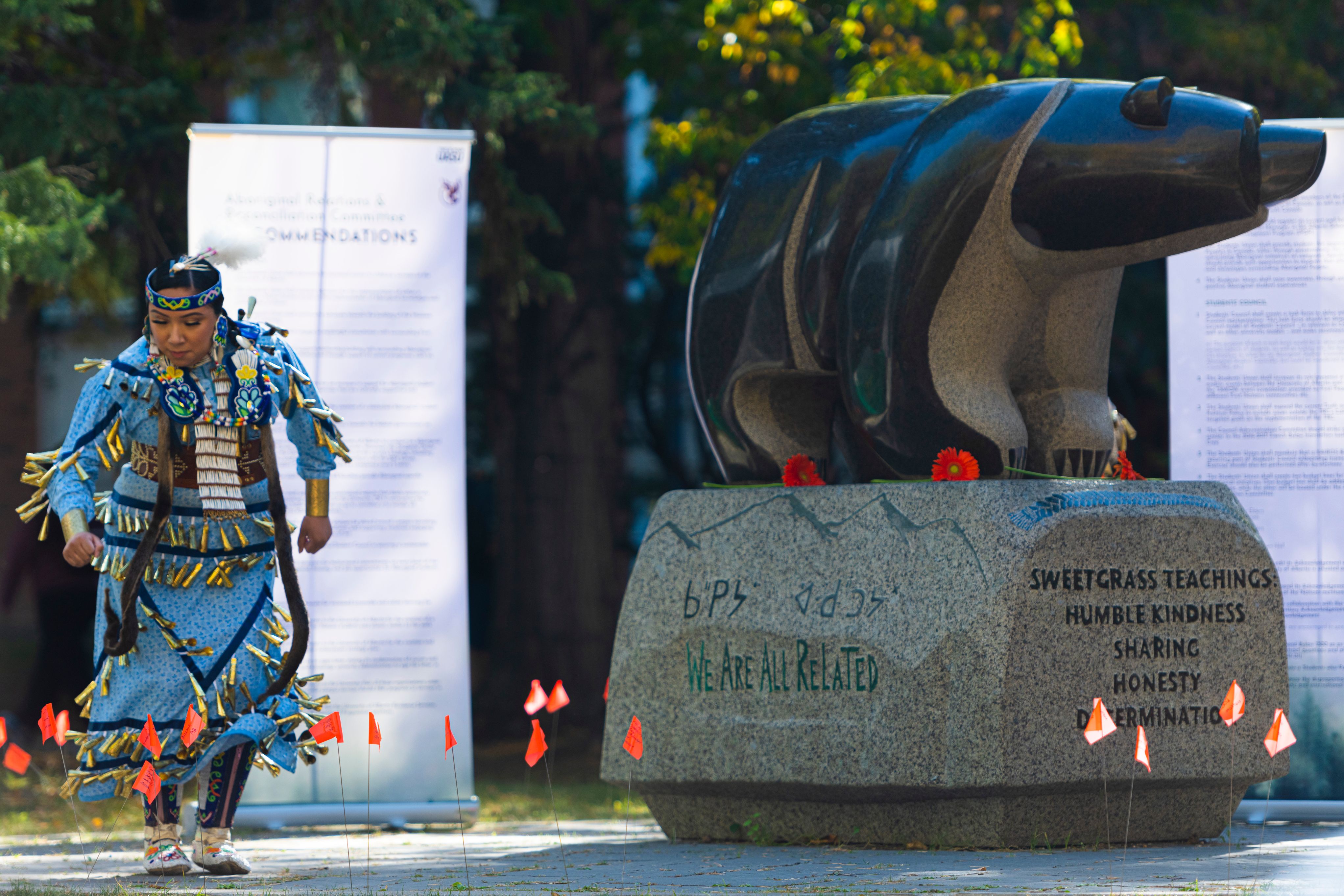
“The Sweetgrass Bear is more than a sculpture on campus. It has become a gathering place for many Indigenous-led events,” says Danni Okemaw, Faculty of Native Studies community engagement and alumni relations coordinator. “One memory I will always carry with me is dancing Jingle Dress beside the Sweetgrass Bear during an Orange Shirt Day gathering to honour Indian residential school survivors. That moment was especially meaningful because my dad is a survivor."
It’s not just U of A students and employees who connect with Sweetgrass Bear; it has become a pivotal part of any North Campus tour through the Campus Visit program.
“The Campus Visit Program welcomes more than 5,000 guests each year," says Alex Rocca, team lead, Future Student Experience in the Office of the Registrar. “While many of our tour guests are from the Edmonton area, people from across Alberta, Canada and even the world come to the U of A, and a North Campus tour may be someone’s first time visiting Treaty Six. We feature Sweetgrass Bear on all of our tours to welcome everyone to campus in a really beautiful way. Initially, the statue connects us physically to the land itself, in respect and in celebration of Indigenous knowledge systems and cultures. It also ties all of the U of A’s campuses together, as each is home to a related sculpture. But there is a second connection beyond the land – of us as people and members of the university community. The inscription on Sweetgrass Bear reads, ‘We are all related’ and this message is important in remembering that we come together at the U of A as diverse peoples with diverse perspectives to grow, learn and innovate.”
Although the Sweetgrass Bear is the most familiar of the U of A’s Treaty Six Markers, there are two in the U of A Museums’ Art Collection, contributing to the U of A Museums’ growing collection of work by Indigenous artists.
“As a curator, it’s important that works in the Art Collection resonate so deeply with the campus community and that they remind us of our continued obligations to maintain treaty obligations in good faith," says Nadia. "Treaty Six Territorial Marker also represents the growing efforts of the Art Collection to diversify and collect the work of Indigenous artists so that current and future generations can learn and be inspired by their work. Art is a great way to connect and bring people together, and I believe that Stewart’s work beautifully achieves this."
In recognition of the 150th anniversary of Treaty No. Six in 2026, the U of A Museum’s Art Collection has curated a new online exhibition. From These Lands: Commemorating the 150th Anniversary of Treaty No. 6 presents a selection of artworks by Indigenous artists from Treaty 6 in the collection (including the Sweetgrass Bear) and highlights the histories that Indigenous artists continue to explore and reflect on in their work.
Related story: