
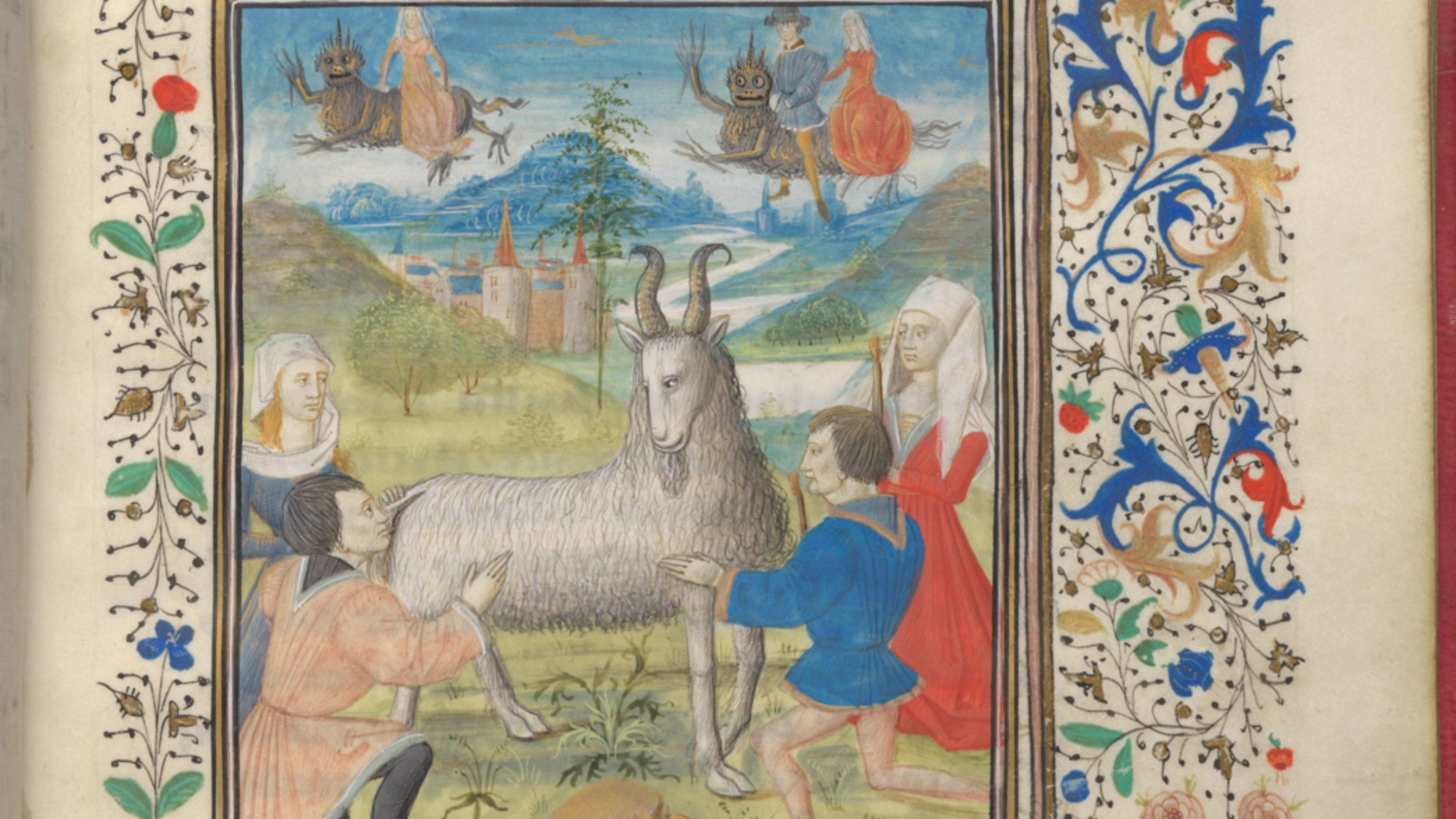
Allan Wright, ATS associate lecturer who teaches Studies in Witchcraft and the Occult in the Faculty of Arts at the University of Alberta, pulls back the historical curtain to reveal these bleak – and sometimes even bizarre – truths about witchcraft.
The church turned witchcraft from superstition into cause for persecution
For much of the Middle Ages, the church viewed witchcraft as a pagan superstition, not a real threat. It embraced supernatural forces in other forms, including the spiritual power of saints and relics.
But as Europe and the world faced a series of devastating crises — from the Little Ice Age to the Hundred Years’ War and the Black Death — people searched for explanations for their suffering, and witchcraft increasingly became a convenient scapegoat.
At the same time, a worldview rooted in the struggle between absolute good and absolute evil took hold. Misfortune became interpreted as evidence of the Devil’s influence, leaving little room for a middle ground.
The Protestant Reformation intensified these tensions. As Catholic and Protestant authorities competed for religious legitimacy, the persecution of alleged witches became one way to demonstrate their commitment to defending the faith. Many of the most intense witch hunts took place in religiously divided regions of the Holy Roman Empire, in what is now Germany.
When domestic duties went “wrong,” women were blamed for evil
In both Europe and North America, the majority of victims – approximately 75 to 80 per cent – were women. Usually, women were accused of harming someone through supernatural means, while men were accused of leading groups and heresy. Witchcraft accusations were usually observed through various social lines, such as between Catholics on one side of town and Protestants on the other.
“Since women were the primary caretakers of the domestic sphere during this time period, they were seen as responsible when problems occurred,” says Allan. This included everything from digestive issues to miscarriages and infant deaths, sparking rumours that witches were stealing babies. Even cancer was attributed to witchcraft because there was no explanation for it.
The “witch's mark” was viewed as powerful supporting evidence in court
The witch hunts reached their peak between 1580 and 1650, a period dominated by public hysteria. During this time, the witch's mark became a widespread obsession. “This was seemingly a mark left by the Devil,” says Allan. “It could look like any skin blemish – a mole, an age spot – so finding these was easy.” Some took it further and would poke the mark, he explains: if it didn’t bleed, it was most certainly from the Devil, because the Devil doesn't feel pain.
Trials shifted from the church courts to secular courts that inflicted even greater inhumane punishments, including burning at the stake and hanging. Things got so out of hand that people began writing letters of concern to government officials and ministers.
U of A Libraries has one of the earliest witch-hunting manuals
Equal parts historic and disturbing is Invectives against the Sect of Waldensians, the 1460 treatise by French theologian Johannes Tinctor. Today, there are only four surviving copies in the world, and one of them – believed by scholars to be the oldest copy in French – is housed in the Bruce Peel Special Collections at the U of A.
“If anything was truly dangerous, it was books like Tinctor's,” says Robert Desjardins, an academic program officer in the Faculty of Graduate & Postdoctoral Studies (GPS), who published the first-ever English translation of the manuscript alongside researchers Andrew Colin Gow and François V. Pageau.
“The book was nominally addressed to all good Christians, but its primary audience was powerful people – princes and bishops,” says Robert, who describes the manuscript as a princely artifact bound in oak and written on expensive vellum with rich inks and gold leaf.
“Like other prosecutorial intellectuals writing in his time, Tinctor was less enlightened than many medieval churchmen who came before him,” he says. “Earlier thinkers tended to write off accusations of "witchcraft" in terms of superstition and self-deception. Tinctor found loopholes to argue that diabolical witches knew exactly what they were doing when they made deals with the Devil – and that their crime was so vile that it would bring the end of the world.”