
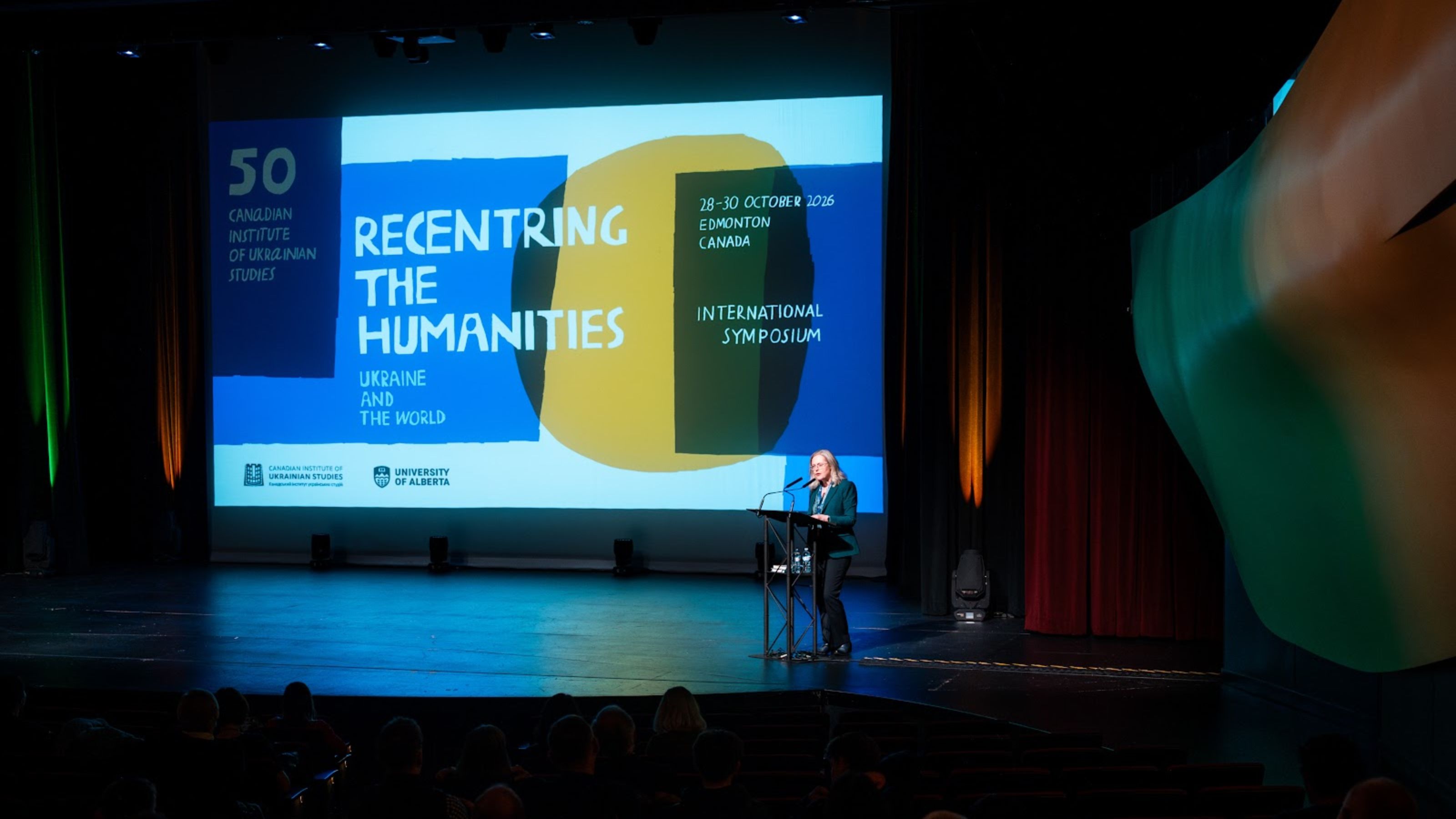
“Fifty years ago, a community of Ukrainian Canadians made a leap of faith," CIUS director Dr. Natalia Khanenko-Friesen remarks. "They believed that Ukraine and Ukrainians deserved a place in the university, and that knowledge about Ukraine was worth building across generations.”
To celebrate this milestone, here are 15 objects that commemorate CIUS's rich history.
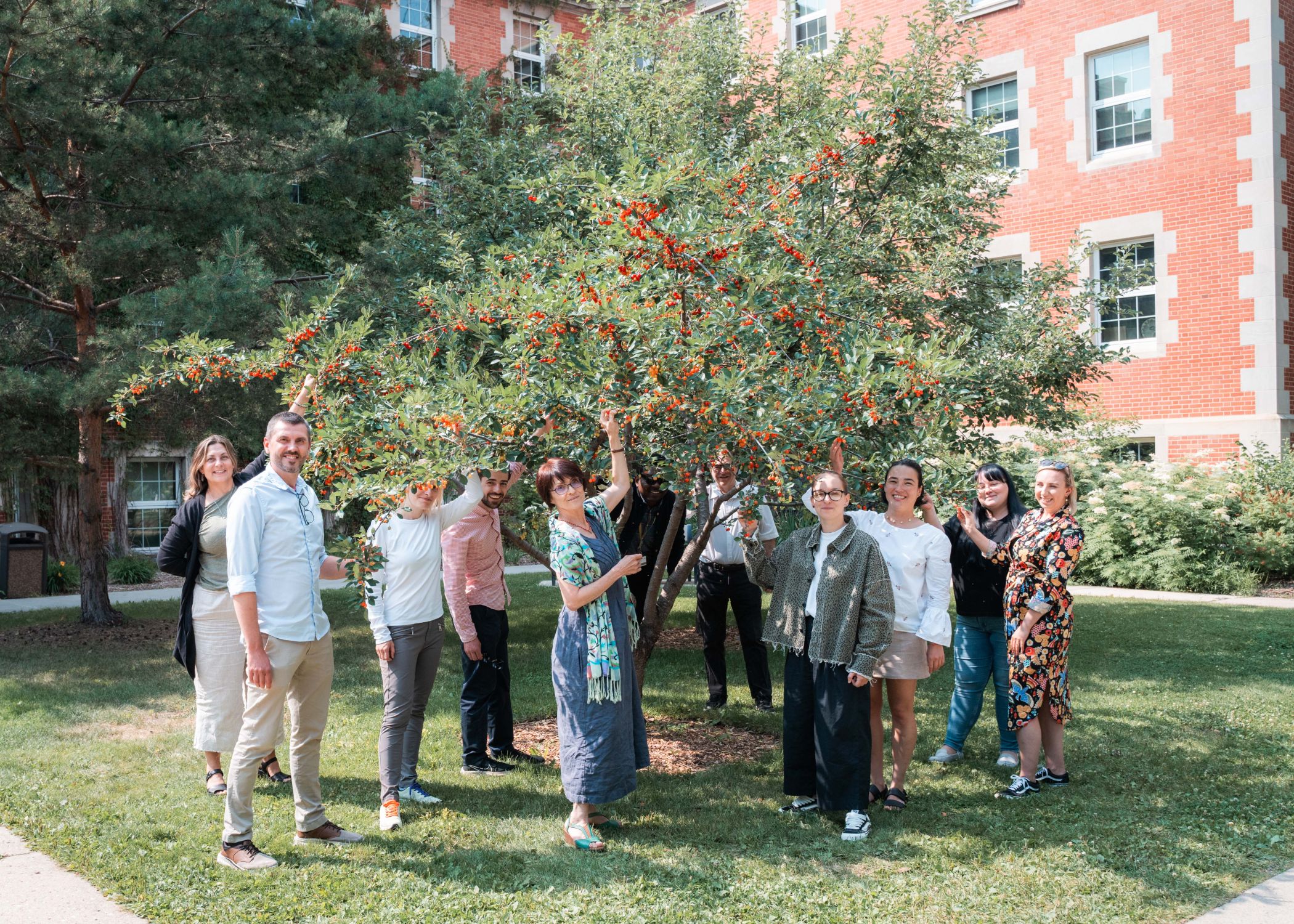
1. Three fruit trees at Pembina Hall — A living legacy of generosity
In 2005, Ukrainian Canadian donor Mykhailo Samytsia (1920–2009) gifted fruit trees to CIUS, including a remarkable apple tree bearing five varieties he had personally grafted. Still growing outside Pembina Hall, the trees, together with a commemorative plaque unveiled in 2013, symbolize the enduring generosity of the Ukrainian Canadian community and the lasting impact of philanthropy on Ukrainian studies.
2. The Encyclopedia of Ukraine — Scholarship meets art
The five-volume Encyclopedia of Ukraine (1984–93) was a landmark CIUS project that made authoritative knowledge about Ukraine accessible to English-speaking readers. Its distinctive sunflower emblem, a woodcut by internationally recognized Ukrainian artist Jacques Hnizdovsky, adds a remarkable artistic dimension to one of the Institute's most ambitious scholarly achievements.

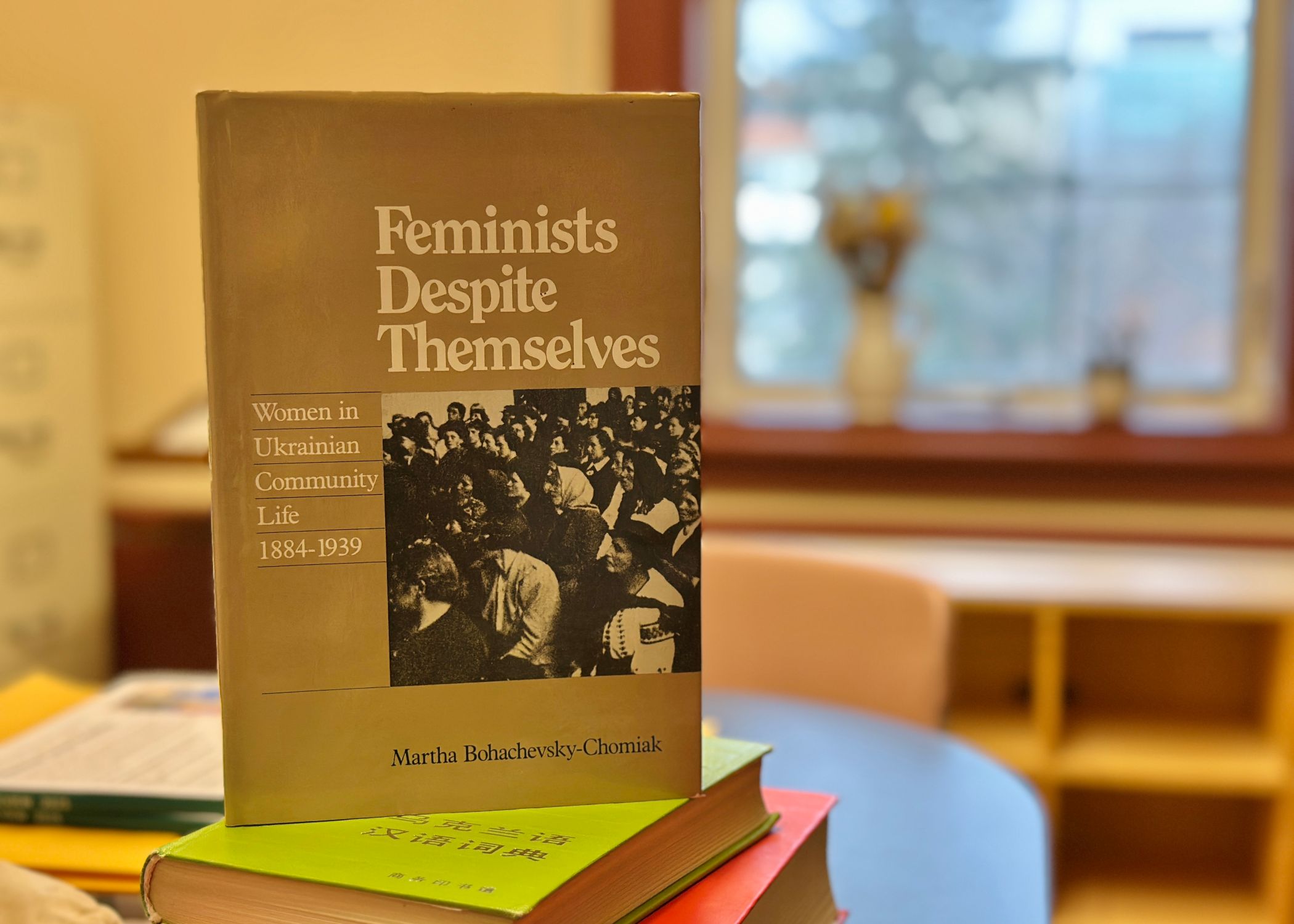
3. Feminists Despite Themselves — A pioneering history of Ukrainian women
Published by CIUS Press in 1988, Martha Bohachevsky-Chomiak's Feminists Despite Themselves: Women in Ukrainian Community Life, 1884–1939, was the first comprehensive history of the women's movement in Ukraine. This groundbreaking work brought Ukrainian women's experiences, activism and community leadership into the broader field of women's and gender history.
The complete English translation of Mykhailo Hrushevsky's monumental ten-volume History of Ukraine-Rus′, published in twelve books, represents one of CIUS Press's most ambitious scholarly undertakings. By making this foundational work accessible to international readers, the project helped establish Ukrainian history as an essential field of study in its own right.

5. Connecting Ukrainian communities across the Americas
Serge Cipko's Ukrainians in Argentina, 1897–1950: The Making of a Community, alongside diplomas and awards recognizing CIUS's international partnerships, could illustrate the Institute's long-standing engagement with Ukrainian communities in South America. Together, these objects tell a story of research, cultural exchange and academic diplomacy connecting Canada, Argentina, Uruguay and the wider Ukrainian diaspora.

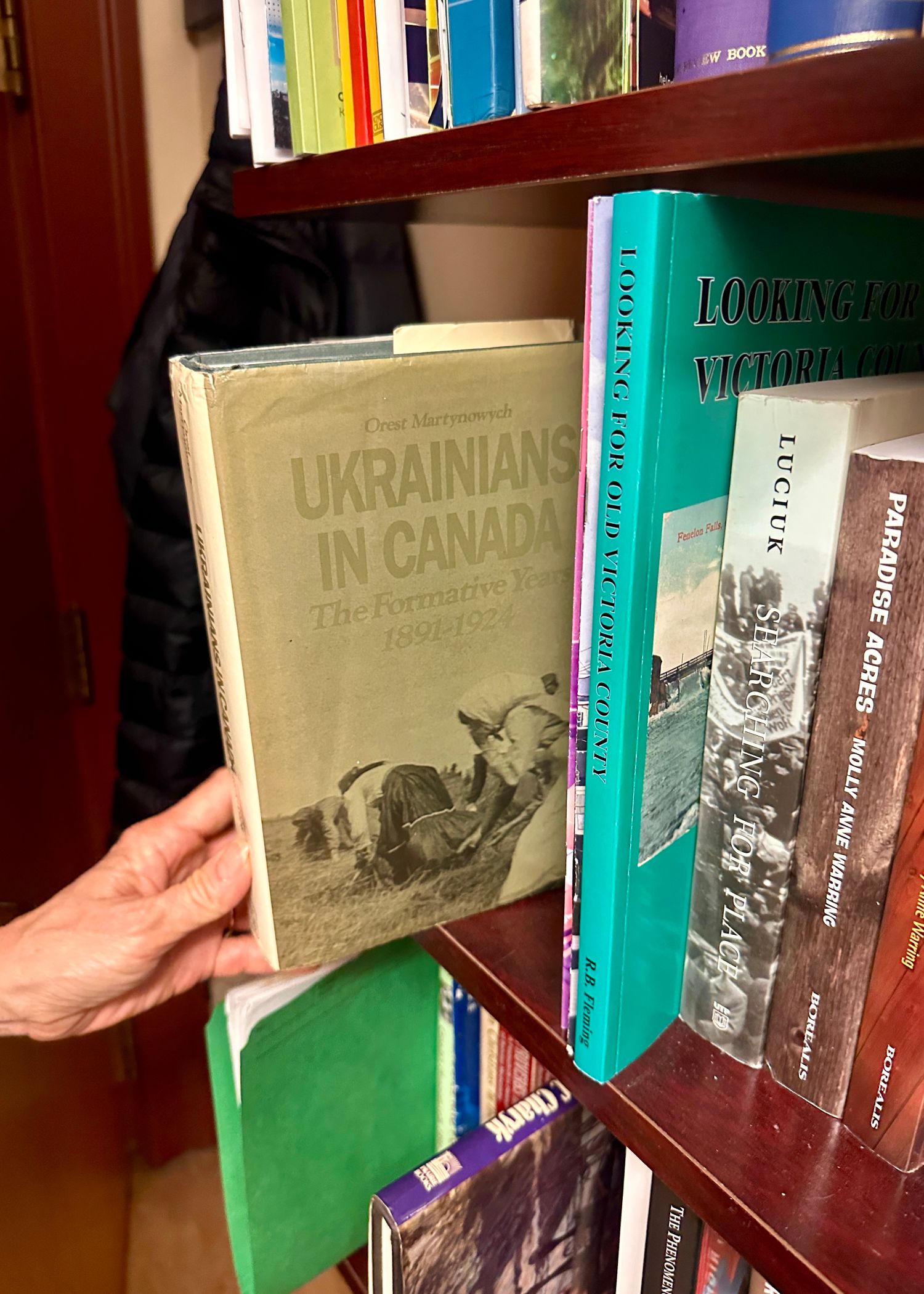
6. Ukrainians in Canada — Documenting the making of a community
Orest T. Martynowych's Ukrainians in Canada: The Formative Years, 1891–1924, published by CIUS Press in 1991, is a foundational study of early Ukrainian immigration and community-building in Canada. Going beyond a traditional settlement narrative, it places Ukrainian Canadian experiences within the larger history of Canadian society, immigration, religion and identity.
7. A Crimean Tatar fes — Expanding the boundaries of Ukrainian Studies
This richly embroidered Crimean Tatar women's traditional headdress, known as a fes, offers a tangible connection to the cultural heritage of Crimea's Indigenous people. It also provides an opportunity to highlight CIUS's growing engagement with Crimean Tatar studies, Indigenous knowledge and international scholarly collaboration, bringing historically marginalized voices and perspectives into broader conversations about Ukraine and the world.

8. The first Ukrainian–Chinese dictionary (1990) — Building bridges across continents
Published in Beijing in 1990 and compiled by the Institute of Lexicography at Heilongjiang University, the first Ukrainian–Chinese Dictionary marked an important milestone in the development of Ukrainian studies in China. Supported by CIUS, this pioneering publication illustrates the institute's role in fostering international scholarly connections and expanding access to the Ukrainian language and culture far beyond North America.

Signed in March 2026, the agreement between CIUS and the State Sectoral Archive of the Security Service of Ukraine represents a major step in the Adalet (meaning "justice" in Crimean Tatar) project. Combining historical research, international collaboration and AI-assisted archival analysis, the initiative seeks to uncover the mechanisms of Soviet repression against the Indigenous peoples of Crimea and restore access to histories long obscured by colonial violence.
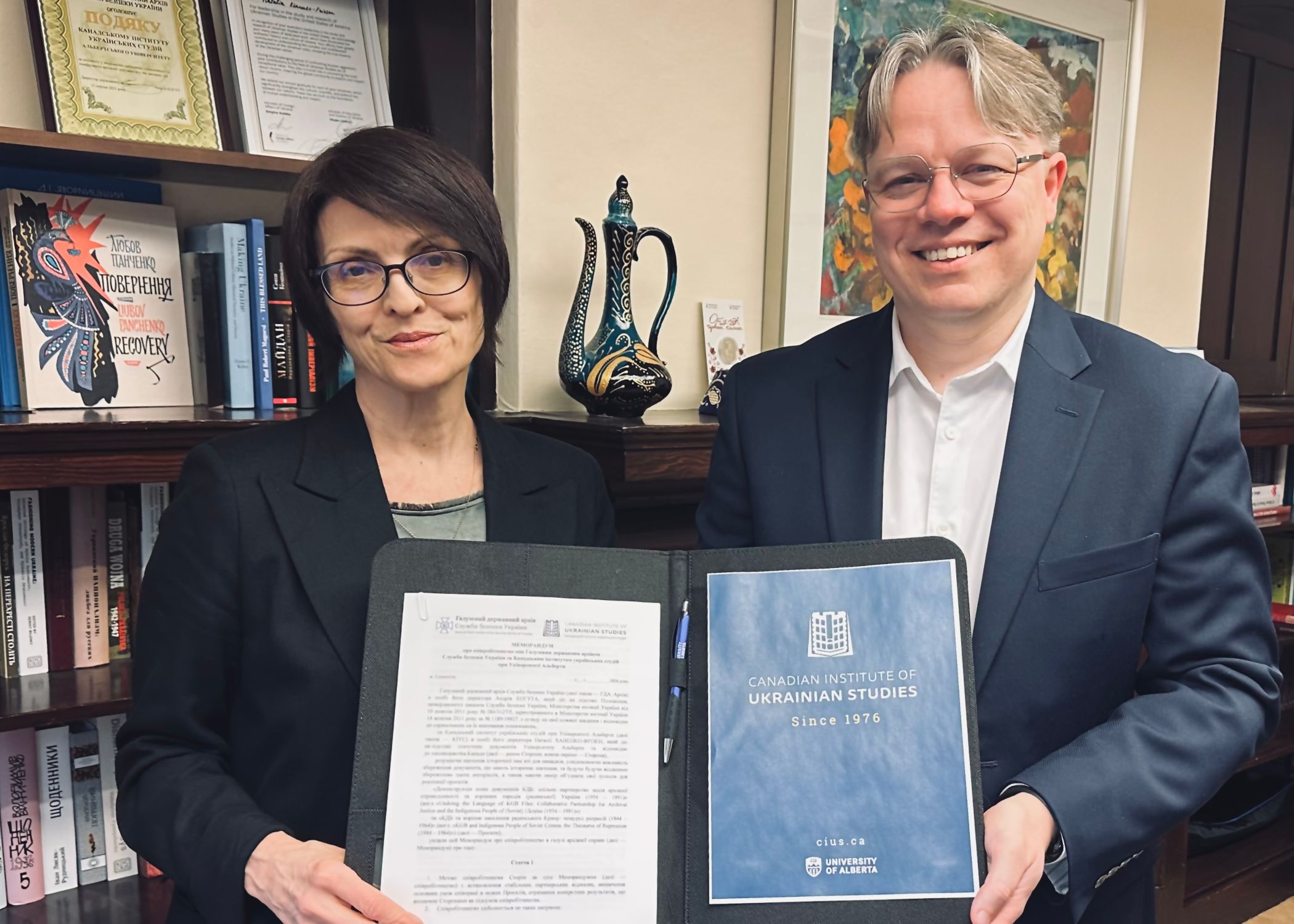
Natalia Khanenko-Friesen, CIUS director, and Andriy Kohut, director of the Sectoral State Archive of the Security Service of Ukraine, sign a Memorandum of Understanding between CIUS and the Sectoral State Archive of the Security Service of Ukraine.
10. Alberta's Bill 37 — When historical memory becomes public recognition
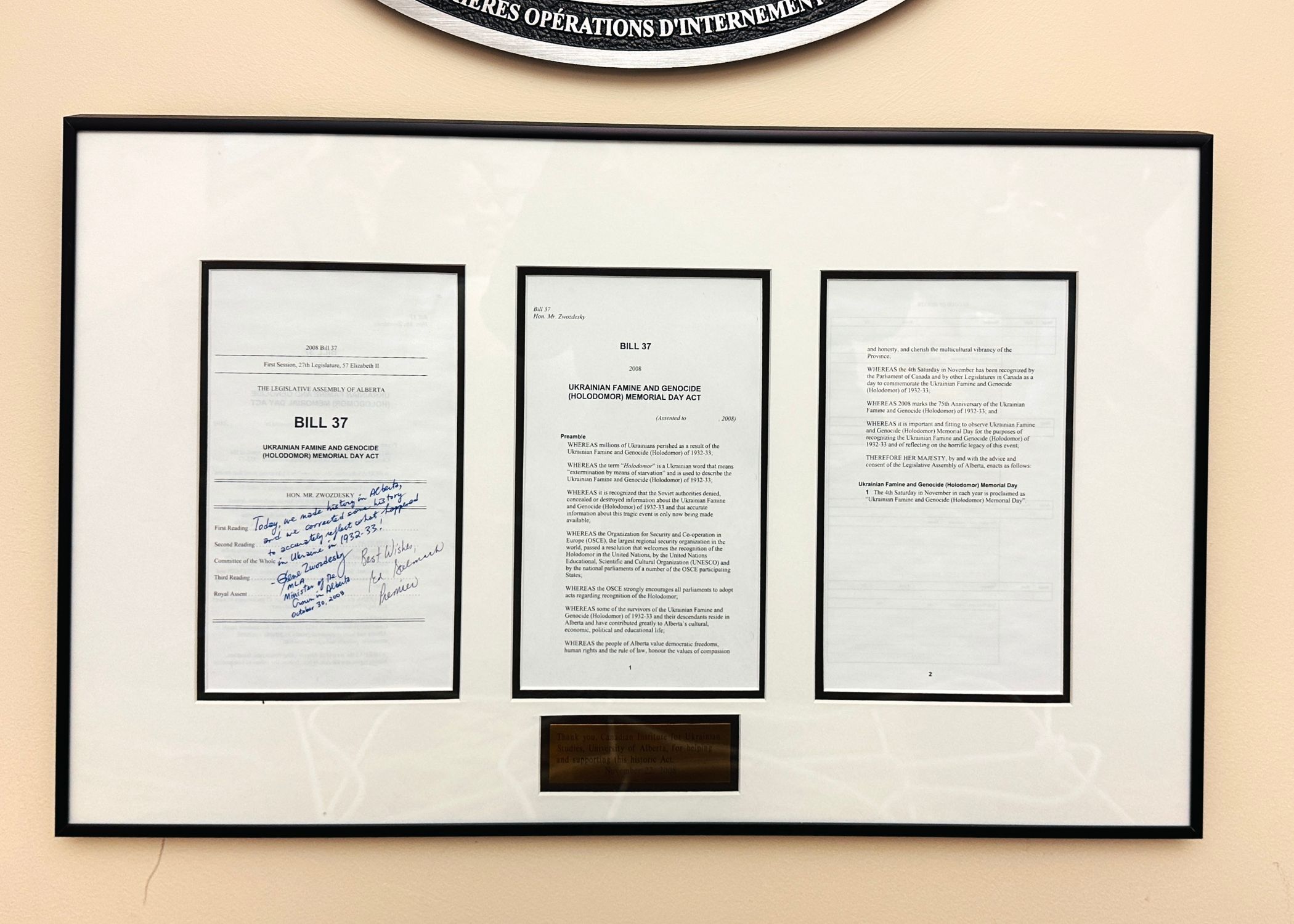
Alberta's 2008 Ukrainian Famine and Genocide (Holodomor) Memorial Day Act, introduced by MLA Gene Zwozdesky, established the fourth Saturday of November as an annual day of Holodomor remembrance. A copy of this historic legislation could illustrate the broader impact of Ukrainian historical scholarship, public education and community advocacy on how the province commemorates the victims of the Holodomor.
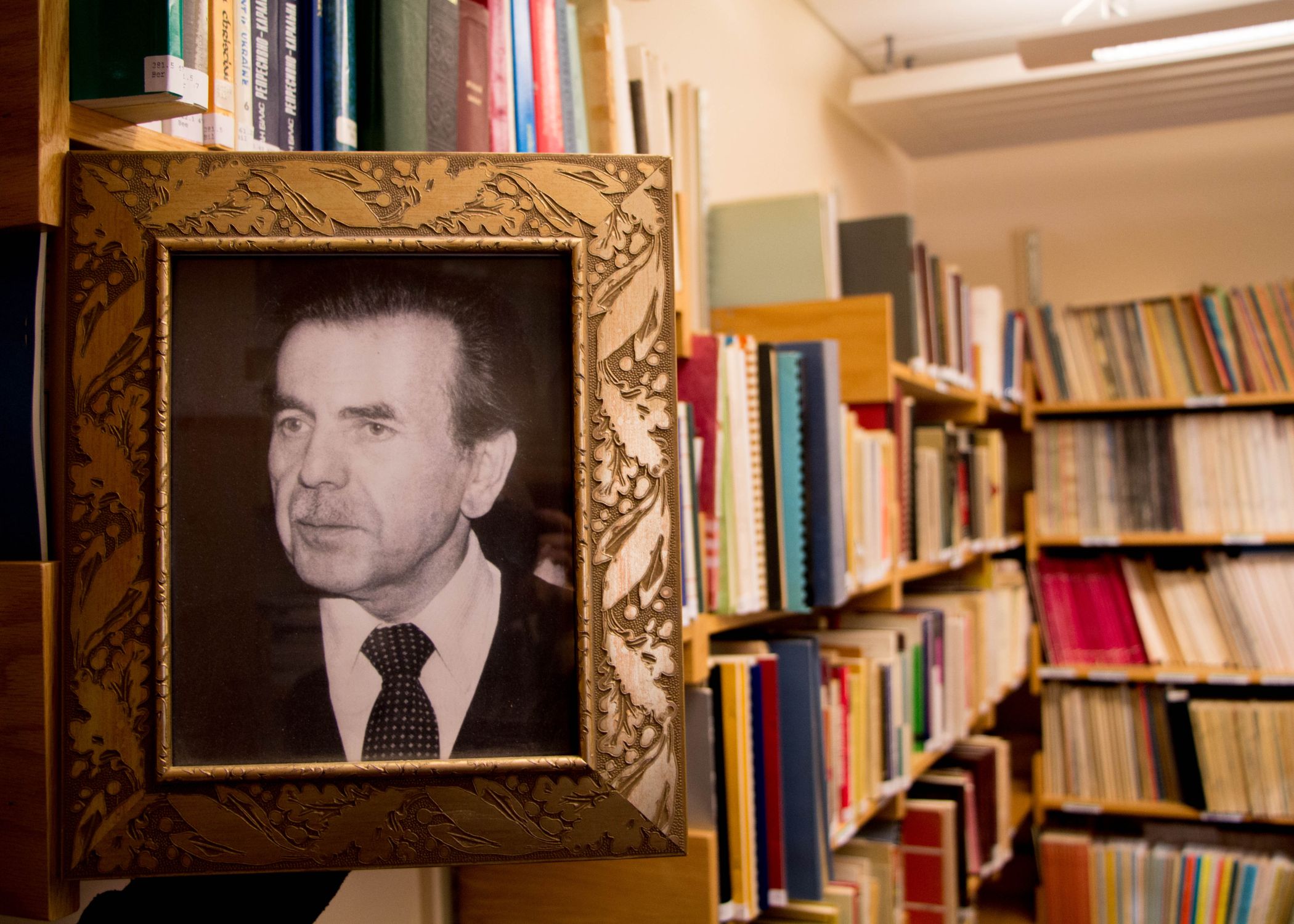
11. The Bohdan Bociurkiw Memorial Library — Preserving a scholar's legacy
Officially opened in 2001, the Bohdan Bociurkiw Memorial Library preserves the personal library and archives of a renowned scholar of Soviet religious policy, human rights and Ukrainian church history. Bequeathed to CIUS by professor Dr. Bohdan Bociurkiw, the collection represents both an invaluable resource for researchers and a lasting commitment to preserving scholarly knowledge for future generations.
Created to mark CIUS's 50th anniversary in 2026, Shaping Knowledge and Community brings together archival documents, publications, photographs and milestones that trace the institute's evolution from a community-supported vision in 1976 into an internationally recognized centre for Ukrainian studies. The exhibition captures five decades of scholarship, publishing, collaboration and public engagement, offering both a reflection on CIUS's legacy and a starting point for imagining its future.
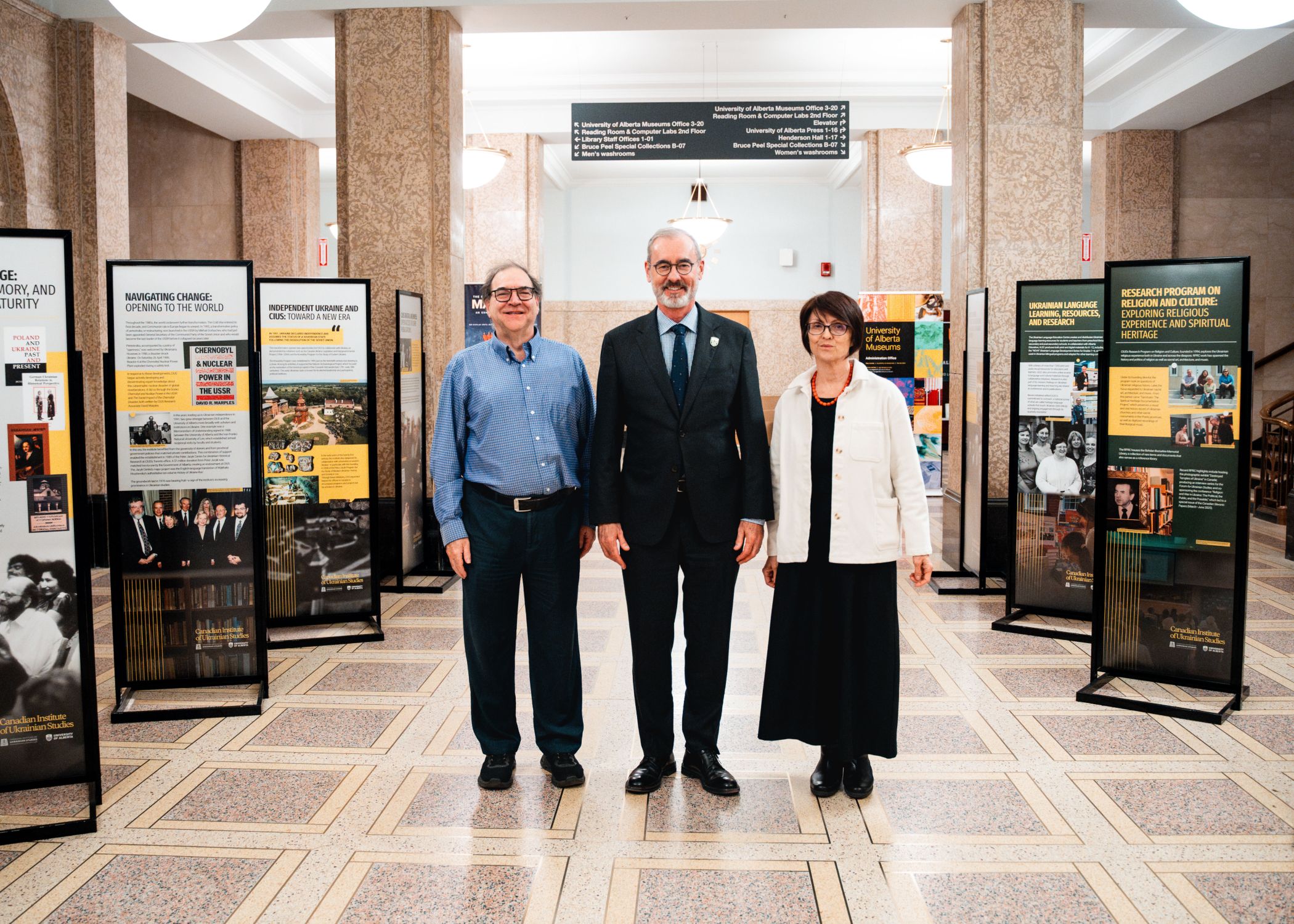
Left to right: Serge Cipko, CIUS assistant director (Research); Bill Flanagan, president and vice-chancellor; and Natalia Khanenko-Friesen, CIUS director, at the CIUS 50th Anniversary Exhibit, Rutherford Library South Foyer.
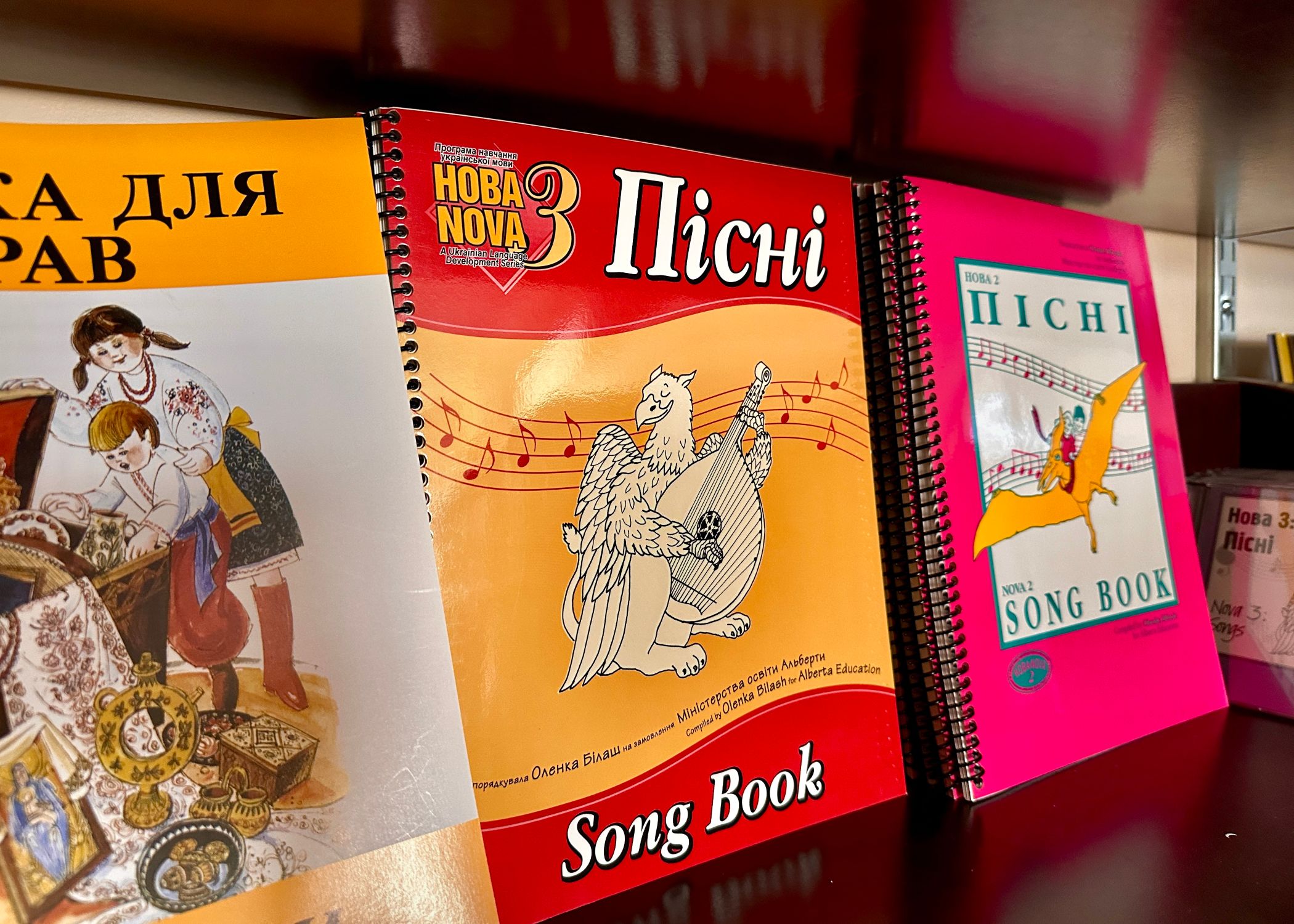
13. Nova: Teaching Ukrainian to the next generation
Developed by CIUS's Ukrainian Language Education Centre (ULEC), Nova: A Ukrainian Language Development Series is one of the Institute's most ambitious educational publishing projects. Initiated in 1983 by educator Dr. Olenka Bilash in collaboration with John Sokolowski, Nova grew into a comprehensive six-level program designed to teach Ukrainian as a second language to elementary school children. Combining illustrated readers, dialogues, songs, games and teaching resources, the series brought research-based language instruction into Ukrainian bilingual classrooms. More than a collection of textbooks, Nova represents CIUS's longstanding commitment to preserving the Ukrainian language and passing it on to new generations in Canada.
14. In Many Voices: Fifty years of CIUS, told by those who shaped it
Published to mark the Canadian Institute of Ukrainian Studies' 50th anniversary, In Many Voices: An Oral History of the Canadian Institute of Ukrainian Studies brings together firsthand accounts from the scholars, directors and collaborators who helped shape the Institute since its founding in 1976. Compiled by Drs. Natalia Khanenko-Friesen and Jars Balan, and Mariia Burtseva, the volume traces five decades of scholarship, community engagement and international collaboration. From Holodomor research and Ukrainian-Canadian history to language education and contemporary Ukraine, these personal stories reveal the people and ideas behind CIUS's evolution into an internationally recognized centre of Ukrainian studies. More than an anniversary publication, the book preserves the living memory of an institution and the community that built it.

15. The CIUS 50th anniversary symposium poster — Where Ukrainian art meets scholarship
Created by acclaimed Ukrainian illustrator Serhiy Maidukov, whose work has appeared in The New Yorker, The New York Times and other major international publications, the poster for CIUS's 50th Anniversary International Symposium, Recentring the Humanities: Ukraine and the World, brings contemporary Ukrainian visual art into dialogue with academic thought. Commissioned for this milestone celebration, the artwork reflects CIUS's commitment to connecting Ukrainian scholarship, culture and creative voices with global audiences.
