
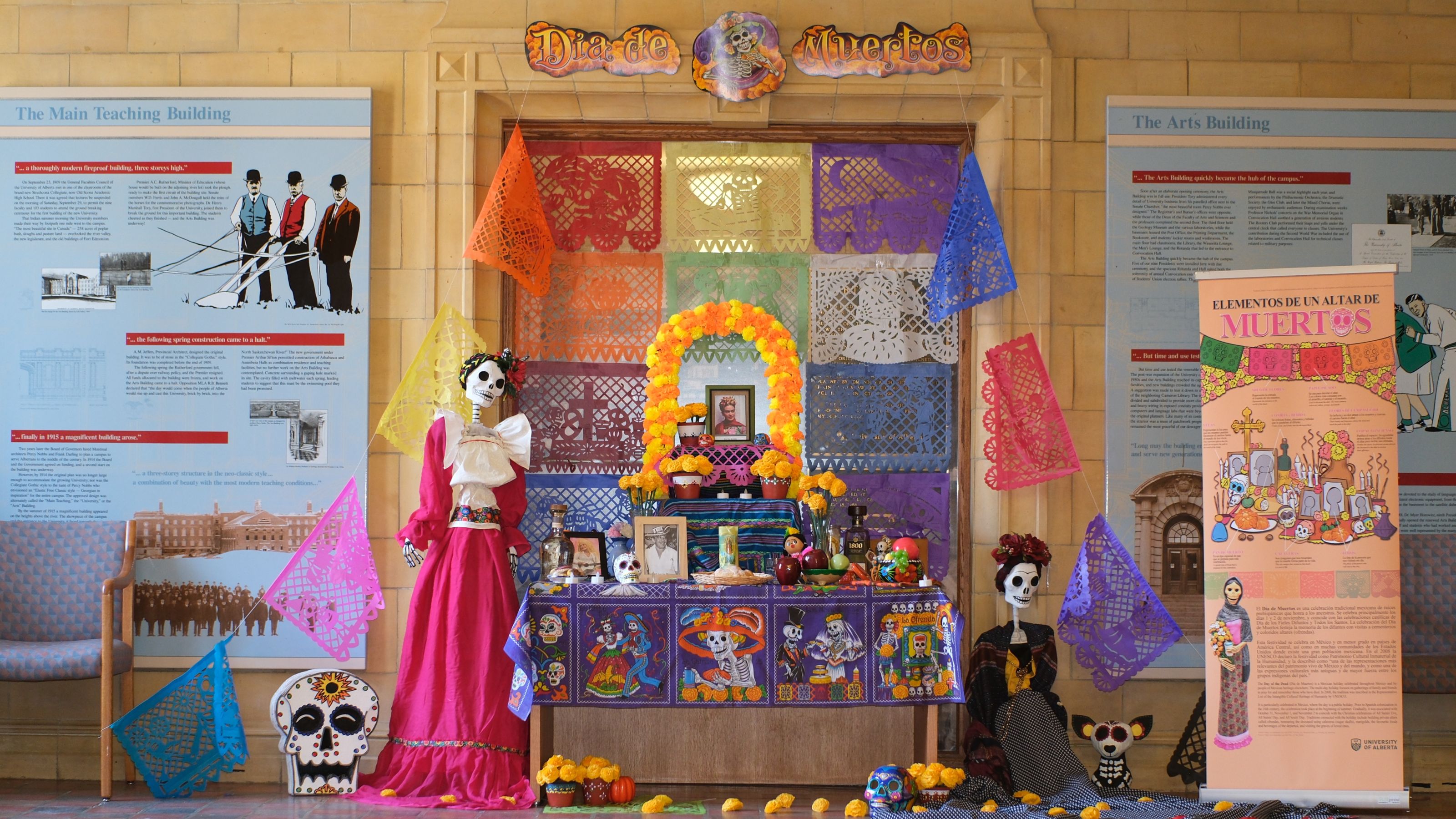
Every year as the last of the leaves fall and winter beckons, a vibrant tapestry of colour, handcrafted paper cutouts and skeletal figures transforms a corner of the University of Alberta’s Arts and Convocation Hall foyer.
Organized by longtime Department of Modern Languages and Cultural Studies Spanish instructors Delma Gil Wilson and Sarah DeLano, the annual Day of the Dead (Día de Muertos) altar (ofrenda) serves as both an authentic cultural tradition and an inviting educational display for the wider campus community.
The altar follows time-honoured Mexican traditions and almost every element on display is handcrafted or sourced directly from Mexico, says Delma. From delicate papel picado (tissue paper cutouts) sent by her family in Mexico to hand-sculpted paper-mâché La Catrina figures (the iconic skeleton lady most associated with Día de Muertos), created by Delma — the display represents weeks of dedicated effort.
"It’s a day not only to celebrate, but a day to remember the people we love who have passed away,” she says. “It’s not a sad celebration; it’s actually quite joyful because you feel like they come back to be with you.”
In Mexico, she adds, the celebration is “insane,” with a huge, colourful parade in Mexico City and people everywhere dressed up in elaborate La Catrina costumes. The parade owes its origins to an unlikely source — James Bond. Originally created for the 2015 film Spectre, the fictional parade became a real-life annual tradition around 2016.
There are also massive neighbourhood altars, although each home would likely have smaller, more personalized displays.
“It's the one day in the entire year where they [deceased loved ones] can get together again, so it’s super important,” says Delma. “It’s personal, but it’s also communal.”
The altar goes up on Nov. 2 — the official Day of the Dead — offering the U of A community a meaningful moment to stop, reflect and celebrate memory through art and shared heritage, where all are welcome.
While Día de Muertos coincides closely with Halloween on the calendar, Delma and Sarah emphasize that the two holidays are entirely distinct. The altar acts as an educational exercise, complete with informational posters explaining the symbolism behind each traditional item:
- Bright orange marigolds (Cempasúchil): Their vivid colour and scent guide returning spirits back to Earth
- Pan de Muerto and favourite foods: Offerings of traditional bread, favourite meals and drinks welcomed by deceased loved ones
- Water and candles: Elements to quench the spirits' thirst after their long journey and light their path
- Favourite items: The things that the deceased people used to love when they were alive
- Photographs: The focal point of the altar, honouring those being remembered
Rather than letting cultural history sit quietly in textbooks, the MLCS Día de Muertos altar brings it into living — or strictly speaking, afterliving — colour.
"The emotion behind the altar changes depending on the year and what’s going on in the world,” explains Sarah. “It’s been an interesting outlet for the department to think about those in the larger world who have passed and the social issues of our time.”
The Día de Muertos altar, located in the foyer of Arts and Convocation Hall, will be on display until Saturday, Nov. 14, 2026.