
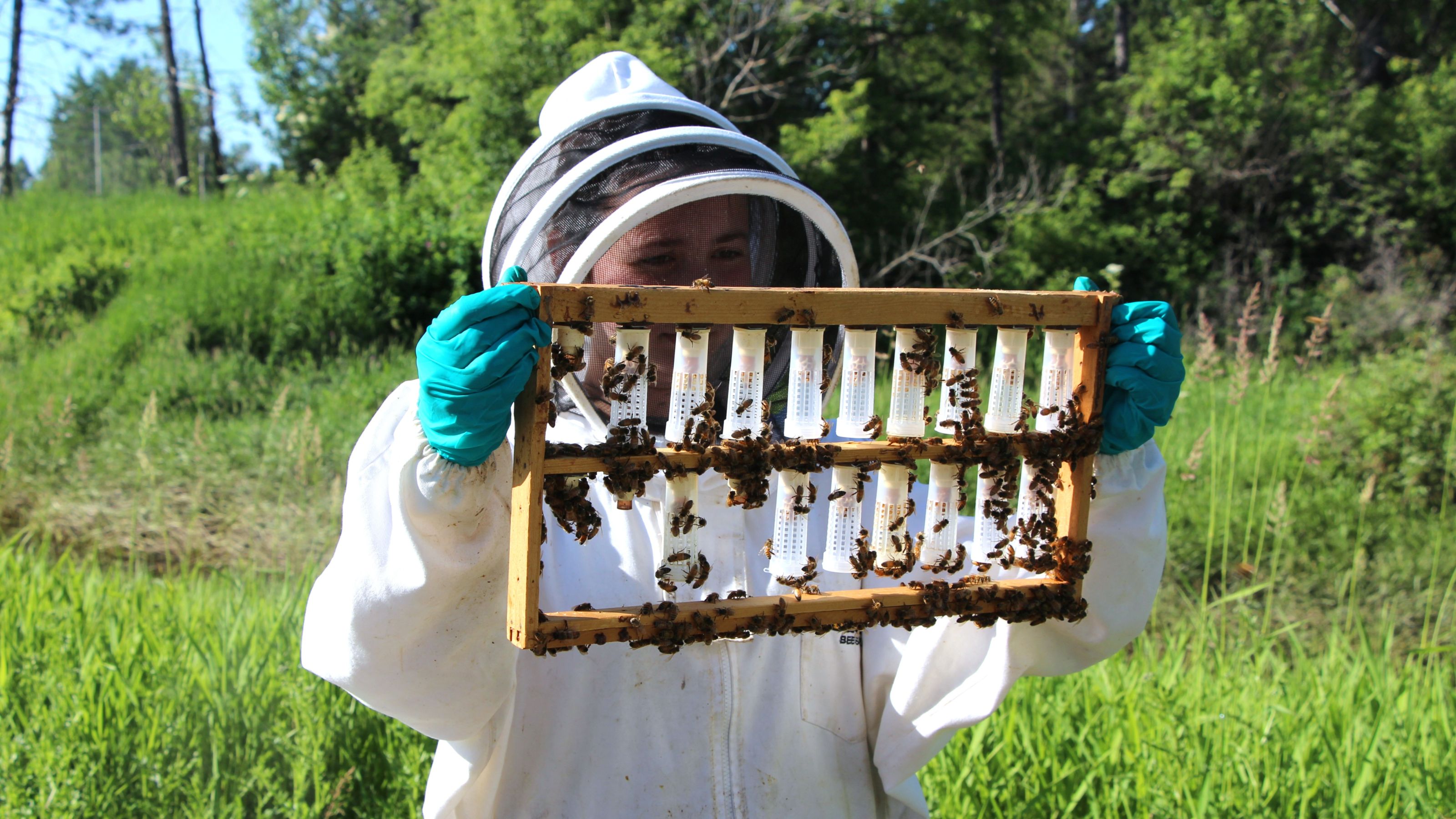
What happens when you tear down the traditional walls of laboratory science? Built on the belief that environmental research belongs to everyone, the I-STEAM Pathways Program is opening doors for First Nations, Métis and Inuit students across all colleges and faculties — embedding Indigenous knowledge and diverse perspectives directly into undergraduate research wherever possible.
Founded in 2020 by an interdisciplinary team including Dr. Makere Stewart-Harawira (Education), Dr. Ania Ulrich (Engineering), Dr. Cameron Jefferies (Law) and Dr. Greg Goss (Science), joined later by Dr. Chelsea Benally (Engineering) and Dr. Wesley Chalifoux (Science) — with the support of Paul First Nation Industry Relations Corporation (IRC) liaison Raymond Cardinal and the blessing of the late Elder Lloyd Saulteaux — I-STEAM Pathways has rapidly evolved into a high-impact, educational opportunity for Indigenous student leadership.
The program, which pairs undergraduate students with faculty mentors across the natural, physical and social sciences, combines hands-on environmental research projects with interdisciplinary seminars.
As Makere explains, I-STEAM’s transformative power relies entirely on the program’s distinct interdisciplinary framework. Rather than restricting environmental research to traditional laboratory sciences, it welcomes Indigenous undergraduate students from all disciplines. This year’s cohort alone drew participants from across the university, supporting projects that ranged from Indigenous fire stewardship and river breakup dynamics in the Smoky River Basin to nurturing land-based two spirit teachings.
A student from any background can engage in environmental inquiry because the program approaches research through an Indigenous understanding of interconnectedness — one that recognizes that the impact of any single field is inseparable from the community and environment around it.
“Sometimes people will say to me, 'What has this or that got to do with the environment?,’ and my answer is, ‘Indigenous Peoples understand how everything is connected,’” says Makere, a professor in the Faculty of Education and a member of the Waitaha ki Te Waipounamu iwi (tribe) from Aotearoa, New Zealand. “We know how the health of a single cell — or being — depends on the health of its environment and the inter-relationships between all of those aspects. An elder explained it to me as everything being in ‘right relations.’”
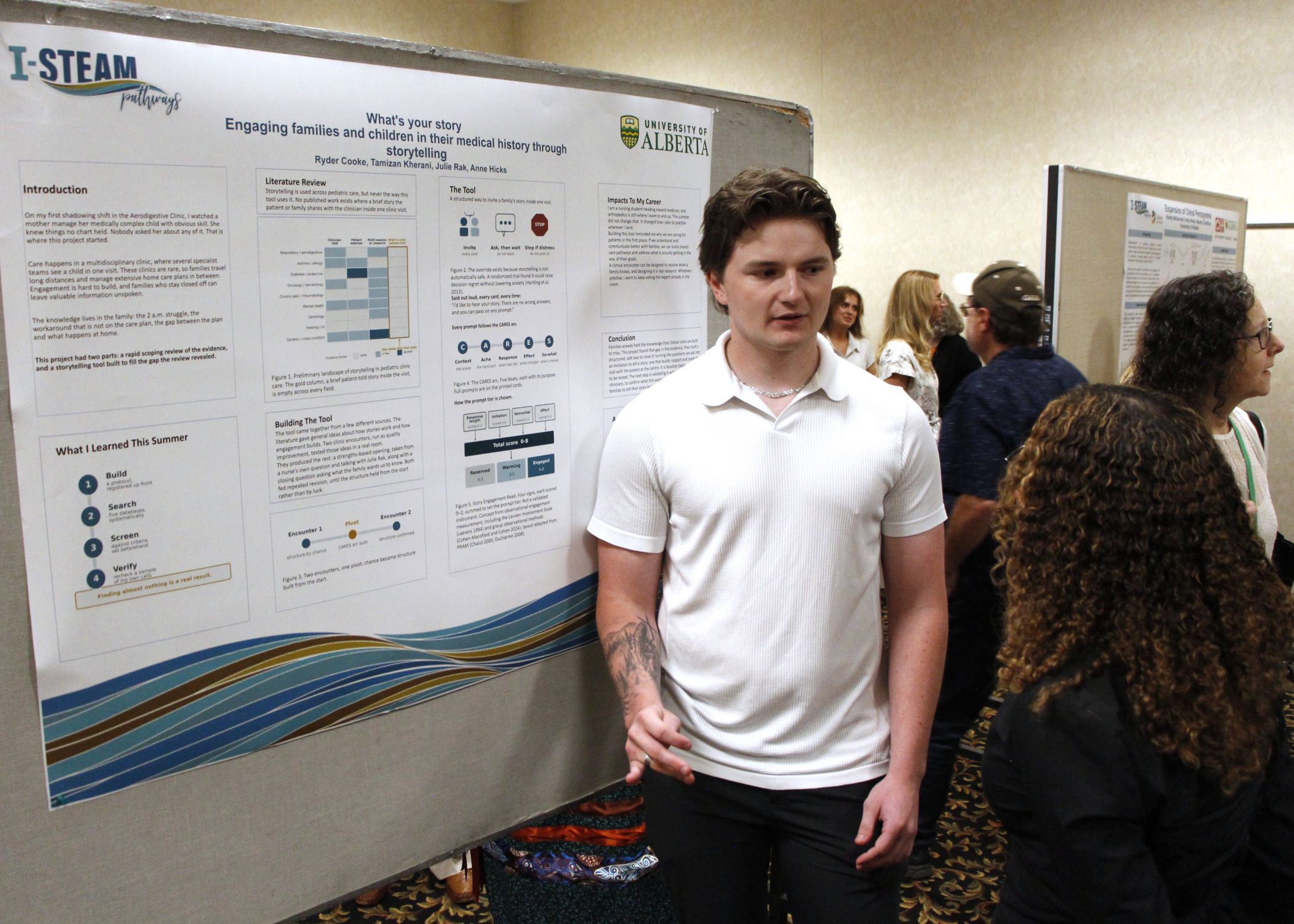
For his project, third-year nursing student Ryder Cooke created a storytelling tool that helps patients share their knowledge, concerns and questions to foster better communication with health-care teams.
“The best part was being able to capture their experiences in a genuine way that so many other people may have overlooked or missed,” says Ryder. “Seeing their appreciation after asking about their specific expertise was a moment I will hold for me for the rest of my health-care career.”
Dr. Julie Rak, HM Tory Chair and professor in the Department of English and Film Studies mentored Ryder as he developed communication tools for his project. “Ryder’s training did not include the work of sharing that can build trust between a medical professional and families of patients,” she says, noting the initial challenge of translating his natural storytelling abilities into a clinical setting. “I was able to help him see how to connect his own story to the stories of others, and he made a fantastic communication tool based on story work as a result."
Denée Reansbury, a fourth-year student in a combined degree program in native studies (BA), majoring in Cree language and secondary education (BEd), minoring in mathematics, worked with the Rupertsland Centre for Métis Research and the Otipemisiwak Métis Government (formerly the Métis Nation of Alberta) on research exploring Métis food sovereignty.
“At its core, my project emphasized the importance of empowering Métis people and communities to define and shape their own food futures,” she says. “The best part about I-STEAM was the opportunity to participate in meaningful research as an undergraduate student, opening doors I never imagined.”
The program has built a strong network of faculty mentors across the university who understand how to support Indigenous students effectively. Each cycle begins with a call for proposals in October. To qualify, proposed projects must centre on environmental themes, hold direct relevance to Indigenous communities and require project supervisors to complete mentorship training. Program leads adjudicate these submissions before selecting viable projects and opening the student application portal in December.
Makere emphasizes that I-STEAM is less about preparing Indigenous students for jobs and more about creating opportunities to pursue graduate studies, conduct meaningful environmental research and learn alongside dedicated faculty mentors. The goal is to develop future leaders, not simply prepare students for industry careers.
For many Indigenous students, this approach demystifies research while expanding their exposure to diverse academic fields. To support this growth, program leaders actively nurture whole-family relationships, whether that means sitting down over coffee to resolve communication hurdles or welcoming Elders and parents who travel hundreds of miles to celebrate their children's achievements at the program’s conclusion.
“I still remember, in that first year, a student sitting by the Athabasca River doing water testing,” says Makere. “That young man's family came — eight of them drove down in a van from Fort McMurray to attend the celebration. And in the following year, a mother, who was in a wheelchair, saying to me, ‘Thank you for making our children's dreams come true’.” It's really important that Indigenous Peoples are there in the front lines, in positions of leadership, influencing policy and decisions. And, in a nutshell, that’s what the program is about.”
The success of I-STEAM and its expansion has required creative persistence, assembling sustainable funding from the university support alongside crucial external partnerships like the National Research Council and sponsorships from aligned industries. Today, demand is overwhelming with an eager generation of Indigenous scholars ready to lead.
For students like Denée, that opportunity has proven to be transformative.
“It goes beyond developing valuable research and professional skills,” she says. “My internship with I-STEAM has strengthened my confidence, expanded my understanding of community-engaged research and provided opportunities that will continue to shape my education, future career and personal growth.”
I-STEAM research project applications now open
Share your expertise and welcome a fully funded Indigenous undergraduate student onto your team to support your research in summer 2027. The I-STEAM Pathways Program team is waiting to hear about your social science or STEM project to facilitate a connection with an Indigenous intern. Supervisor project submissions from U of A faculty and researchers are due by Nov. 20, 2026. Learn more and apply.
I-STEAM student internship applications
Internship applications for the I-STEAM Pathways Program open on Dec. 1 and close on Jan. 15. Watch this space for more information about the 2027 program.