The odds seemed stacked against Bridget Alichie from the start.
Shortly after she arrived at the University of Alberta to begin a doctorate in sociology, her father died back home in Nigeria.
“He was my most favourite person in the world,” she says. “It was so devastating.”
She considered dropping out, or at least deferring her studies for a few months. But the support she received, especially from new friends she met through the Black Graduate Student Association, encouraged her to rally.
“The strength they gave me convinced me to rededicate myself,” she says. “It was so emotionally draining, but people ended up visiting me, checking on me, and it kind of drew me out of my shell.”
Two years later, as she was finally hitting her stride again, her mother died. Then COVID hit. “It was so tough. I felt like I wouldn’t survive. As a person of faith, I would say, ‘The devil keeps fighting — he never stops.’”
She finally received some good news when her husband, Martin Ojonta, still working back in Nigeria, decided to join her in Edmonton. It was a welcome relief, giving her the support she needed to continue, but she still had one more unexpected hurdle to clear.
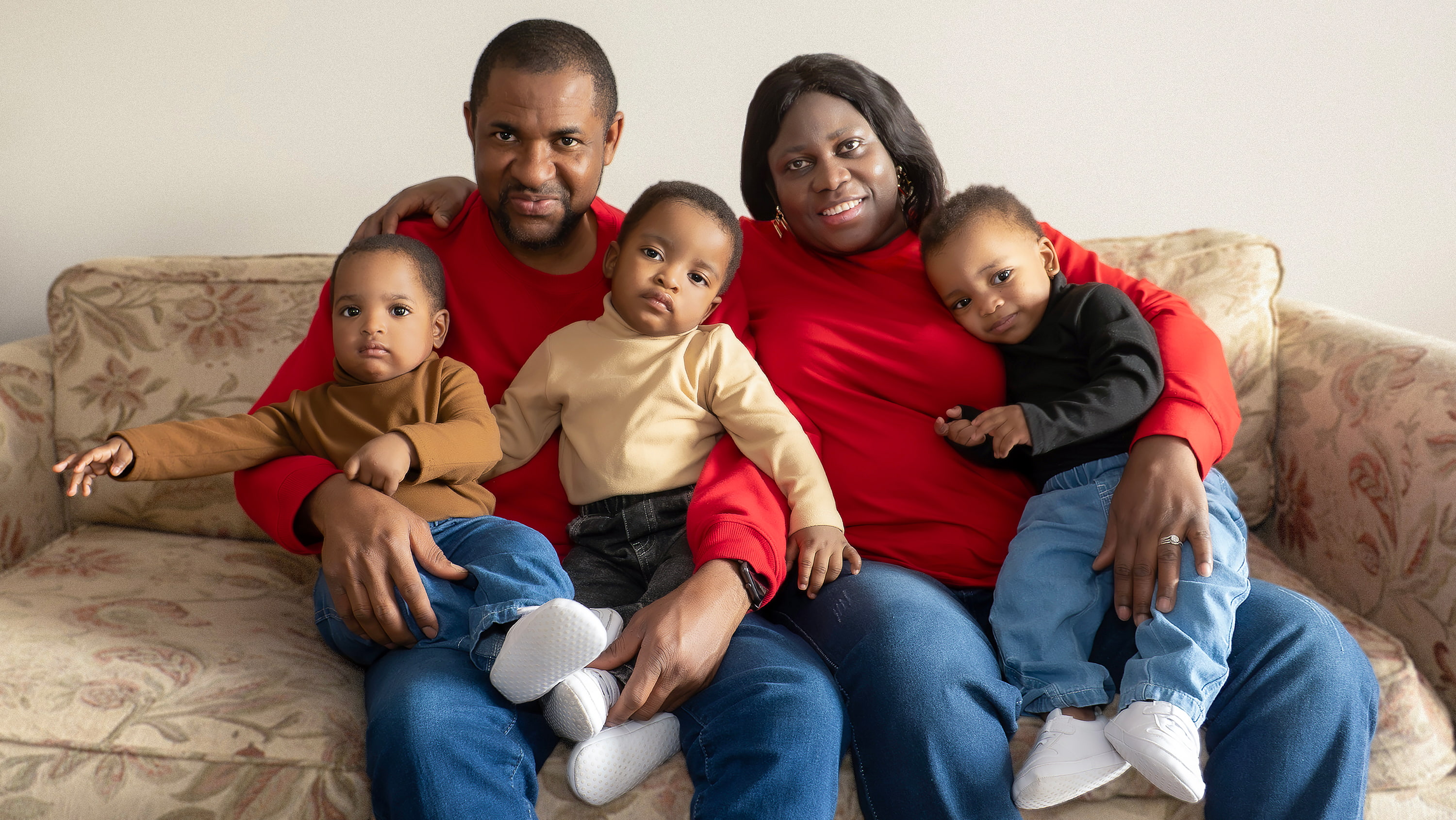
“Near the tail end of my dissertation, I got pregnant. We were prepared for a single baby, but everything unravelled really fast, and we were having triplets.
“It was excitement mixed with serious fear, like, how are we going to do this? But I told myself, ‘You survived everything else. Why not this?”
An inspiring mentor
Having found the perfect supervisor in Temitope Oriola was also a crucial factor in sustaining her motivation. His research on crime, human rights and gender politics in Nigeria aligned with her own chosen project: research on clergy sexual abuse against women in the Nigerian Pentecostal church.
“Temitope was one of the first researchers who did serious work on the Bring Back Our Girls movement,” says Alichie, referring to the kidnapping of 276 Nigerian schoolgirls by Boko Haram in 2014. “His activism and research around gender rights just drew me to him.”
Oriola calls Alichie the “personification of intelligence, resilience and hard work. Her doctoral studies coincided with remarkable personal challenges. Nonetheless, she persevered and excelled.
“Her findings reveal a complicated interplay of unbridled pastoral power, growing awareness about sexual violence in the House of God and the salience of traditional and new media platforms in exposing social problems.”
A passion for helping women and children
Growing up in rural Nigeria, Alichie was mostly insulated from news of the outside world. But she was a voracious reader, devouring any book she could find. As a teenager, she secured an internship with a local agency for women, which helped clients with challenges stemming from various forms of gender oppression.
“I asked myself: why are women going through this? This is a country where everyone should be living in abundance. Why are men aspiring and getting what they want out of society, while women are kept down by all these cultural forces?
“I thought, I really want to do things with my life that help women.”
Alichie graduated with a Bachelor's from Nnamdi Azikiwe University Nigeria, at the top of her class, then put in her mandatory year with the National Youth Service Corps, working at the University of Calabar Teaching Hospital, before returning to her alma mater as an assistant lecturer of sociology for three years. She left Nigeria on a Commonwealth Scholarship at the University of London, earning a master’s degree in Anthropology.
“That’s where I started learning the nitty-gritty of grant writing, research and teaching — everything necessary to prepare me for academic life.”
Studying the abuses in the Pentecostal Church was a natural progression, she says. Raised in the church, she briefly flirted with agnosticism in early adulthood before eventually converting to Catholicism, where she found her husband.
But Alichie couldn’t shake the nagging suspicion that something was deeply flawed about some Pentecostal church practices, she says.
“I needed to bring all those hidden issues to the front burner, because most victims are still very scared to talk. I needed to look for a way to gain access and start telling their stories.”
She has now landed a prestigious Provost’s Postdoctoral Fellowship at the University of Toronto, where she will continue investigating Pentecostal clergy — this time examining how they use accusations of witchcraft to rationalize the abuse of children.
“I used to hear stories about witchcraft accusations when I was growing up in Nigeria … but it is still very much in existence in this part of the world.”
“The children might be those who lost their mothers at birth, have deformities, are slow learners, or have dyslexia or other mental health issues, says Alichie. “Instead of getting them medically diagnosed, they claim there's no other explanation except that the children are witches. And the parents buy it immediately. Religious leaders are like gods in Nigeria.”
Accused children are locked up, hunted, beaten to death or “thrown into the bush,” says Alichie.
“We just don’t have much research that covers this,” she adds.
As part of her post-doc, she plans to interview survivors of the Pentecostal Church in Nigeria as soon as she gets the chance. Her aim is to collect stories missing in media and existing research, and learn how people formerly branded as witches can recover and reintegrate into their communities.
As for her triplets, they’ve turned out to be more of a pure blessing than she would have imagined, says Alichie.
“The PhD program was a roller coaster of emotions, but the triplets are doing awesomely well, beyond our expectations, and so good-natured.”
“I owe my academic success story partly to them, because they actually let me work — and start a post-doc.”