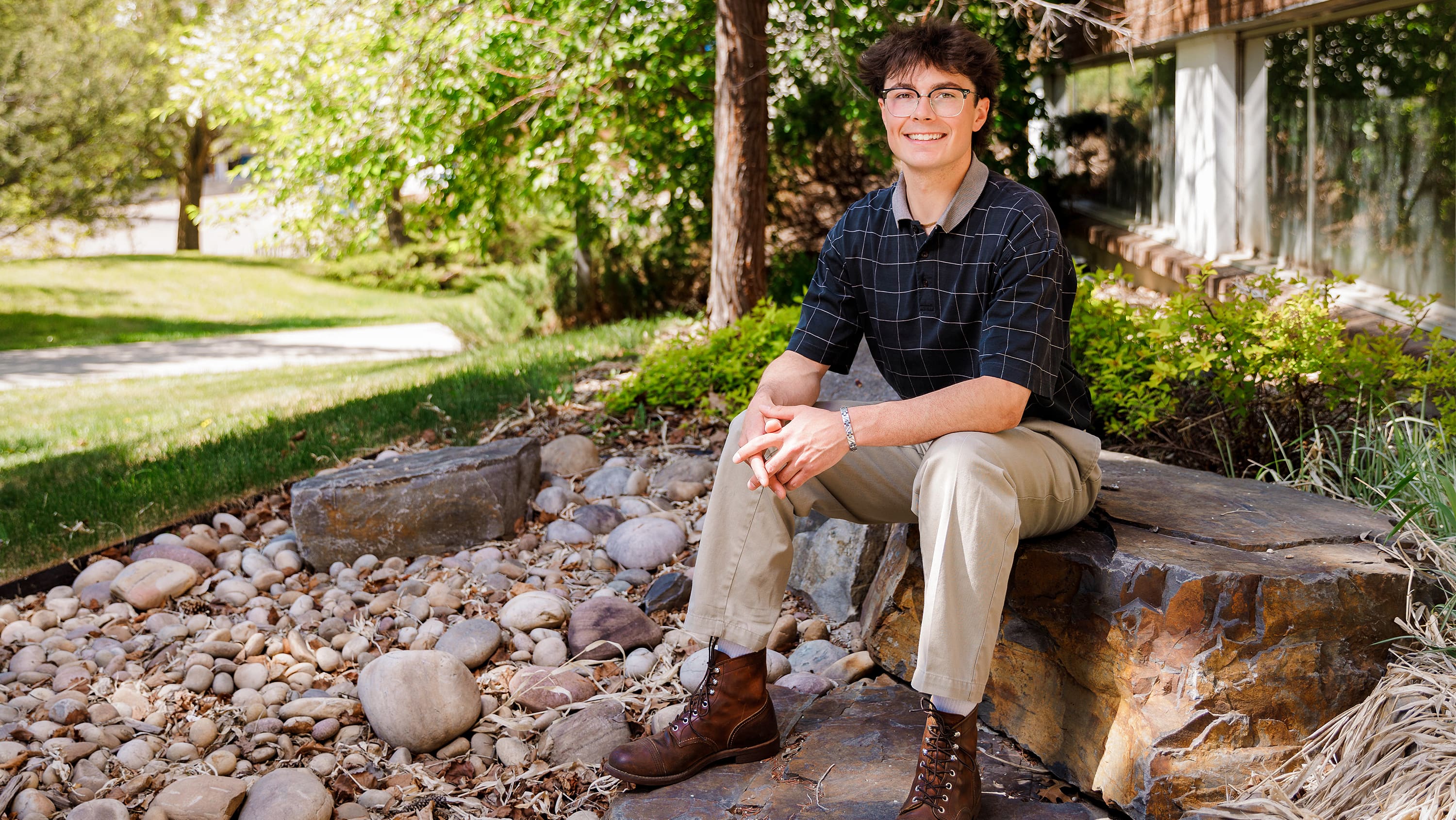
By combining his job experience with his education and passion for nature, Chance Park wants to help improve best practices in the oil and gas industry.
June 04, 2026 By Bev Betkowski
By combining his job experience with his education and passion for nature, conservation biology grad Chance Park hopes to contribute to improving best practices in the oil and gas industry. (Photo: Alex Pugliese)
Growing up in Red Deer, a city steeped in Alberta’s oil and gas industry, it felt natural for Chance Park to take a job with an oilfield equipment company after graduating from high school. Unsure of what his ultimate career plans were, the work filled his time and his pockets while he figured out what to do next.
Over his three years on the job, advancing from shop hand to quality control technician, and then to working as a safety rep, he developed an understanding of the industry’s importance to the province, and beyond.
“It’s the backbone of Alberta and it has a lot of applicability in everything we do day to day, it’s where a big portion of our country’s money comes from, so it’s not going away.”
At the same time, Park also knew he wanted to honour his personal passion — a lifelong love of nature. A member of the K’atl’odeeche First Nation in the Northwest Territories, he says he’s always felt a deep connection to the outdoors, catching frogs, finding snakes, fishing and exploring.
“I love nature for its complexity, but also calmness; it feels like that’s exactly where you’re supposed to be.”
(Photo: Alex Pugliese )
“
“I think the responsibility of having the cleanest, most efficient way of operating makes sense, and I think that’s a big part of where conservation in the oilfield is going. I want to contribute to that.
“I think the responsibility of having the cleanest, most efficient way of operating makes sense, and I think that’s a big part of where conservation in the oilfield is going. I want to contribute to that.”
Getting to know the industry through his time spent on the ground, Park, who now plans to study for a master's degree in conservation at the U of A, believes he can eventually use his valuable experience to help improve best practices, particularly in day-to-day work.
Using what he’s learned, Park says he wants to focus on remediation of chemical spills, an important issue for an industry heavily reliant on solvents for its production processes.
Through his time working with people in the field, he feels he can connect with them more effectively in helping them take proactive measures in their everyday tasks.
“The biggest thing we learn in our degree program is mitigation, and prevention is the first step. I know how they think, and being able to know your clientele, what they’re doing and how they’re doing it is the best way to practise prevention.”
Opening a window on the natural world
Along with being able to put his workaday expertise into action, Park’s degree has also widened his window into the natural world he loves.
“Through the courses I took, I learned what the diversity of nature really is, all about Alberta’s plants, birds, mammals and insects. The program helped me see nature in an absolutely beautiful way, and it makes you want to conserve it.”
That passion was also fed through some of his instructors, including René Belland, Park says.
“He has that fire in his belly for conservation, and I like how much hope he has for things to be better. He really loves the work he’s doing, and that’s what I feel too.”
“He’s supported me academically and inspired me through his dedication to conservation, and I’m hoping to work with him in the future, after graduation.”
Later on in his career, Park says he may follow in the footsteps of another mentor he’s had since childhood, Steve Irwin, the famous Australian conservationist who raised awareness about wildlife.
“I would love to do advocacy work like that, doing safety workshops around the environment for the oil industry.”
Helping to address such issues around one of Canada’s biggest industries is “an honour,” he adds.
“What excites me is, who doesn’t want to make change? If you’re living in this world, it’s pretty hard to not want change in some way for the better.”