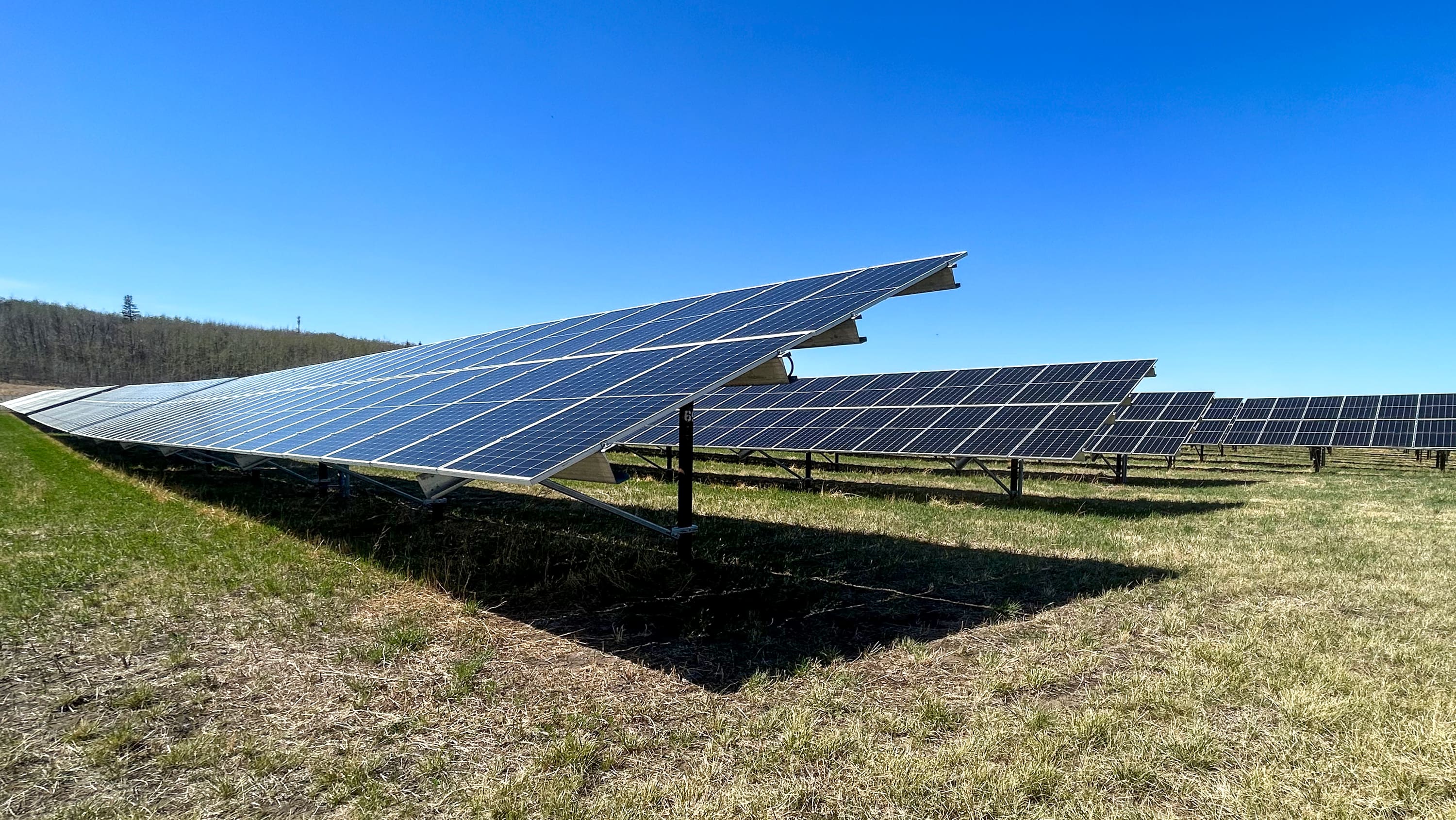
Using solar energy is good for the environment, but look down, and the grass isn’t always greener.
While solar panel farms can generate massive amounts of renewable energy, when they’re built in natural areas, they change the growing conditions underneath, making it easy for native grasses to be squeezed out by invasive weeds and non-native plants. On top of that, fast-growing turf or other non-native grasses are often used as a less costly, more convenient replacement in reclamation efforts.
Now, a new University of Alberta study is shedding light on how to give that native vegetation a better foothold by exploring how those plants and grasses respond to the microclimates created by solar panels.
It’s environmentally important to identify native grasses that can thrive under the panels because they offer many more ecological benefits than non-native species, says Fengxue Zheng, who led the study to earn a master of science in rangeland and wildlife resources in the Faculty of Agricultural, Life & Environmental Sciences.
“Native grasslands are one of the rarest ecosystems remaining in the aspen parkland, so every opportunity for restoration is valuable,” says Zheng. “They’re the most resilient and beneficial choice when replanting vegetation after solar farms are constructed, as they provide improved soil stability, soil carbon storage, water infiltration and refuge for pollinators. And they’re also low-maintenance once they’re established.”
One of the few studies to explore how solar panels affect seeded grass establishment in Canada’s cooler aspen parkland region, the work was conducted on old cropland on the kīsikāw pīsim solar farm in the North Saskatchewan River valley in Edmonton. Former fields are often used as locations for solar panel farms.
Studying the survival of seven native seeded grass species over two years, the researchers examined how solar panels altered shaded areas directly underneath, partially shaded areas right along the panel edges and sunny areas in the open spaces between the rows of panels.
They measured factors like soil temperature, moisture and light, then analyzed how those changes affected plant growth and diversity, ground coverage, the types of plants growing in each area, and how successfully the planted native grasses grew and blocked out invasive weeds. The research also compared dry sites with wet areas, where rainwater had pooled in puddles.
The solar panels had varying effects on vegetation. In the open spaces between panels, plants got nearly 12 times more sunlight, the soil was about 3.2 C warmer, and the soil was 12 per cent drier compared with the shaded spots directly under the panels. The spaces also had more than twice as many plant species growing, compared with the shaded areas under the panels.
As well, wetter areas associated with lower topography, where water accumulated after solar farm construction, grew 68 per cent more vegetation and nearly double the amount of grass compared with dry areas in higher spots.
Different plants also had preferences around the panels. Sunny areas had more planted native grasses but also had more invasive weeds, while some non-native grasses managed to survive everywhere, whether in full sun or deep shade.
Different species of the planted native grasses also preferred growing either under the panels in shade or in the sunny areas between the panel rows.
The results show that solar panel farms, despite their patchwork of growing conditions, can successfully support the re-establishment of native grasses if a strategic approach is used, Zheng notes.
A related study, for example, showed that targeted management, including spraying with selective herbicides and mowing, suppressed invasive weeds, reduced competition and promoted native grass establishment around the solar panels.
Together, the pair of studies show “that successful restoration requires adaptive management rather than a single solution,” Zheng says.
The findings of the latter study can contribute to developing effective native grass seed mixes that include shade and drought tolerance for replanting around solar panels. Developers could also consider altering the design of solar farms by spacing the rows farther apart or mounting the panels higher off the ground, the researchers note.
Developing management strategies that combine ecological restoration with renewable energy projects is vital to preserving plant biodiversity and resilience, and replanting native vegetation under solar panels can be an important part of that, Zheng adds.
“While long-term studies are still needed to understand how restored grassland develops over time, turning former farm fields back to native vegetation — while they also serve as places for solar energy — is an example of sustainability at its best.”
The research was funded by Mitacs, Epcor Water Services, the Alberta Conservation Association and Future Energy Systems.
The study’s co-authors include Dr. Cameron Carlyle and Dr. Carol Frost, who supervised Zheng’s work.