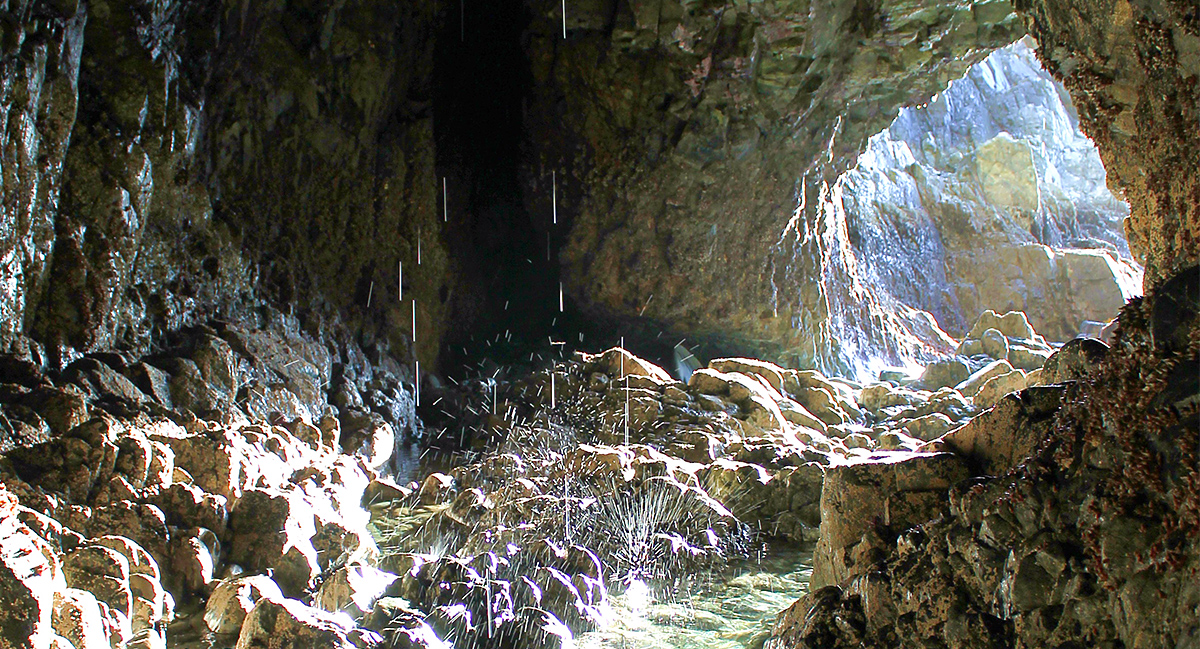
The Bamfield Marine Sciences Centre is relatively untouched yet still accessible, say researchers. It offers students valuable insights into the natural environment and humans' place in it. [Photo Credit: Sarah Pratt]
Our little sedan bounced along the dark logging road for 90 bone-jarring minutes. Richard Palmer, my host for the trip, had warned me about the road. "It's a long, unpleasant drive, but it's the only way to get there," he had told me as we waited for our rental car at the airport in Comox, B.C. If I'd had any idea of just how "unpleasant," I would have taken more Gravol.
A seasoned rally car driver would have hummed with excitement at this road. For someone like me, prone to carsickness, it was a relief when our headlights finally lit up the Bamfield Marine Sciences Centre. After unfurling from the backseat, I instinctively glanced skyward. The long journey was instantly forgotten as I stared at the infinite night sky.
It was a humbling welcome to this West Coast treasure, the perfect backdrop to ponder our significance - or more to the point, insignificance - in the universe. Feeling sluggishly philosophical, I prepared for bed in the rustic cabin that was to be my home for the next eight days. Debating the possible presence of rodents eager to scurry across my feet, I made a frantic leap onto the bed and, thanks to the Gravol and a good dose of David Attenborough's Blue Planet on my iPad, dozed off in no time.
After a mouse-free night, the morning brought my first look at the marine station. It's a curious collection of buildings that invite exploration, with all the ingredients to make a great Nancy Drew novel - perhaps The Mystery at The Moss-Covered Marine Station. Curving gravel paths connect wooden cottages, a clam-shaped central building, a whale lab and more than 3,000 square metres of teaching and research space. Feral cats and racoons slink in their Grinchy way near the dining hall. Sea-worn buildings nestle along the hillside, and wooden steps lead to the docks. The muffled sound of boat motors and the clang of divers cleaning the dock pilings lured me to the waterfront. Kingfishers perched on the seaside railings while ducks quacked softly and ripped up grass for their morning snack.
Bamfield, on the outer west coast of Vancouver Island, is considered by many to be the foremost marine biology station in Canada. Its 75 hectares (three kilometres on the waterfront) allows researchers access to an impressive diversity of environments - rainforest, coastal, marine - and creatures in those spaces. It's also one of the few places left in the world that's relatively untouched but remains accessible.
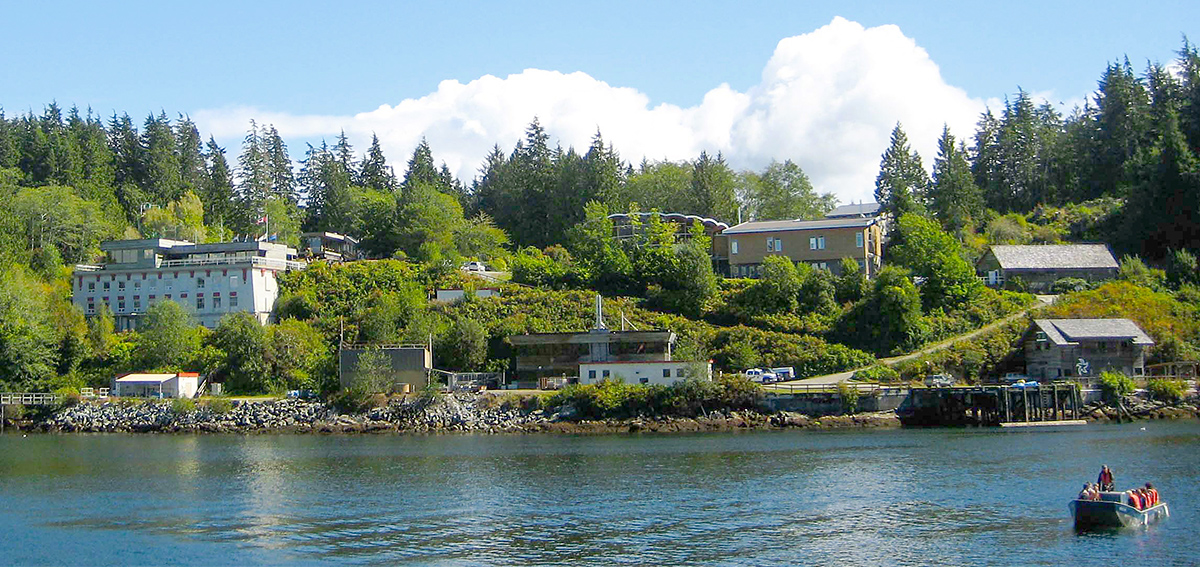
The Bamfield centre, located on Barkley Sound on Vancouver Island's west coast, is considered Canada's foremost marine research and teaching stations. [Photo Credit: Maia Ludwig-Ives]
But what business does a university in land-locked Alberta have with a marine biology station anyway? Well, for one it allows Prairie people first-person access to a more coastal point of view, says Palmer, who, when he's not chauffeuring curious writers, is a professor in UAlberta's Department of Biological Sciences. Fieldwork in a location such as Bamfield can change the way students work, study and understand the natural world. "A facility like this helps our students be more informed citizens and offers them a well-rounded education," he says. "One of the goals from our Bamfield courses is to change the way our students see the world forever."
Bamfield is also a shared campus involing UAlberta, Simon Fraser and the universities of Victoria, British Columbia and Calgary. The five universities co-operate to provide this facility that none of them could provide on their own. The marine station attracts graduate students from around the world - including two who were granted the prestigious $50,000 Vanier Canada Graduate Scholarships. And there are a large number of high-impact papers coming out of Bamfield. UAlberta students, professors and researchers absorb all of that shared brainpower and bring it home with them when they return to the Prairies.
So Bamfield is an incredible place for students and researchers. It also offers public tours twice weekly from July to September, and its outreach programming reaches more than 2,500 students every year - half of them from Alberta. I was lucky enough to have a tour in February.
I have long been fascinated by anything with gills and tentacles. As a kid, I was romanced by Jacques Cousteau and his underwater films. The sight of humpback whales breaking the water's surface still leaves me in awe. After learning about Bamfield in high school, it immediately became the Shangri-La on my bucket list.
Now I was finally here and eager to explore. Below are a few reasons Bamfield should be on your bucket list, too, and some of the things I learned during my stay.
Life on the Edge
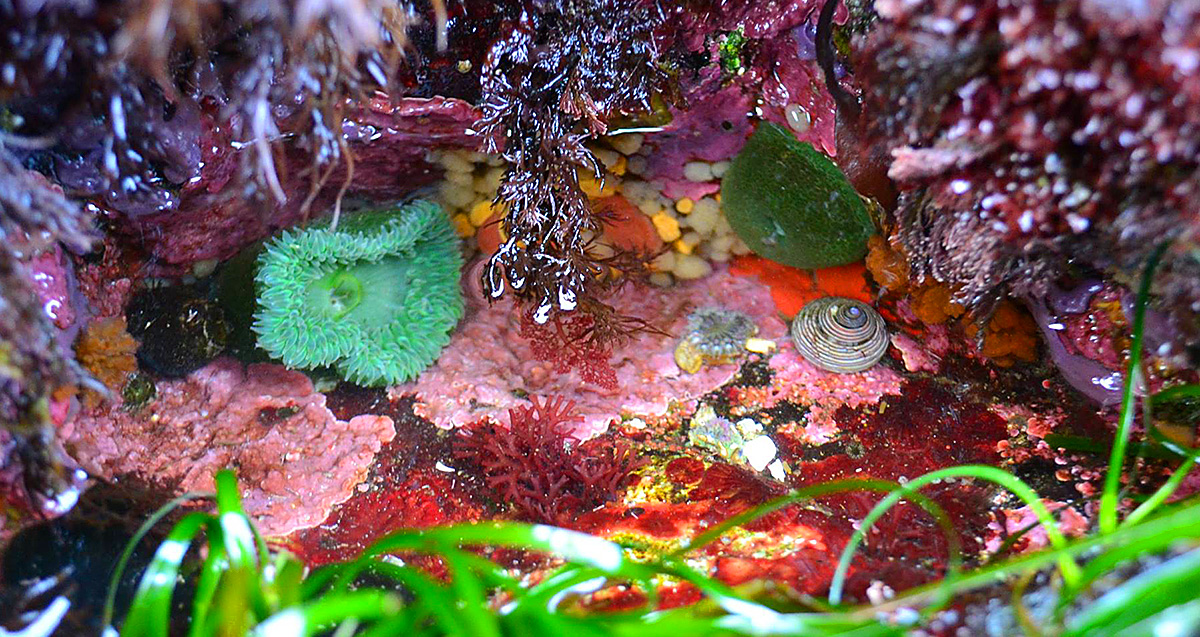
Many creatures call tide pools home. Take your time and look carefully to notice these ecosystems that change on the whim of a wave. [Photo Credit: Bamfield Marine Sciences Centre, Ian Robert Reid]
Every day I would hang around the lab and the docks, waiting for a chance to explore beaches and tide pools, view sea lions or learn seaweed identification. One afternoon I tagged along with marine science educator Tory Reid, who was taking a group of post-secondary students to explore tide pools, ever-changing miniature ecosystems that form among the rocks on the shoreline at low tide and change on the whim of a wave. A large swell can turn your pool of hermit crabs into a mini lab filled with sculpin, shrimp and bivalves. Accidentally brush an anemone and it quickly retracts its tentacles, while sea stars and mussels provide a more sedate backdrop.
Lesson learned: These amazing marine cities in the intertidal zone contain much more life than you'll see at first glance, so be patient and look closely. Know your tide pool etiquette: watch where you step and use a gentle touch, take photos rather than samples and pick up any garbage you find. If you turn over a rock, put it back. If you dig a hole, fill it up. And no matter what, don't pry animals off whatever it is they're clinging to. Life in a tide pool is demanding. Don't make it any harder for them.
Creatures I'd only read about
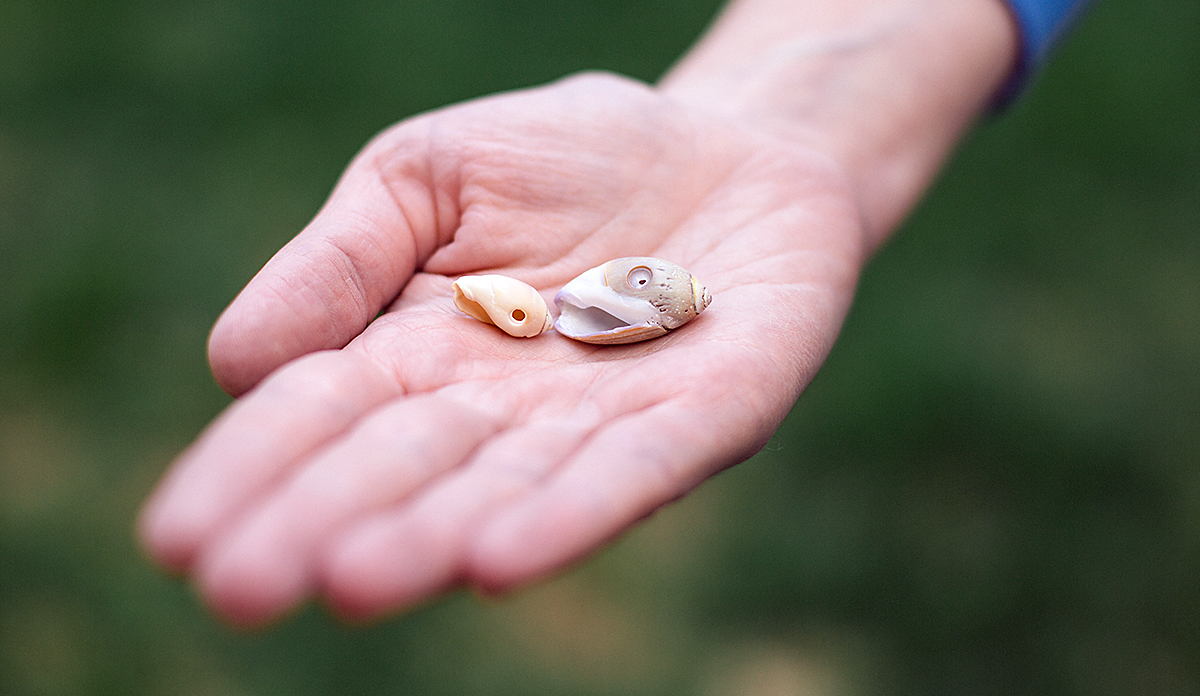
Predatory moon snails bore holes in these olive snails to extract the flesh. [Photo Credit: Ryan Whitefield, '10 BA]
While wandering the beach one day, I encountered Palmer. He showed me a group of empty olive snail shells with tiny circular holes in them. I recognized those holes! I had just written about these very shells. From my land-locked desk, I had tried to describe how predatory moon snails bore these holes using a combination of an acid secretion to soften the shell and a raspy tongue to sand it away. Now here was an example resting in my palm. It was so satisfying.
Then one night, boating across Bamfield Inlet on a seaweed identification excursion, I noticed blue sparks in the boat's wake - bioluminescence! The surface of the water sparkled as though tiny fireworks were exploding in the ripples.
Lesson learned: There's nothing like seeing the wonders of nature in person rather than on a screen.
The scientific part: Some creatures make their own light using a chemical reaction that creates photons, or flashes of light. Bioluminescence is used to attract prey or deter predators, so when humans disturb these creatures it triggers this natural reaction. Three ingredients create bioluminescence: oxygen, luciferin and luciferase. Luciferin is a molecule that reacts with the oxygen and emits light, while luciferase is a molecule that triggers the reaction.
Just a touch away
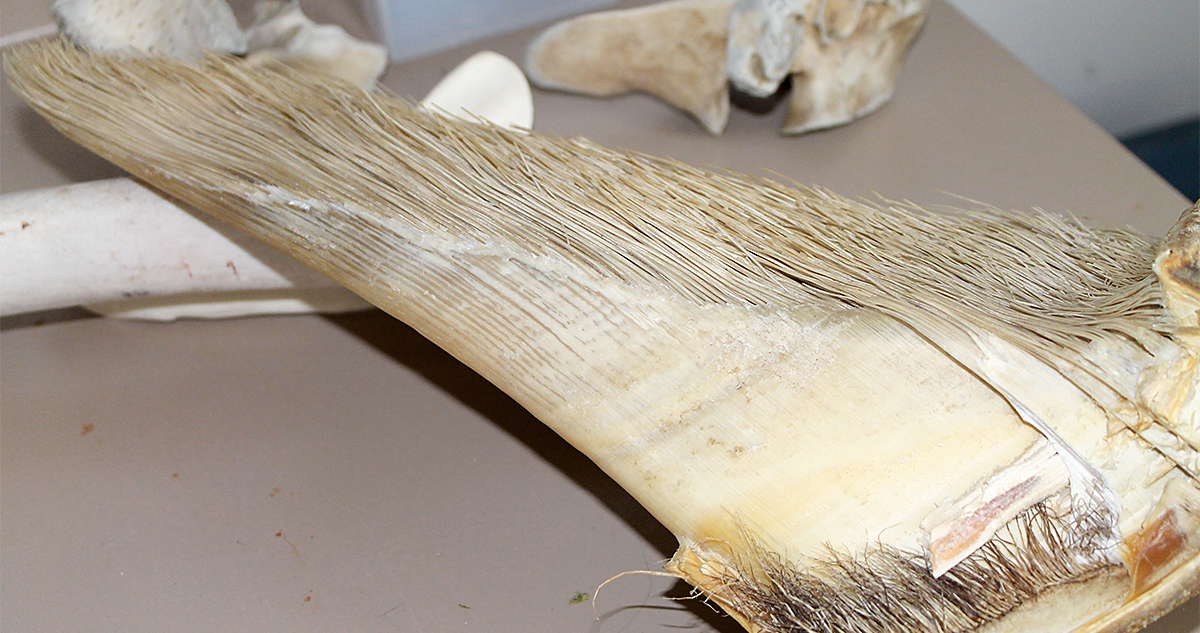
The rough strands of grey whale baleen, used to filter krill, feel like corn broom fibres. [Photo Credit: Sarah Pratt]
Walking into the whale lab at the Bamfield centre is a sensory experience: the briny smell of salt water, the gurgle of pumping water; touch tanks everywhere and otter and cetacean skeletons hanging overhead. The lab is a hands-on classroom offering university and field trip students from grades 7 to 12 the opportunity to examine marine flora and fauna up close.
Anemones, sea stars and urchins in tubs and tanks were waiting for my touch. Walking around, my fingers brushed across a piece of grey whale baleen on display and I imagined krill filtering through the rough strands that feel a bit like corn broom fibres. The sea otter's sharp canine teeth make the skeleton look predatory. It's hard to reconcile the pointy choppers with the teddy bear cuteness of these playful animals.
Lesson learned: The whale lab is a science playground, allowing marine enthusiasts of all ages the opportunity to observe and touch everything from slippery jellies to slimy seaweed. It's a truly hands-on space where researchers can share their discoveries and the excitement of exploring creatures up close.
The scientific part: Brad Anholt, '79 BSc(Hons), director of the Bamfield centre, said scientists aren't certain how the physics of baleen works. (Editor's note: a May 9, 2015, episode of CBC Radio's Quirks and Quarks features an interview with Wayne Vogl, professor in the Department of Cellular Biology and Physiological Sciences at the University of British Columbia. Vogl describes the latest research on how baleen works.)
Even Cousteau and Jeremy Wade were impressed
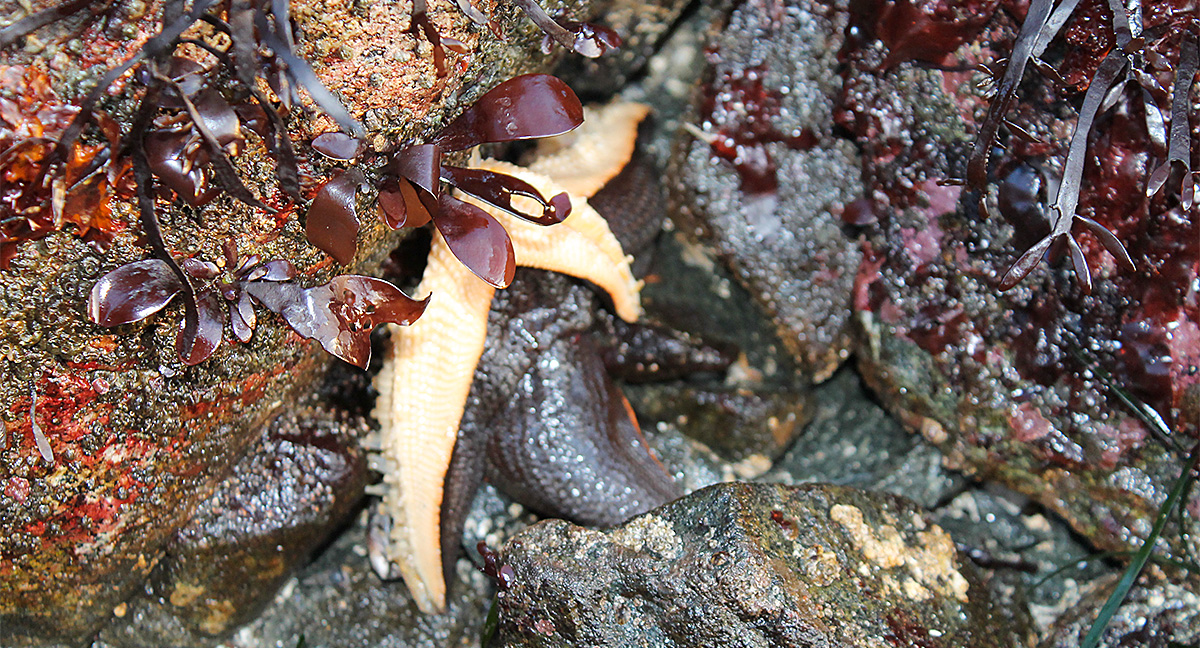
Seaweed of many colours and about 100 species can be found in the Bamfield area. [Photo Credit: Sarah Pratt]
Explorer Jacques Cousteau is said to have deemed the Bamfield area one of the best cold-water diving locations in the world. High praise, indeed, but it's not surprising given the varying depths and currents of cool water from the north that mix with warm water from the south to create an explosion of biodiversity. Fortunately, you don't have to dive to explore the wealth of life. Barkley Sound - the bays, inlets and islands alongside Bamfield - is home to birds, mollusks and cetaceans (such as dolphins and whales), algae, seaweed, fish, crustaceans and echinoderms (starfish, sand dollars and urchins). (See sidebar for terminology.) More recently, Bamfield attracted the notice of Discovery Canada. In fall 2014, Jeremy Wade, host of the show River Monsters, visited BMSC. Wade fished for creatures to include in his episode entitled Prehistoric Terror, which aired May 25. River Monsters is a wildly popular show and has more than a million followers on Facebook.
Lesson learned: Talk about diversity! The Bamfield area is home to about 100 seaweed species of varying shapes, sizes and textures, with colours that include red, green and brown. Bull kelp, one of the most edible and common seaweeds found here, can be recognized by the gas-filled bladders that keep the fronds afloat as they grow toward the sun. It's the fastest-growing seaweed in the world, growing up to 60 centimetres a day.
Are you convinced yet? Ready to put the Bamfield Marine Science Centre on your own bucket list? Here's where you can get more information.
Take a look at their education programs. Public tours are offered throughout the summer. Adult and naturalist groups can also book tours or classes, which include Coastal Science and Interpretation for Wilderness Guides.
Post-secondary credit courses and grade school field trips are among the education programs available at the centre.
Grade schools and university classes can book live Internet marine labs and live dives.