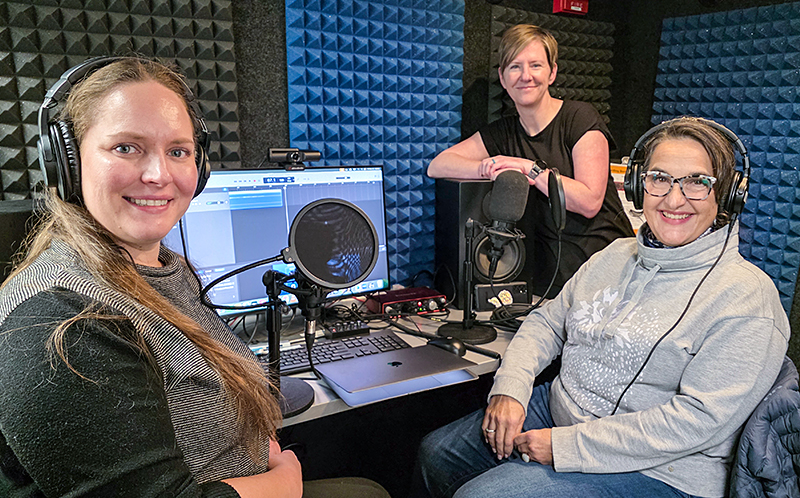
Digital tools make it easier than ever for researchers and experts to share their insights with a global audience, connecting with communities and creating new ones.
For proof, look no further than Ski Like a Girl Podcast. The documentary-style academic podcast was created by three University of Alberta researchers in the Faculty of Kinesiology, Sport, and Recreation who aim to “write women and girls into the history of Canadian Nordic skiing,” in the words of host and historian PearlAnn Reichwein, ’88 BA.
Since releasing the first season in late 2024, Reichwein and fellow hosts and historians Charlotte Mitchell, ’22 MA, and Lyndsay Conrad, ’23 BKin, have heard from listeners in Australia, China, Europe, and across North America. Season one also attracted ample attention from within Alberta.
The success of the first season persuaded the research team to craft a second one, launched in late 2025. The new season, in sync with the 2026 Olympic and Paralympic Winter Games, includes episodes on learning to ski, interviews with early and current members of Canada’s national teams, volunteers, and much more.
Here are four tips for conveying expertise through digital media, drawn from the experience of the Ski Like a Girl Podcast hosts.
1. Pick a podcast, probably
The Ski Like a Girl Podcast hosts all praise podcasting as a great tool to reach a general and global audience.
“I think podcasting is more accessible to a larger audience than something like TikTok,” says Conrad. “A podcast lets you reach both younger and older people. We use Spotify with its accessibility features and archive on Aviary.”
The barriers to entry to both produce and create podcasts are low. Podcasts can be of any length, and they meet the listener whenever and wherever they want to tune in to the show. The only thing a person needs to hear a podcast is an internet connection and a device that can play digital audio.
2. Choose your format with care
The documentary style of the Ski Like a Girl Podcast is similar to radio shows like CBC Ideas or This American Life. Making a show like this demands a lot of time in pre-production, during recording and in editing. The payoff for that time investment is an immersive aesthetic and confidence in the stories the show shares.
“Creating a documentary podcast is very similar to preparing an academic work for publication in its rigorous demands for attention to detail,” says Reichwein. “That’s what our team does. We start with reading in archives and interviewing for oral history before we go into the studio.”
Conrad, Mitchell and Reichwein do all of the work on the show, from scripting in pre-production to performance coaching during recording to editing to marketing. A season of Ski Like a Girl Podcast takes hundreds of hours to make, says Reichwein.
“We chose to go with episodes of 30 minutes or more, but there are other formats a researcher can use,” says Conrad. “If longer episodes are too much, explore a shorter episode.”
Many popular podcasts use a conversational format called a gabfest or chumcast where hosts essentially hang out on mic. The Ski Like a Girl Podcast digs deeper. An academic podcast needs a strong research backbone, rich storylines and deep conversations — and that takes time, says the U of A research team. Try a format with one interview or storyline to get started.
3. Draw on all your skills
Though none of the hosts of the Ski Like a Girl Podcast had made a podcast before they teamed up, all three brought skills developed in other parts of their lives.
“I had done a lot of musical theatre,” says Reichwein, “and I had transposed my PhD thesis into a theatre show for Parks Canada. It played for up to 300 people in Lake Louise.”
Mitchell, a PhD student, had written a radio documentary for CJSR as part of her master’s program, and Conrad had experience with video production.
Adding to the mix, they are all U of A grads with knowledge across the arts and sciences. Drawing on their past experiences and skills helped these three historians learn to make a podcast together.
4. Team up for imagination and impact
The hosts emphasize the collaborative nature of the show.
“It’s all done by the three of us and we all learn together,” says Mitchell.
“We’re really working together as a creative research collective,” adds Reichwein.
Teaming up to create the show has also broadened the Nordic skiing community by highlighting stories of inclusion.
“We want to share these stories,” says Mitchell, “not only with the wider community of people who are interested in history, but with everyone, to let them know about this amazing history.”