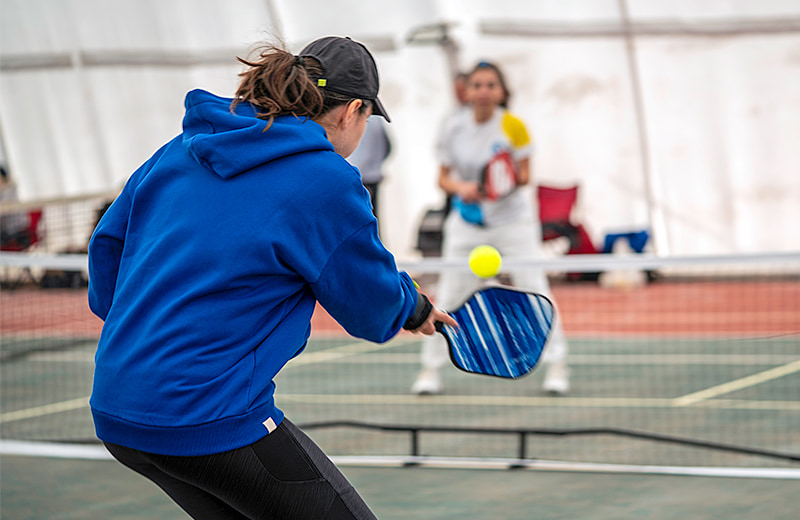
I’ve never played a team sport in my life — unless you count K-12 gym class. I’ve always shied away from competition. I don’t even like board games that have direct competition.
But last spring, a surprising number of my friends and family members got pickleball curious and started signing up for classes. I joined them because I’m always up for trying something new. If an activity comes with a bit of exercise disguised as fun and a dose of social connection, I’m in.
Given my past attempts at tennis, and one deeply humbling squash lesson, I assumed pickleball wouldn’t be for me. But when even my uncle and his friends — all in their late 70s and with nary an original hip — started playing, I figured maybe this was a sport I could actually keep up with.
While others were eager to level up, ladder up, enter tournaments and really compete, I just wanted a little movement and social time, with a side of pickleball. What I didn’t expect was how much the experience would teach me about myself — especially how learning a new sport as an adult offers unexpected life lessons.
Pickleball has exploded in popularity. It’s everywhere, from local rec centres to internet memes. In Canada, the biggest growth in participation is among adults aged 35 to 54, and national membership jumped by 25 per cent between 2023 and 2024. However, the growth of the game actually started with older players who were looking for a sport that was less physically intensive.
Paul Plakas, ’90 BA(RecAdmin) — Kinesiology, Sport, and Recreation graduate, personal trainer and pickleball instructor with 35 years of experience — points to both accessibility and the social aspect of the game. Pickleball requires less physical intensity, with a smaller court and lighter paddle, and the learning curve is gentle enough that beginners can pick it up fairly quickly. And the focus on doubles play creates an environment that allows for building community.
“At this stage of my life, I’ve made dozens of new friends just from this sport alone — people I never would have met anywhere else,” Plakas says.
Faculty of Kinesiology, Sport, and Recreation graduate and assistant teaching professor Danielle Cormier, ’16 BA, ’18 MA, ’23 MA, notes that pickleball’s origins set it apart.
“What’s been really cool about the pickleball movement is that it started with retirees and masters athletes,” she says. “That’s very rare.”
The fusion of the physical benefits and social dynamic explains why the sport’s appeal goes beyond simply physical fitness, according to Shannon Pynn, ’15 BPE, ’17 MA, ’23 PhD, also a Faculty of Kinesiology, Sport, and Recreation graduate and now an assistant professor at Utah State University.
“A lot of people are just discovering the social and psychological benefits of the sport,” she explains, “which is making it more popular, especially for older adults.”
Pynn’s research focuses on the psychosocial benefits of sport in children — teamwork, communication, resilience — but she says these lessons also extend to adults.
As we age, she adds, our bodies and minds change — and we often seek new ways to connect.
Adults, it turns out, can be unforgiving beginners. Unlike children, who often learn sports in structured, low‑stakes environments, adults worry about embarrassment, judgment and letting others down. That pressure can make starting something new feel daunting.
“Sport is inherently competitive,” Pynn notes. “Even in non‑competitive settings, you’re always evaluating yourself — doing something right or wrong, winning or losing.”
That instinct intensifies when someone else is relying on you, she says. “There’s an evaluative nature when you’re working with someone else. You don’t want to feel like you let them down. That’s just part of being human.”
Cormier agrees. “Adults trying anything new — and sports especially — can feel really uncomfortable,” she says. “You’re putting yourself in a space where you’re not good at it, and the scoreboard makes comparison unavoidable.”
So how do we start moving past that discomfort to enjoy the experience? Cormier’s research focuses on grit, self‑compassion and mental toughness in sport. Self-compassion, she says, is especially important because many adults expect instant competence — and feel discouraged when they don’t meet that expectation.
This is where grit also comes into play. Both Cormier and Pynn emphasize encouraging yourself the way you would a close friend.
“Grit is passion and perseverance over the long term,” Cormier explains. “But it also includes self‑compassion. Remind yourself that everyone started at the bottom. You can’t expect to be great at something right away.”
Plakas encourages players to focus on process, not points. And for players who apologize after every missed shot? “Everybody makes errors,” he says. “You don’t need to apologize. Let it go and focus on the next point.”
That ability to let go of mistakes, outcomes and expectations is one of the court’s most valuable lessons.
Pynn echoes that trying something new is inherently scary, and that supportive environments matter. If you’re playing with people who make you feel safe, she says, you’re more likely to stick with it. Maybe you aren’t very good yet — but you’re having a good time.
Cormier encourages players to reflect on their goals. “Is it to get really good at it? Or is it to enjoy yourself, have fun, and be social?”
In sport, she says, it’s easy to fixate on scores and outcomes. Letting go requires being intentional about what you’re actually there for.
“Sports give us a safe space to fail, reflect and keep going,” Cormier says. “That muscle of growth and self‑compassion, if we exercise it, can carry over into everything else we do.”
Playing as a beginner teaches you how to navigate setbacks, communicate with teammates and be patient with yourself — skills that extend well beyond the court. Pickleball, and recreational sports in general, don’t demand perfection. You just need to show up, try again and let go of what you can’t control.