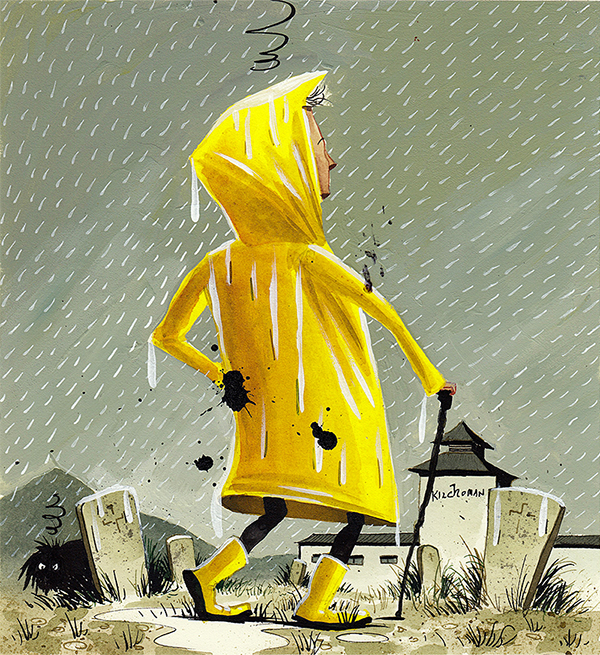
The rain was hammering down so fiercely I could feel it thrumming against my skull under the hood of my waterproof coat. I suppose it would have been more pleasant to be standing there in bright sunshine and warm breezes, but when you come to one of the more remote parts of one of the more remote Hebridean islands, you would be delusional to not expect storms. And the shocking weather helped me imagine what it must have been like to live on this island centuries ago. It helped me understand what must have driven my ancestors to seek out an entirely new existence.
This particular storm happened on the island of Islay. I went there to look at the small hamlet and farms where my great-great-great-grandfather Dougald Gillespie crofted (small-scale subsistence farming particular to Scotland) in the early 1800s. The hamlet has about a dozen homes, a graveyard and a derelict church on a site that has been a place of worship for about eight centuries. Some of the graveyard is well-maintained and some of it in ruins, but I found a few gravestones with the name Gillespie hewn into the wet, mossy granite.
As I stood in the lashing rain, in the beautiful, stark landscape, I tried to imagine what it must have been like to farm this land two centuries earlier, to leave that land and journey a half a world away, to a country that didn’t yet exist, to take up a new life. What lengths of desperation drove him? I was unexpectedly moved by the scene and my thoughts.
Gillespies crofted around that area for many centuries, in Kilchoman, Kilchiaran and Conisby, until Dougald left in 1833 and made his way to Upper Canada with his wife, Mary, and their six children, leaving Scotland forever. Poor old Dougald wasn’t in Canada two years when a tree he was felling dropped a giant limb on him and killed him. But the Gillespie line remained in Canada, grew, drifted west and eventually settled in the Camrose and Daysland area in eastern Alberta more than 100 years ago.
And so it was nearly 200 years after Dougald and Mary first left Islay that I found myself looking out over the same fields they worked, with the rain beating down, every inch of me saturated, wondering, OK, wait. What am I doing here?
Of course, the search for one’s heritage is big these days. Family research is superpowered by DNA searches. I guess people really want to know which Druid sect they belonged to. But for most of my life I haven’t been particularly curious about my heritage. I hail from a mixed Scottish and Irish heritage, the Scottish on my father’s side. Growing up, we spent more time with my mother’s side of the family, but it’s safe to say that we heard more about my father’s heritage because his brother, my Uncle Gordon, was interested in tracing the family history.
And despite my earlier ambivalence, as I get older, wiser, more insightful and more thoughtful (or just one of those things) I’m more curious about where I emanated from and what forces shaped me. The accelerating passage of time is responsible for that, but one of the insights I gained along the way is that none of us is a singular creation. No man is an island, wrote John Donne in 1624. If you can forgive the male focus, Donne’s message is clear. One’s existence is the result of multiple forces coming together. Nature. Nurture. Rupture. Rapture. There is a connectedness to everything. I am a combination of every single thing in my orbit that came before me and stands alongside me. First and foremost, of course, is family. Mostly that means my immediate family.
Another thing I’ve learned is that sometimes I have to let things come to me rather than chasing them. This was precisely what happened immediately after leaving the ruins of Kilchoman parish. Staring north, I could see that the fields Dougald must have worked were now well-tended barley fields that cut a distinctly orderly pattern amidst the rough and harsh lands around them. Getting back in the car, I decided to drive back towards Bowmore and in doing so passed a sign along a side road indicating that a distillery I was not familiar with, Kilchoman, was down the road. On a whim, I turned right. Inside was a warm and inviting space, with delicious hot soup and a pleasant owner I was lucky to meet, Anthony Wills, who had founded the distillery 20 years earlier. It was Islay’s first new distillery in 120 years, and we had a delightful chat about the area, the barley, the fields and my ancestry. It seems almost absurd, but the conversation connected me to the island and terrain in a way I wouldn’t have predicted. I would have been even happier had he connected me to a bottle of single malt for letting him use the land my ancestors tilled, but alas, no.
I have always loved a good single malt whiskey, especially the peaty, smoky varieties. Now I know that I come by it honestly. There’s nothing like a wee dram to make me think of Islay and my roots.
But it all remains a tricky knot to untie. The question is not so much of one’s heritage, but of what it means. It has always struck me as somewhat arbitrary and even pretentious, the whole lineage quest. Dougald was cutting trees, and one fell over and killed him. What does that say about me? That I should avoid using chainsaws in my backyard? You can only take this stuff so far. For me, it has always come down to some level of accepting responsibility for who you are. Placing too much emphasis on one’s heritage might be a way of both accepting too much glory while ignoring the disrepute from those who came before us. Did having a war hero grandfather (as I had) make me more of a heroic type? Did having a racist and misanthropic forebear (as I had) make me prone to being a hateful person? In both cases, the answer is no. And does it all mean that one of my great-great-grandchildren will look back at my life, going by what I’ve written, and think, “OK, so that’s where I got the procrastination and smart-alecky attitude from!” Again, no.
So what is the point of investigating our heritage? I guess it lies somewhere in thinking about the fact that we all came from somewhere and that we are meaning-seeking creatures. But it can lean too deeply into accepting that we are either formed by our history or can’t escape it, or both. To me, it encapsulates the struggle between searching for the significance of our individual trajectories versus coming to grips with the arbitrary randomness that underlies so much about birth, death and what lies between.
Speaking of which, it was in that same poem that Donne wrote: “Any man’s death diminishes me/ Because I am involved in mankind./ And therefore never send to know/ for whom the bell tolls;/ it tolls for thee.”
The bell of mortality rings for us all at some point, no matter who we are or where we’re from. Which is what poor old Dougald found out when that tree fell on him. But what I found so rewarding about exploring my Islay heritage had less to do with me than it did with meditating on what it all must have meant for them — the hardships, the sacrifices, the journeys. Of course, it did all lead to me, a couple of hundred years down the line, which I am thankful for, and which seems like a pretty solid outcome. So, well done, Dougald and Mary! Let me raise a wee dram to you for making brave decisions. And here’s hoping that some descendant a few generations from now will look back and think well of me, also, and raise a dram to dear old Curtis. That’d be meaning enough for me.