The Dairy Research and Technology Centre (DRTC) now has a fresh face and new technology after months of collaborative efforts to introduce innovative robotic milkers and a K-12 friendly educational space.
Renovating the barn and installing robotic milkers
Holstein cows at the facility have long been milked manually with the help of milking machines for Alberta Milk commercial products, requiring long shifts that started very early in the day for staff. Installing voluntary robotic milkers improves animal comfort and increases efficiency and milk quality. The Faculty of Agricultural, Life & Environmental Sciences (ALES), with support from the Office of Research Integrity Support, funded the technology and the necessary concrete work to accommodate the larger, uninhibited tie-free stalls in the barn, which are more comfortable for the cows.
"The new robotic milking system supports safer, more efficient workflows, improved animal care and integrated data collection across the unit," says DRTC Unit Supervisor Devin Dittmer, who’s a U of A grad who grew up on a dairy farm. He commends the staff for their work during the transition and helping train the cows to use it.

Pictured are two of the robotic milking stalls (one approachable from the left and one from the right) at the time of installation.
This technology, installed by a local team from Dairy Lane Systems, is the future of the industry. The robotic milking system lets cows decide when they’d like to be milked — up to five times a day. It only takes five to seven minutes to milk each cow and they get treats to eat at each visit!
Beyond the great benefit to the cows, the technology also advances safe milk production for human consumption. Did you know each quarter within the udder produces unique milk? The robotic milker collects milk from each quarter individually, checking for quality and separating any unacceptable milk. This is yet another safeguard for safety and quality assurance between milking and production.

Cows enter the stall to be milked at their leisure, often lured by the treats inside, and are tracked by the RFID tag on their collar.
Designing and opening an interpretive education space
While the renovation was taking place in the barn, another project was underway to refresh the front of the facility and create an engaging educational space that would entice K-12 students.
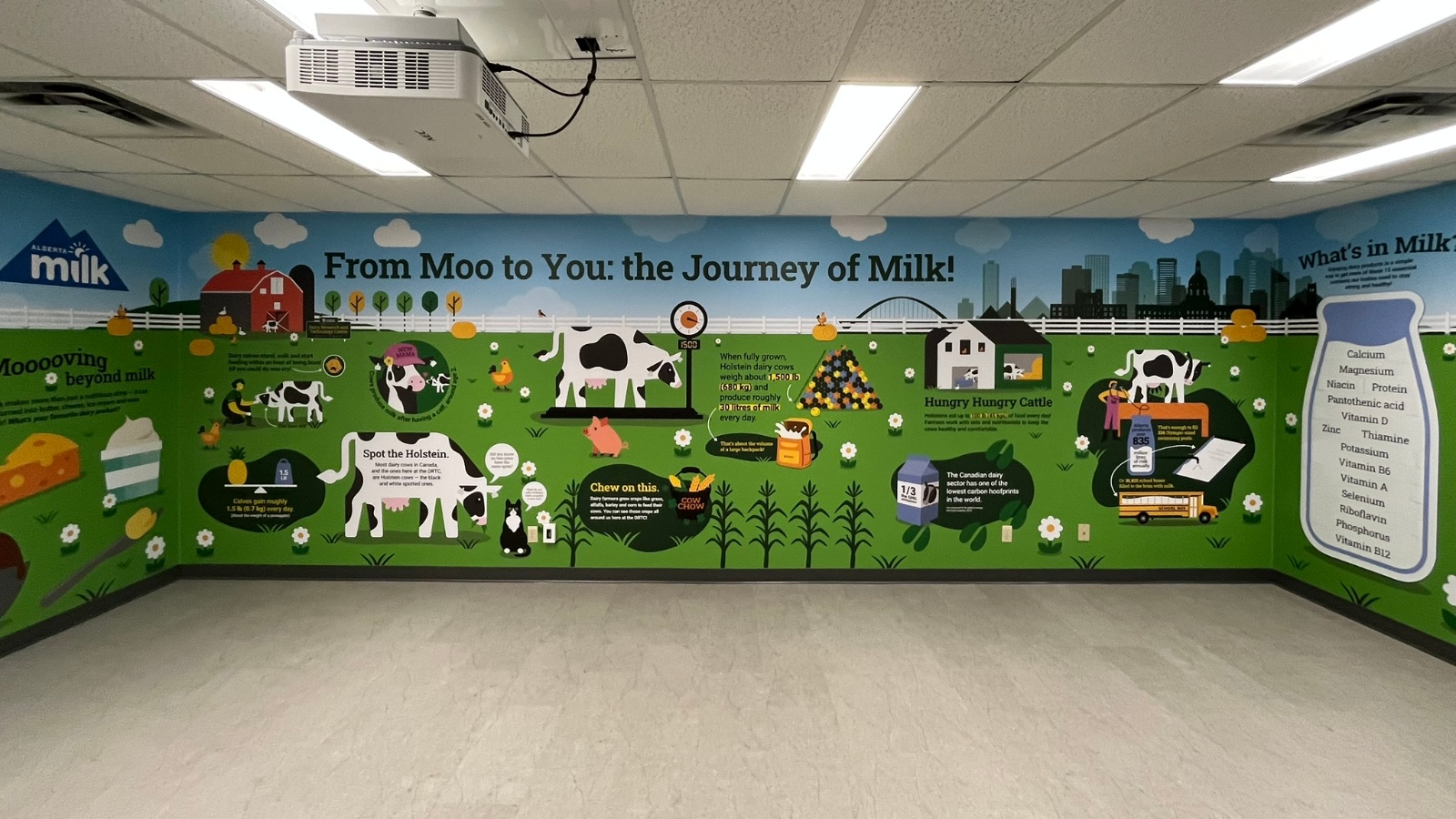
Thanks to expertise and funding from longtime partner Alberta Milk, the classroom received wrap-around wall decals describing the dairy industry, from production to human nutrition and careers. The exhibition was enthusiastically endorsed by the Frank Robinson Youth Academy (FRYA) as part of its mandate to offer experiential learning opportunities to promote food security and help youth consider careers in agriculture, food production and the environment, such as through presentations at U of A facilities.
Dittmer, who’s a member of the FRYA board, explains they’re excited about the new classroom design, “which will enhance hands-on education, collaboration and meaningful connections between modern agriculture and student learning.”

The classroom describes the dairy industry from farm-to-table with interesting facts, fun puns and even a magnet board listing the nutrients of milk.
The hallway connecting the entryway and the classroom was decorated as well, making important biosecurity information visually appealing and clear to protect both the animals and visitors. The wall also includes a spot to mount a TV to show video from the milkers, to come in the near future.

This wall in the entryway is dedicated to the new robotic milker technology, putting it front and centre for returning researchers and students. Soon to come is a TV with video feed from the milker.

The biosecurity wall is located next to the entrance to make this important information immediately available.
Should participants get excited about a career in dairy after going through the classroom displays in order, they’ll last see a call to action to get involved in this “udderly amazing industry!” ALES offers four related BSc degrees, just like a dairy udder has four teats.

This “career streams” graphic lists possible degrees and jobs those interested in dairy and related industries can pursue.
A collaborative effort
Matching the dairy expertise with creative design and installation was a herd effort! The DRTC staff and animal science faculty members were integral to this project for their expertise and ongoing dedication to the cows throughout these projects. The vision would not have been made a reality without funding and educational content provided by Alberta Milk, demonstrating the potential to make a positive impact when working with industry partners.
“Alberta Milk is excited to partner with the U of A on the DRTC dairy unit classroom,” says David Morey, the Chair of Alberta Milk. “Together, we’re bringing modern dairy farming, research and innovation to life through hands-on, year-round learning that helps students understand where milk comes from and the important role dairy plays in Alberta’s food system.”
You’ll appreciate the personal, localized touch applied to the facts and figures when looking closely at little details like the red barn similar to the one on South Campus, the Edmonton skyline and a drawing of Duke, the DRTC barn cat.
Next time you’re consuming Canadian dairy products, consider that you could be enjoying milk from the DRTC!
Please note that the facility is not open to drop-in visitors. To organize a tour, email drtc@ualberta.ca.