
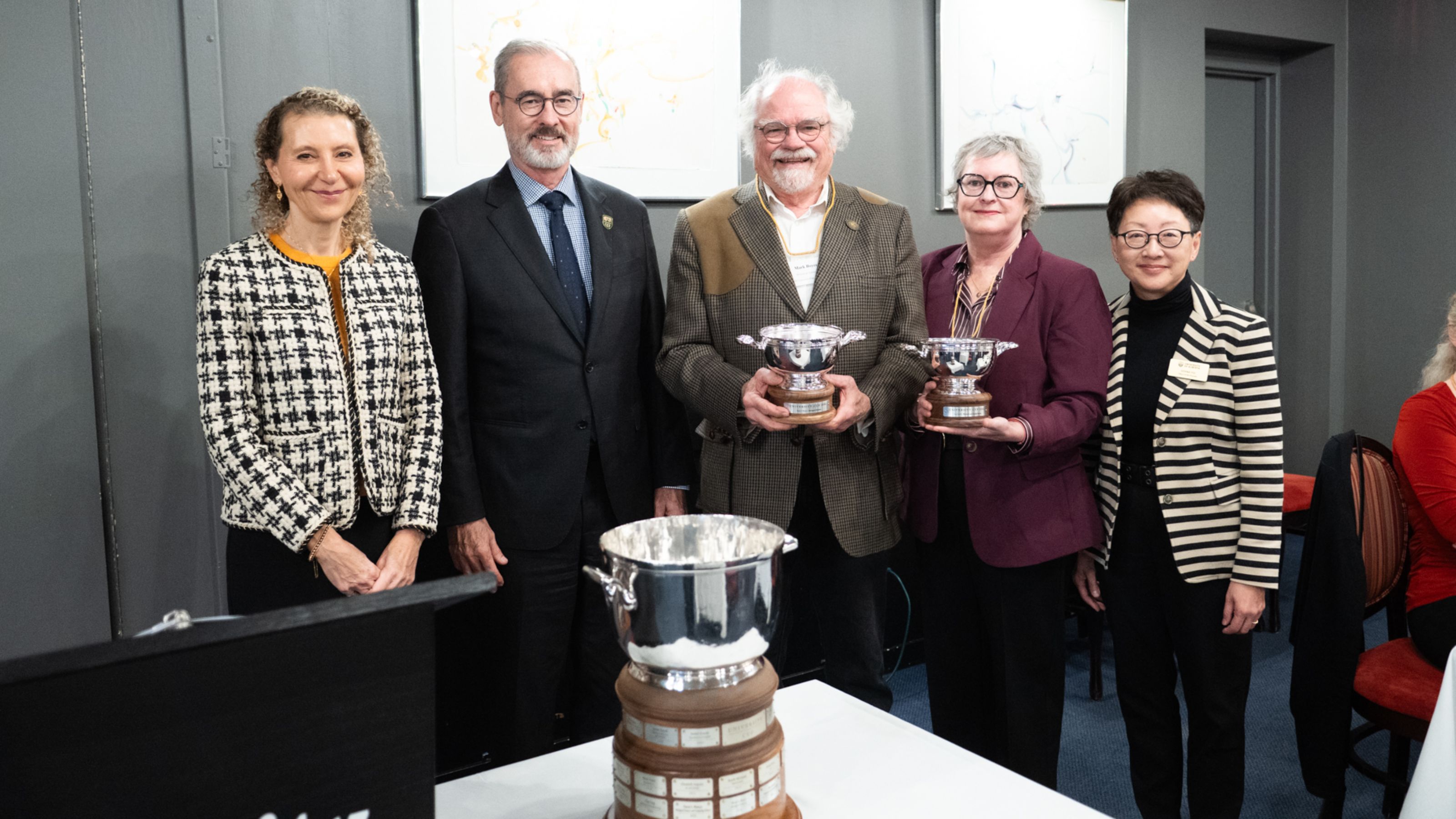
For Dr. Mark Boyce, there’s a fundamental truth he has championed throughout his 50-year career: Effective wildlife science must be grounded in community connection. It is this philosophy — combining rigorous quantitative science with deep-rooted collaboration — that has made Mark one of the world’s most influential ecologists, earning him the 2026 University Cup, the institution’s highest honour.
The ACA Endowed Chair in Fisheries and Wildlife, Mark’s pioneering quantitative models have transformed wildlife population management across the globe. Yet his legacy extends far beyond metrics, encompassing decades of championing Indigenous co-management, pioneering grassland conservation and carbon sequestration and equipping generations of young scientists for environmental stewardship.
Beyond community-led conservation, Mark’s research has repeatedly shaped national environmental policy. In 2007, his team published groundbreaking habitat-modelling work in Ecological Applications, a top-tier ecological journal, which mapped critical habitat for endangered sage grouse in southeastern Alberta. When the federal government’s 2008 recovery plan omitted critical habitat identification — violating the Species at Risk Act — the environmental law organization Ecojustice invited Mark to join a lawsuit against the government.
Hesitant about potential institutional fallout from suing a major university funder, Mark sought advice from his department chair, the late Dr. Laura Frost.
“I went to see Laura and she said, ‘That's why we hired you. Get after it,’” he recalls. “We sued the federal government, and we won.” The government then hired 75 people to conduct this crucial habitat-modelling work, fundamentally changing the process nationwide. “It was rewarding to see that our research transformed wildlife management practices.”
Teaching students how to generate rigorous data remains one of Mark’s proudest contributions. He emphasizes that modern conservation relies as much on high-level quantitative calculations as it does on field skills.
"A lot of people go into wildlife ecology because they don't want to do the hard math, but it's essential,” he says. “Calculus, statistics, probability theory, GIS, computer science, AI — it’s all important, and that's where the jobs are." Developing these core competencies gives young scientists a distinct advantage in an industry that demands data-driven solutions. The majority of his students have gone on to careers in academia, government or environmental consulting.
For Mark, seeing his former students apply these tools to solve real-world ecological challenges represents the ultimate fulfilment of a 50-year career — one that transformed a childhood love of the outdoors into a global legacy of wildlife stewardship.
Referring to the University Cup as a career capstone, Mark quickly clarifies that he has no plans to retire — yet. The line between his work and personal life is razor-thin, and hunting, fishing and spending time outdoors are through-lines in both. Alberta’s landscape and its opportunities for unparalleled wildlife encounters, he says, is a constant source of inspiration. Lately, that passion has expanded to include training his Labrador retriever and becoming a self-described ‘crazy bird-watcher.’
“I love working with graduate students,” he says, adding that his endowed chair is designed specifically for this role. “And I’m just having too much fun.”
Learn more about Mark in this video and on the Faculty of Science site.
For nearly three decades, Dr. Lise Gotell’s work has reshaped how Canadian law understands consent and justice. An internationally recognized feminist legal scholar, Lise has dedicated her career to elevating the voices of sexual assault survivors.
Since joining the University of Alberta in 1997, her scholarship challenging traditional notions of consent has directly informed landmark Supreme Court of Canada cases, clarifying critical protections around bodily harm with profound implications for survivors of gender-based violence. She has also been a driving force behind the creation and advancement of Women’s and Gender Studies (WGS) into a thriving department.
This commitment to aligning rigorous academic inquiry with public advocacy has earned Lise the 2026 University Cup — the U of A’s highest distinction, awarded to faculty who exemplify sustained excellence across research, teaching and service.
As an educator and mentor, Lise has dedicated much of her career to shaping the undergraduate experience. Reflecting on her teaching practice, she emphasizes two main pillars: developing practical research skills and cultivating disciplined, open-minded inquiry.
“A principle that has informed my teaching is the importance of contestation and respectful debate within the classroom,” she says. “There's this tendency, especially for younger students, to think that once they've arrived at their own position, everybody else is wrong. I want students to understand that the world is a complicated place, and that we can learn from perspectives with which we might disagree.”
Over her tenure at the U of A, Lise has served in key administrative roles — most notably as chair of WGS (2011- 18), a program which became a department in 2013 largely through her visionary guidance alongside one of her mentors, Dr. Jo-Ann Wallace.
“Lise has built WGS to what it is today,” says current chair Dr. Talia Welsh. “Anchored by her selfless dedication to our field, she has helped us move from a program to a department with a flourishing undergraduate major and minor and a nationally unique MA in gender and social justice. Her mentorship and supervision of countless WGS and GSJ students has shaped feminist activism and research in Canada and beyond. We owe her an enormous debt."
For Lise, the University Cup’s unique value lies in honouring every dimension of an academic career — a recognition she hopes will inspire other scholars, who, like her, have that “particular package of research, activism and advocacy,” to put themselves forward. Yet, when reflecting on her greatest career highlights, she returns to her real-world impact on Canadian law.
"I've always been extremely grateful when my research has led to measurable improvements in the law that will really affect the well-being of women,” she says. “To have that work — and the long history of feminist advocacy behind it — honoured with the University Cup is profoundly meaningful.”
Learn more about Lise in her video and on the Faculty on Arts site.
Read a list of all of the Celebrate! Teaching. Learning. Research. 2026 recipients.