
The Sustainability in Action series highlights the University of Alberta’s contributions to the UN Sustainable Development Goals. By documenting how our community integrates sustainability into teaching, research and daily operations, this series demonstrates U of A leadership in solving complex global problems and securing a resilient future for Alberta and beyond.
Five years into its commitment to the United Nations’ Sustainable Development Goals (SDGs), the University of Alberta is showing how global ambitions translate into everyday action on campus. While the goals can feel broad, their impact is often most visible in the behind-the-scenes work that keeps the university running — and evolving — more sustainably.
That’s where Abbie’s role comes in. Abbie Herbert, a waste management coordinator in University Services, Operations and Finance (USOF), oversees waste diversion and recycling at the U of A, which includes everything from our fleet of dumpsters and compactors to maintaining waste flows across buildings and supporting events (if you need to organize rental bins, she’s your go-to). But her work is also a direct expression of SDG #12, Responsible Consumption and Production, in action. “I did some courses in environmental sociology [during my BA in Environmental Studies at the U of A] and they helped me think of the bigger picture in how we use materials,” says Abbie. “Once you become aware of it, it's in every facet you see.”
A significant portion of her role focuses on helping lead the university’s transition to a Zero Waste approach. This includes building awareness around everyday waste and expanding the use of the familiar colourful Zero Waste Stations across North Campus, Augustana and Campus Saint-Jean, where materials are sorted into organics, recyclables, mixed paper and landfill as the system continues to roll out across all buildings.
In 2025, Zero Waste Stations were added to the Humanities Centre and Arts and Convocation Hall, and soon will be included in the new First Peoples' House space. Abbie has also received feedback from other waste sorting programs that people respond better to icons rather than hyper specific images, and the newer Zero Waste Stations will reflect this.
So far, organics is the Zero Waste category the U of A is focusing on the most. “About half of the waste the university produces and diverts from landfills is organics (food scraps, food-soiled paper, food containers, paper towels, etc.),” says Abbie. “Organics is somewhat new to the scene, so sometimes people are a bit hesitant, whereas usually they are pretty good at separating things like beverage containers for recycling, because they’ve done it for a long time.”
A large portion of the remaining half is recyclable. Abbie recommends checking out the U of A’s Waste Diversion and Recycling page to learn how to sort common items and see the university's current diversion rate. Abbie is working hard to promote waste sorting education, from sharing guides to hosting talks. However, it’s definitely a collective effort. For example, Energy and Climate Action, another team within USOF responsible for reducing utility consumption, greenhouse gas emissions and environmental impact, also considers proper waste sorting a fundamental action for green spaces certification.
In addition to waste collected in common spaces such as food courts and hallways, a lot of waste comes from offices and labs. “When a group is doing an office cleanup and they email me to find out where things go, even though it's going to take them a little more time than disposing of everything in the landfill, it always means a lot to me,” says Abbie. The Health, Safety and Environment team in USOF can support a lab closeout as well, guiding building occupants to where recyclable items belong.
Furthermore, Abbie and the Project Management Office team have lots of success diverting demolition waste from construction projects on campuses from landfills. The waste produced – concrete, metal pipes, etc. – is considered specialty recyclables, which also includes shredding paper, grease bins, batteries and e-waste. However, some things must remain destined for the dumpster for now: most single-use paper coffee cups need to be thrown in the landfill bins. “They feel papery, but because they're for hot beverages, they have a plastic lining on the inside layer, which is difficult to separate and sort for recycling,” explains Abbie.
The solution? Use a reusable coffee cup or head to Daily Grind in SUB or UCommons on North Campus, which uses compostable cups that are safe to go into organics bins. If you’re heading to a different coffee shop, look for a BPI Certified Compostable logo. “Compostable usually means the item has been verified to decompose completely in a commercial composting facility,” says Abbie. This is different to biodegradable items, she notes, which may take much longer to decompose, contaminating the finished compost bi-product.
The university's landfill diversion rate is a collective effort, one that is measured each year by Energy & Climate Action (E&CA). Data is collected not just from Abbie’s team, but from every group on campus that keeps things out of the landfill, including Distribution Services which manages electronics recycling. Results are publicly available on the E&CA’s Sustainable Operations Dashboards, where you can also see how the data has shifted over the years.
“I do feel a lot of success comes from the campus community really engaging with zero waste initiatives and making that effort to divert,” says Abbie.
For questions about responsible waste disposal, visit uab.ca/zerowaste or email zerowaste@ualberta.ca.
Sustainability in Action
Turning big sustainability goals into everyday impact
November 12, 2026
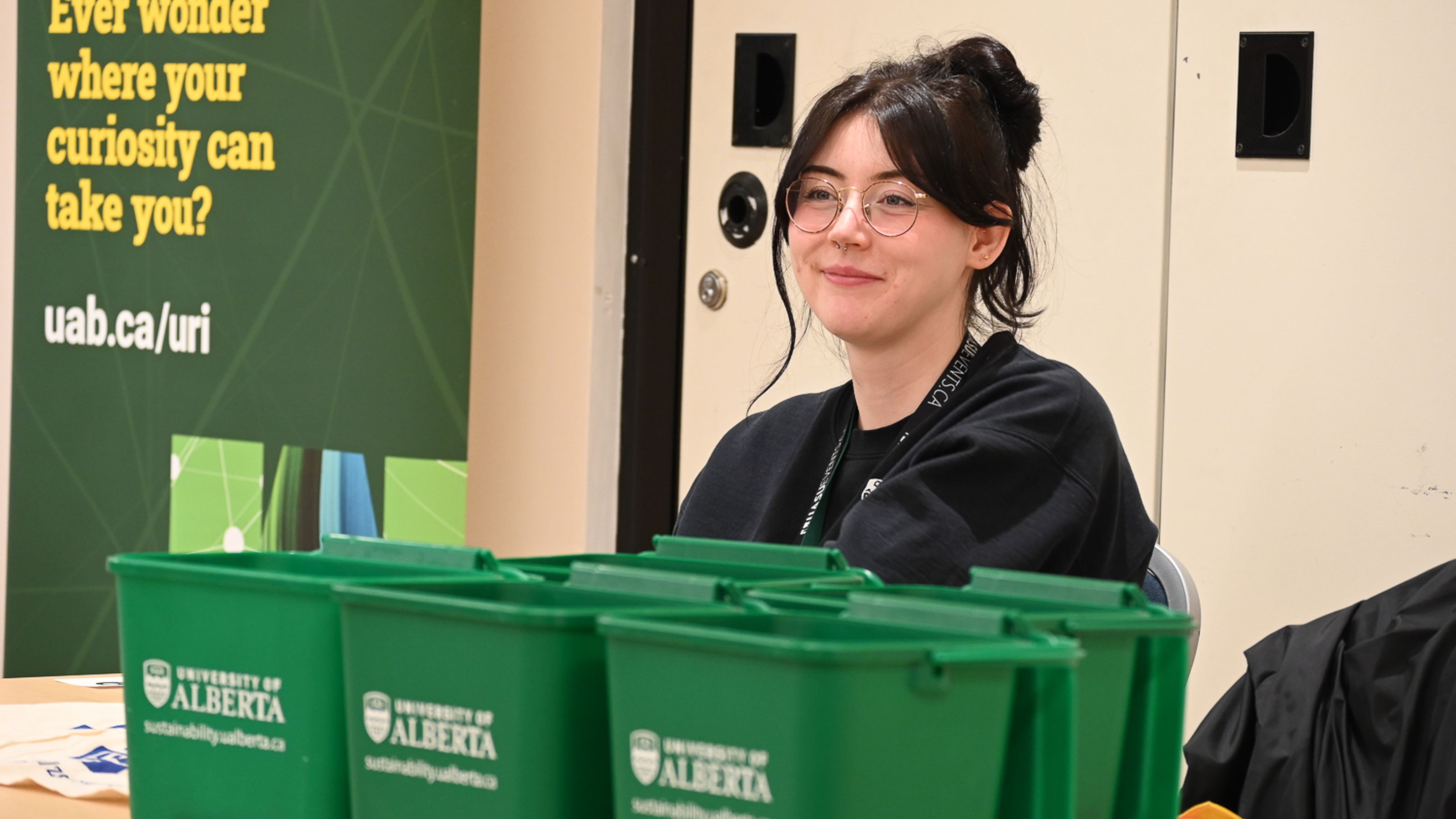
Abbie Herbert at U of A's Green to be Gold event in June 2026. Photo credit: Christy Dean Photography.