 YouAlberta

This article was updated Jan. 12, 2026. The event described is the 2023 Round Dance, but it is an annual event. You can learn more about the 2026 edition on the FPH website.
The Round Dance ceremony brings us closer to our community and reminds us that we are all related.
Attending Round Dance was a special experience for me because it gave me the opportunity to connect with the campus community and learn how we are each related in our unique ways.
I was also able to understand more about the history and traditions of Indigenous Peoples and how I can better connect with their teachings and establish inclusive relationships of learning. I found the Round Dance to be a highly inclusive and supportive environment where all members of the community are welcome to participate. In the circle, I danced and shared the songs with other U of A students, young children, members of the Edmonton community and those who came from outside of Edmonton to participate.
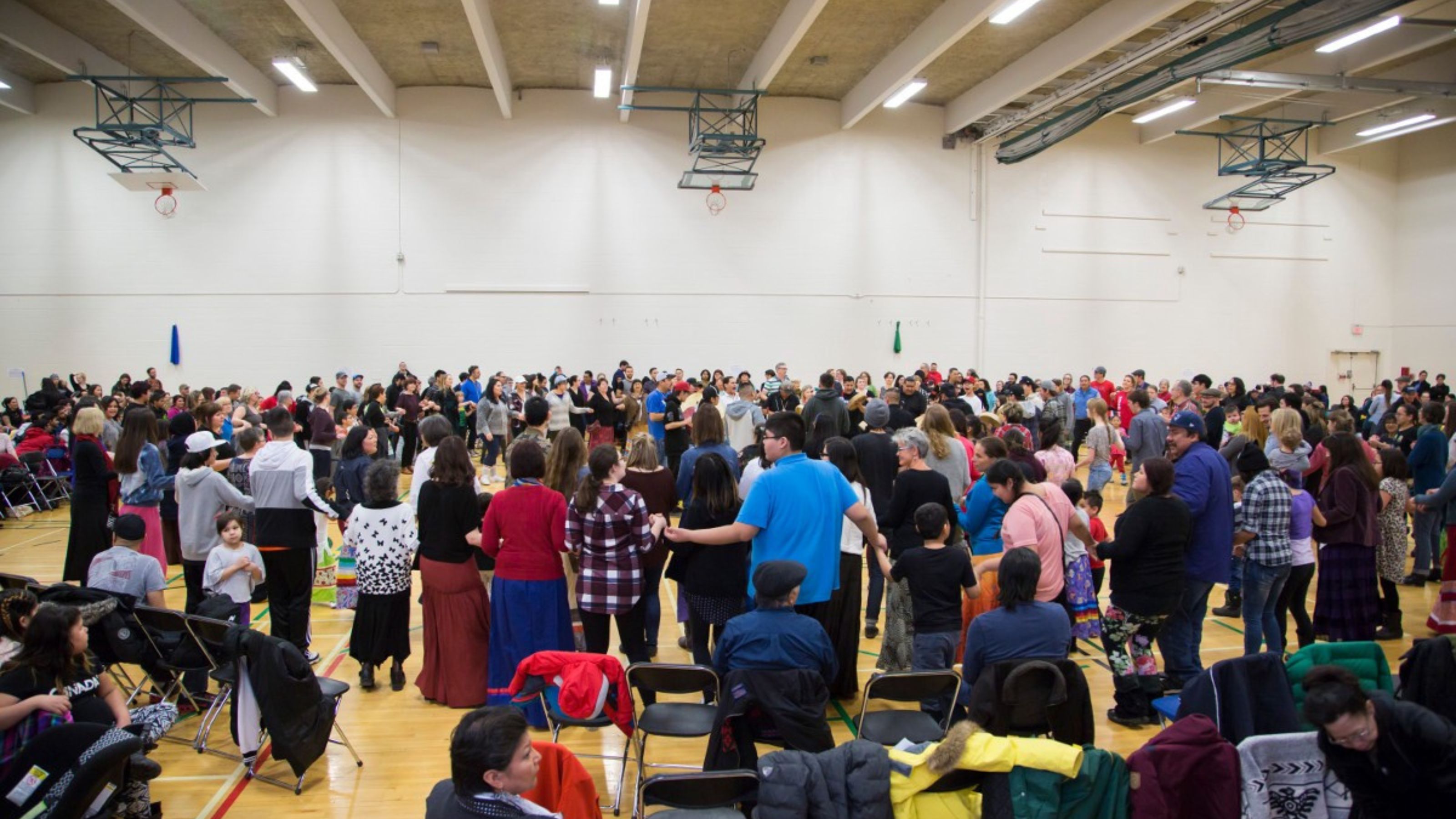
The ceremony started with an opening song and prayer. The songs continued one after the other, and the dancing was ongoing for hours; taking a break in between songs was also an option, but you could dance one song after the other if you were feeling really energetic. Singers and drummers came from both afar and locally, and they sat in the middle of the circle while everyone else joined hands and danced, surrounding the singers. The songs share the stories of the communities where the singers came from, and for this Round Dance, the songs were in Cree. There is also a closing song and prayer. At the end of the Round Dance, there were a variety of gifts shared with everyone as a sign of community.
At the Round Dance ceremony, I learned that the journey of healing is ongoing and that music works as medicine that nourishes our emotional, mental and physical states. When we dance, we connect with others, but we also get to know ourselves better by honouring the traditions and culture of our community.
Marc Jr. Doire, a criminology student and previously part of the Transition Year Program at First Peoples’ House, shares how the Round Dance connects him with his Indigenous culture and traditions:
What's special about the Round Dance being held on campus?
Attending the First Peoples’ House Annual Round Dance is one of the most important ways I remain connected with my community’s teachings while on campus. Having previously dropped out of high school, I came to the U of A through the Transition Year Program (TYP), a U of A access program for First Nations, Métis and Inuit students who may need additional support to enter a faculty undergraduate program.
The TYP opened doors to cultural continuance, academic support and community building. I was asked by Shana Dion, assistant dean for First Nations, Métis and Inuit students, to serve as one of the oskapêweyo to help organize and support the Round Dance.
I was invited to get involved in the Round Dance through this position because of my volunteerism and involvement with First Peoples’ House, as well as the relationships I have made with the Elders. And since nêhiyawêwin — Cree — is my mother Edna Doire’s first and everyday-used language, the First Peoples’ House Annual Round Dance presents as a safe space where she and my relatives and other Cree-speakers we meet out here can visit and speak the language without fear of any judgment.
Being able to see my family feel comfortable like this in an urban setting over 400 kilometres away from where we back home call “the bush” is what makes this particular Round Dance the most special.
Why is attending the Round Dance meaningful to you?
I grew up between the town of Grande Cache and the Cree-speaking community called the Susa Creek Co-operative, which is neither a reserve nor a Métis Settlement but one of seven land parcels my maternal grandparents’ generation negotiated retention of with the Province of Alberta after the rapid industrialization and development of the town of Grande Cache over our homelands in the late 1960s and early 1970s.
These parcels were legally constituted in Canadian law through an Order-in-Council issued by the first Indigenous Lieutenant-Governor of Alberta, Ralph Steinhauer, in 1975. Today, many of my relatives travel across the province, country and into the U.S. for ceremony. But back home, the most recent Round Dances our community has held were combined memorials for my late aunt Doris McDonald and her parents, Myles and Marie McDonald (born Wanyandie), which are always beautiful but bear a heavy emotional responsibility.
So, seeing my friends and relatives — the Wanyandies, McDonalds, Moberlys, Joachims and Karakunties — come together to celebrate our being in a space that my maternal grandmother, Mabel Wanyandie, prayed and visioned for my siblings and me to exist and be successful in is powerful and full-circle.
Relationality is an important concept for me because it reminds us that we have a shared relational responsibility to take care of one another, and that's the essence of this ceremony.
Regardless of which group you belong to, as long as you come with good intentions, you are always welcome within this circle.