 YouAlberta
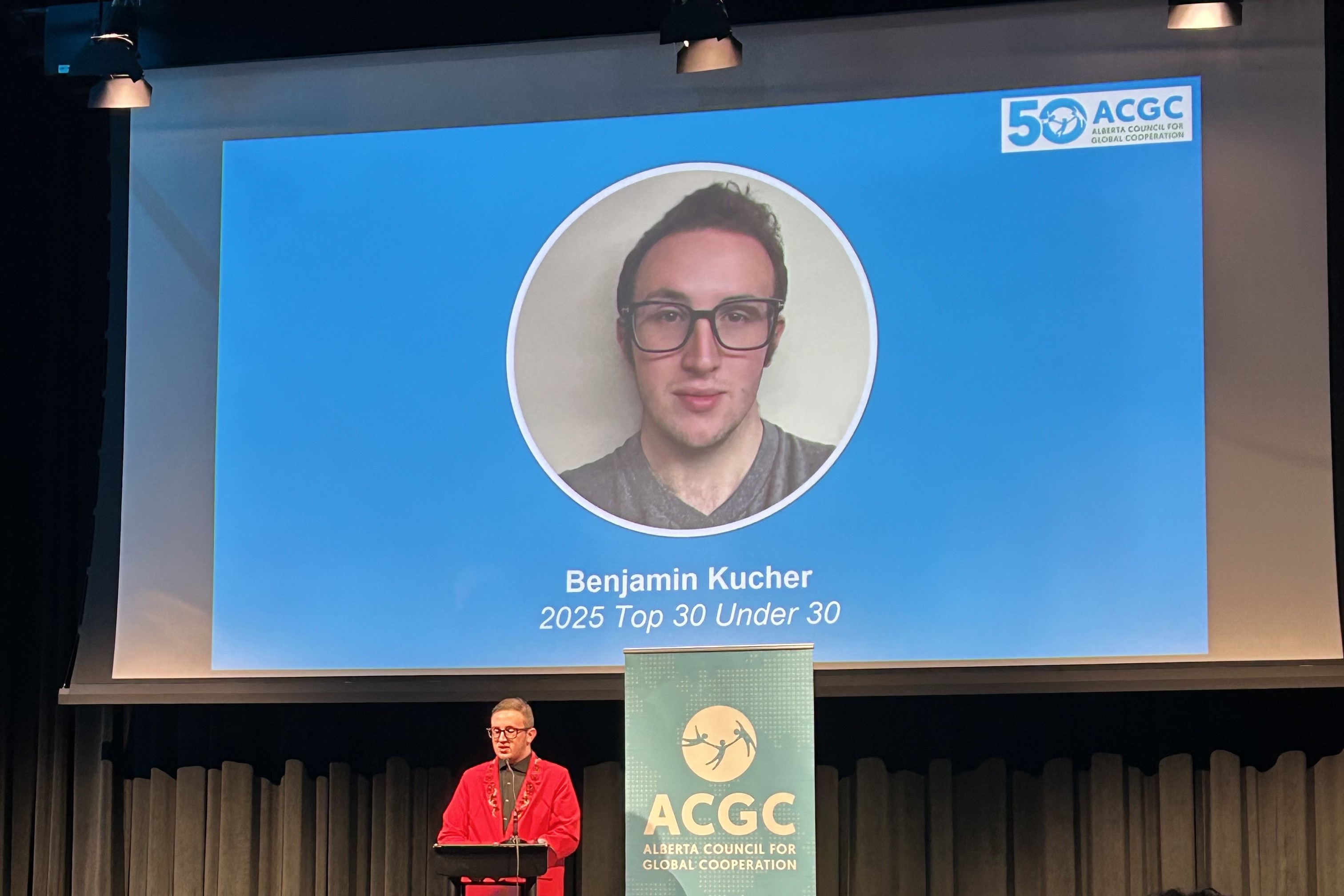

Each year, the Alberta Council for Global Cooperation (ACGC) highlights 30 young leaders making a difference in their communities and beyond. This year, 10 of those recipients are U of A students or alumni tackling issues from social justice and Indigenous advocacy to global education and health awareness.
I caught up with three of this year's U of A student recipients. Over the next three weeks, we'll feature Mel Wilk, Benjamin Kucher and Grace Kunnel to learn more about their work, how their time at the U of A has shaped their vision and what's next for them.
Benjamin Kucher: preserving Métis history and advocating for Indigenous voices
For Benjamin, history isn't confined to textbooks — it's a living, evolving force that shapes identity, culture and policy. As a Métis scholar and advocate, Benjamin is dedicated to preserving Indigenous histories, amplifying Indigenous voices in academic and policy spaces and advancing reconciliation efforts.
His current research focuses on trade beads recovered from the Buffalo Lake Métis archaeological site, exploring how these artifacts tell stories of resilience, adaptation and identity within Métis communities.
As the previous co-president of the Indigenous Graduate Students' Association, he has also led efforts to address residential school denialism and promote truth and reconciliation.
How has your time at the U of A influenced your work in Indigenous advocacy and reconciliation?
Navigating a large, colonial institution like the U of A has been a deeply educational experience in understanding both the challenges and opportunities that come with institutional advocacy. Universities operate within long-standing structures that often resist change, and advocating for Indigenous representation and reconciliation within these spaces requires a strategic and persistent approach. At times, it has meant learning how to engage with bureaucratic processes, push back against institutional inertia and find ways to work within the system while still challenging its colonial foundations.
One of the most valuable aspects of my time here has been the support of Indigenous academics and the Indigenous student body. Faculty mentors and Indigenous colleagues have played a critical role in shaping my approach to advocacy, offering guidance, solidarity and a deep well of knowledge on how to navigate these spaces effectively.
The Indigenous Students' Union (ISU) and Indigenous Graduate Students' Association (IGSA) have been particularly important in fostering a sense of community and collective action, showing me that advocacy doesn't have to be done alone — it's most effective when it's collaborative.
Through my roles in student governance and research, I've been able to not only identify institutional gaps but also work alongside others to address them in meaningful ways. A significant example of this is the creation of the GSA Vice President (Indigenous Relations) position, which will provide sustained representation for Indigenous graduate students long after my time at the university ends.
This work has reinforced for me that change is possible, but it requires persistence, collaboration and a strong community to challenge existing systems effectively.
What are some of the biggest challenges in ensuring Indigenous voices are heard in academic and policy spaces, and how do you work to address them?
One of the most persistent challenges in ensuring Indigenous voices are heard in academic and policy spaces is institutional resistance to change.
Many of these spaces are still structured around settler-dominated perspectives, and any effort to challenge or disrupt these systems is often met with pushback. Whether it's addressing gaps in Indigenous student funding, advocating for Indigenous-led research or pushing for better representation in governance, there's often an expectation that Indigenous people must take on the full burden of change. Reconciliation is framed as something Indigenous people need to lead rather than as a shared responsibility. It's important to recognize and challenge this misconception.
Reconciliation is a shared responsibility and embodies the reciprocal relationship embedded in the Treaties. This resistance makes it difficult to enact large-scale change quickly, but one of the key lessons I've learned is that progress happens one step at a time. Institutions don't move as fast as we would like them to, and while that can be frustrating, it also means that meaningful, long-term change must be built on a solid foundation. I've found that approaching advocacy with patience and persistence — rather than expecting immediate results — helps lay the groundwork for lasting structural change.
At the same time, I work to shift the narrative around reconciliation, emphasizing that it's not just about Indigenous inclusion but about creating stronger, more equitable institutions for everyone. Reconciliation benefits both Indigenous and non-Indigenous people by fostering more informed decision-making, improving institutional accountability and addressing historical injustices that impact all aspects of society. By framing reconciliation as a shared responsibility, I've been able to build allies in both academic and policy spaces who are willing to help push these conversations forward.
Advocacy isn't about working against institutions but about strategically working within them to push for the changes that are necessary for true reconciliation.
Can you share a moment in your research or advocacy that reinforced your commitment to preserving Métis history and challenging colonial narratives?
A particularly powerful moment that reinforced my commitment to Indigenous advocacy is my involvement with the National Indigenous Advocacy Committee (NIAC). The committee has been an essential space for ensuring that Indigenous student perspectives aren't just included but actively shaping national student policy.
One of the most defining experiences was our NIAC retreat, where Indigenous student leaders from across the country gathered to build a strong foundation for our shared goals. The retreat allowed us to collaborate, develop strategic priorities and ensure that our advocacy was guided by collective knowledge and experience. The strength of this committee reinforced how important it is to have Indigenous-led spaces where we can support each other and work towards meaningful change. Seeing the dedication of my peers further cemented my belief that Indigenous advocacy is most powerful when it is done collectively.
Another pivotal moment was the Canadian Alliance of Student Associations' Advocacy Week in November, where we made significant progress for Indigenous post-secondary students. Meeting with policymakers and advocating for improvements in Indigenous student funding, better mental health supports and greater representation in post-secondary institutions was a direct example of how advocacy translates into real-world policy changes. Seeing the impact of our collective efforts — having government officials listen and commit to change — was an affirmation of why this work matters. It showed me that advocacy isn't just about pushing back against colonial structures; it's about actively shaping the policies that impact our communities.
These experiences have only strengthened my commitment to preserving Métis history and challenging colonial narratives. Whether through research, governance or national advocacy, the goal remains the same: to ensure that Indigenous voices are heard, our histories are respected and that the systems we work within are held accountable to the communities they serve.