 YouAlberta
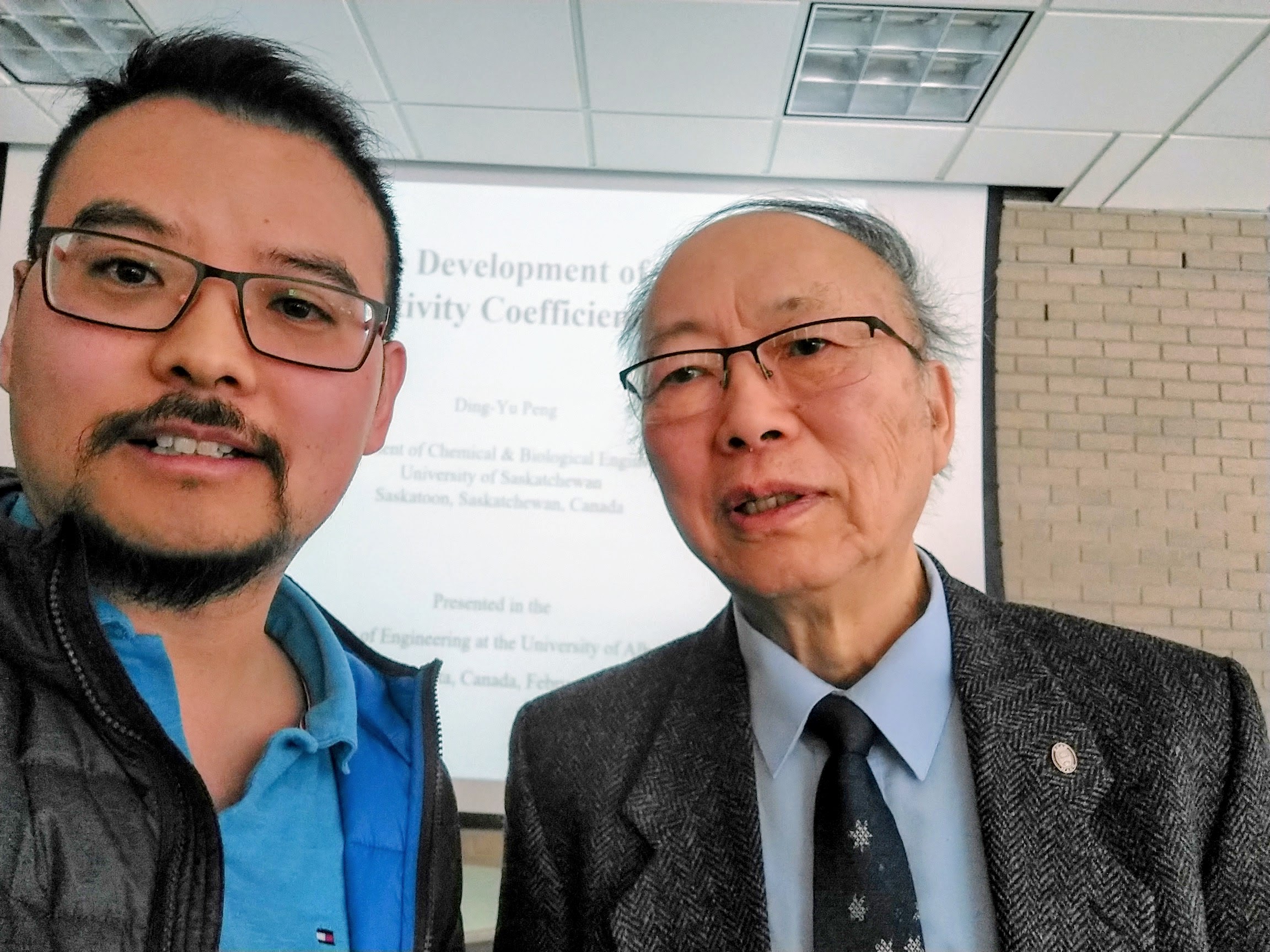

2026 marks the 50th anniversary of the Peng-Robinson Equation of State (PR EoS) model. For Lixing, a PhD student in petroleum engineering, this legacy isn’t just history: it’s the foundation of his daily research.
First published in 1976 by U of A researchers Dr. Ding-Yu Peng and Dr. Donald B. Robinson, the PR EoS model gave scientists a reliable way to predict how fluids behave under varying pressures and temperatures, fundamentally shaping chemical and petroleum engineering.
Lixing, a Chinese-born scholar and Canadian citizen who returned to academia a bit later in life, knows firsthand that the academic journey isn't always a straight line. I chatted with him about building on a 50-year-old U of A discovery and how meeting a leader in his field gave him a much-needed boost.
What made you choose the U of A for your graduate studies?
I graduated with a master's degree from the University of Regina in 2014 and worked as a research engineer/lab coordinator for eight years. That practical experience gave me a solid foundation, but I started feeling the pull to go deeper.
In 2022, I decided I wanted to do more focused, fundamental research — so here I am. Choosing the U of A was an easy decision. With my background in petroleum engineering, there's really no better place. Our program is consistently ranked top five in the world, sometimes even top two. You just can't beat that level of expertise and reputation. It felt like the natural next step to build on my experience and really challenge myself at one of the best institutions for my field.
Your recent paper on Fluid Phase Equilibria directly builds on the PR EoS. For students outside of engineering, how would you describe your research and how it solves modern challenges?
PR EoS, developed by Dr. Peng and Dr. Robinson 50 years ago, is still widely used in the petroleum industry, including many commercial simulators, due to its simplicity and robustness.
But here's the thing: that model was designed for bulk fluids in large spaces. Today, we're developing unconventional tight formations where pores are incredibly small. When you shrink things down to that level, the confinement actually changes how fluids behave. The old rules don't quite work anymore.
So my research builds on that foundation. We've developed an empirical model that takes pore size into account, modifying the PR EoS for these tiny spaces. This matters because if we can better predict how fluids behave in tight formations, we can design more effective and efficient recovery methods. It's about updating a classic tool for a new generation of challenges.
In 2023, you had the chance to meet Dr. Peng at a campus seminar. As a Chinese-Canadian scholar yourself, what was it like to cross paths with someone whose U of A research has had such a massive global impact?
We don't often get to meet the people whose names appear in our textbooks. Dr. Peng is one of those rare figures.
What struck me most during the seminar was his humility. Here's someone whose work has shaped an entire industry for five decades, and he was just so approachable and intellectually sharp. But what truly touched me was his encouragement. He took time to talk with me about my own research journey.
As someone who came back to academia later in life, I've definitely had moments of doubt. You wonder if you made the right choice. But Dr. Peng's kind words really renewed my confidence. It meant so much coming from him. That conversation reminded me why I'm here and encouraged me to keep putting my passion into the work I love.
How has the broader U of A environment and the mentorship available supported you when things get challenging?
The U of A really does have a fantastic research environment, and that support system makes all the difference when things get tough. I meet with my supervisors, Dr. Tayfun Babadagli and Dr. Andy Li, every single week. We sit down and discuss my progress, and whenever I hit a wall, they provide such useful feedback and clear suggestions on how to move forward. But what I truly learn from them goes beyond solving immediate problems.
They've taught me how to identify important questions worth asking in the first place. That skill is everything in research. Other professors here have also been incredibly supportive. Dr. Ergun Kuru, for example, has mentored me on so much more than just technical knowledge. It's that combination of rigorous technical guidance and genuine personal mentorship that makes this place special. You're never really on your own here.
As someone also actively contributing to the outreach and Science, Technology, Engineering and Mathematics (STEM) education, what’s your favourite part about these efforts?
I've volunteered as an SPE Energy4me Ambassador, a mentor for DiscoverE Camp, a science explorer at the Science Rendezvous festival and many other roles. I’m particularly interested in teaching energy topics through interactive presentations and demonstrations.
My favourite part of these outreach efforts is absolutely the curiosity from the kids. Getting young people excited about STEM is incredibly rewarding. During my presentation on carbon capture and storage, a student suggested we should all just hold our breath for a few seconds to reduce our CO₂ emissions. It was hilarious, but also brilliant in its own way.
That kind of creative thinking is exactly what we need. I love seeing their eyes light up during interactive demonstrations. They're not afraid to ask big questions or suggest wild ideas. That openness is something we lose as adults.
From your perspective, why do passion and perseverance matter more than age?
I know that feeling of running out of time all too well. It's easy to convince yourself there's always a better date to start something. But here's what I've learned: it's probably now or never.
If you keep postponing, that passion slowly fades and it becomes harder and harder to pick it up. I'm about ten years older than a typical PhD student. Honestly, I would have regretted it deeply if I hadn't pursued this. Those years of work experience aren't a disadvantage. They've given me perspective.
I know what I want and why I'm here. So my advice is simple: just get started, even with a small step. Passion and perseverance matter more than age because they're what carry you through the hard days. The timeline doesn't matter as much as we think. What matters is showing up and doing the work you care about.