 YouAlberta
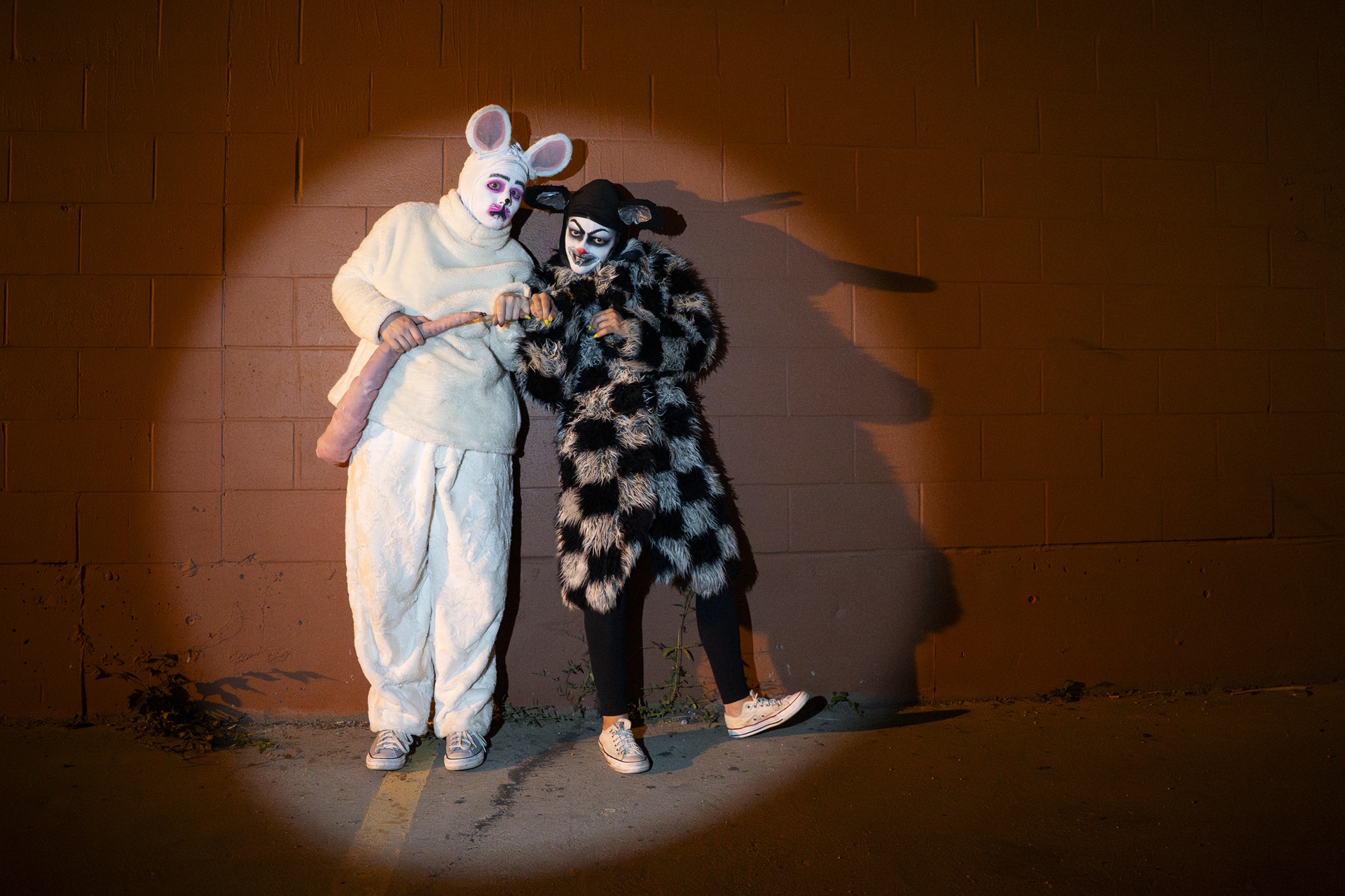

It’s not every day you get to befriend a rat. But, somehow in the chaos, absurdity and tender sincerity of the live show Rat Academy, that’s exactly what happens.
If you haven’t heard of Rat Academy, let me fill you in. Inspired by 1950s anti-rat propaganda, the show follows the last two rats in Alberta — Fingers (Dayna Lea Hoffman), a scrappy street rat, and Shrimp (Katie Yoner), a naive and silly lab rat — as they struggle to survive in a place that hates them.
What began as a short film during the pandemic has since taken on a life of its own. Created by Dayna and Katie, both graduates of the U of A‘s bachelor of fine arts program, the project has evolved through years of collaboration, play and friendship. From its Fringe Festival debut in 2023 to sold-out runs touring in theatres across North America, Rat Academy and its sequel, Rat Academy 2: Gnaw and Order, are beloved in Edmonton and beyond.
And, I’ll admit, I’m a fangirl. I’ve seen Rat Academy more times than I can count, and every single time, I laugh in a deep, belly-hurt inducing way that leaves me grinning long after the curtains close.
This show’s not only hilarious, but it leaves a lasting impact because it brings people together (in a time when we need it most) and allows for an intimate connection with loveable characters. It brings an accessibility to theatre that we don’t always see.
I feel incredibly lucky to know Dayna and Katie, not only as artists I admire, but as friends. And when I exit the theatre and overhear people saying how much they loved it, I always think to myself, “Wow, I can’t believe I know them.”
I sat down with Dayna and Katie to talk about all things Rat Academy — the creative process, getting into character and how they hope audiences respond to their work.
What was the moment in the process when you realized, “Oh, this is going to work”?
D: That moment was definitely at our first Fringe in 2023 — we had no idea what to expect. We developed the show at Play the Fool and it went really well. So, we found the cheapest Fringe venue, a good place to go and test things. We were nervous, but after the third show, the hype started generating. We sold out and people even wanted to talk to us after the show. We would hang out behind the curtain and hear people talking about how much they liked it.
What was the discovery process of these characters, and what did it teach you about your art and yourselves?
K: We started developing the rats when I was finishing the BFA. At the time, my understanding of acting was that to be good in a role, you need to research, write and do acting exercises. What surprised me about playing Shrimp was that so much of the character was discovered on impulse on my feet. In the moment, in the story, the characters’ feelings and choices made sense to me and how Shrimp relates to Fingers. I learned that the character ultimately just needs to exist inside you.
D: In our first performances, we didn’t really have the voices down. A lot of what we discovered over the course of rehearsing is that these characters live so much in the voice and accent. We could do whatever we wanted with the physicality, but individually, we needed to discover who these characters were sonically and vocally.
What do rehearsals look like for you — how do you rehearse for unpredictability and audience interaction?
D: Sometimes we don’t. Sometimes we’re like “We’ll do something like that, “ but we don’t know until we do it. Usually, what we do before the debut is run a workshop — we’d rehearse for a week and have question marks about the audience interaction. We’d bring in colleagues and have them in the room witnessing us, with no makeup and barely a costume. It’s a good way to test it, but we never really know — the work is never officially finished.
K: We have core values for the rehearsal and creation process that we review regularly. Things like, “Try every idea before turning it down.” And, there are different phases to us creating — there are portions where we’re writing or we’re in a room looking at cue cards. And, there's a ton of improvisation. The workshops are an opportunity to throw spaghetti at the wall. The show is so deeply affected by the audience — we never know if something will land until we're in front of them.
What are your pre-show rituals? What do you do to get into character?
D: It’s kind of ‘woowoo.’ We start with yoga and warmups. In the 15 minutes before the shows, we go through two different clown 'ins’ based on the Pochinko style. We thank our cardinal directions and we think back to all the people who have supported us — everyone we know and love — and imagine them standing behind us. Then you go up all the way to space and see a tiny little version of yourself and you give her a fist bump and shoot yourself back down to Earth. Katie and I both have a set of colours, which are personal and unique, and our characters are an amalgamation of our specific colours. We visit all the colours and then put on the teeth— and these are our mask or nose. That's when we are ‘in’ and Shrimp and Fingers have arrived.
K: If you don’t know much about theatre or clown, in a simple way -- before every show, we go through a very specific spiritual meditation that involves gratitude and going through our character’s physicality. Once we have gone through that process, we both consider it that we are those characters. That doesn’t mean that I think that I am Shrimp the rat, but that is only how I will engage until those teeth come off. This allows us to have an absolute respect for the character and gives us permission to explore and play.
D: It really does work. I always think of myself, Dayna the actor, as just okay at improv. But as Fingers, I have no fear about improvising anything.
What do you think is important about touring this show that is very Alberta-specific across North America?
D: There’s nothing really like it. There are very few clown shows that are related to a place. So, I think we’re filling a niche. Beyond Alberta, I think these shows are important because they're absurd, ridiculous and still tender. They allow you to lose things from your day, and you're forced to remain present with the characters on stage. In Gnaw and Order, we bring up a lot of touchy subjects and people have said things like, “This is reminiscent of how I feel as a trans person or as a migrant living in the US.” There are many ways that people can interpret two rats being hated in the place where they live. That’s a big reason for us to tour the show — it gives people hope.
K: Dayna and I are both women in comedy, and shows like this are very important. There are also political and historical themes about how it feels to be an outsider or to be marginalized. I think it really impacts people because there absolutely is a place for theatre made by women or marginalized creators that addresses the intensity of that experience. It’s also important to us that our show is enjoyable, fun and broadly accessible to everyone — regardless of political standings. A lot of the time, people enjoy the show and they aren’t really thinking about the impact of it or what it’s saying until afterwards.
What do you hope audiences feel as they leave the show?
D: JOY!
K: I hope they have a blast. I believe that good theatre comes from a connection with the audience. I hope that the audience leaves feeling like they were part of the show and that the show they just saw will never happen again — that's magic.
D: I learned from my movement teacher that when you directly address the audience, there’s shared information going on between the two of you, and it sounds like “I know that you know, that I know, that you know, that I know, that you know, that I’m right here, right now” — and that feeling is unlike anything else.