Presenting "Who Speaks for Yes?: The Factional Collision of Western Separatists"
13 May 2026
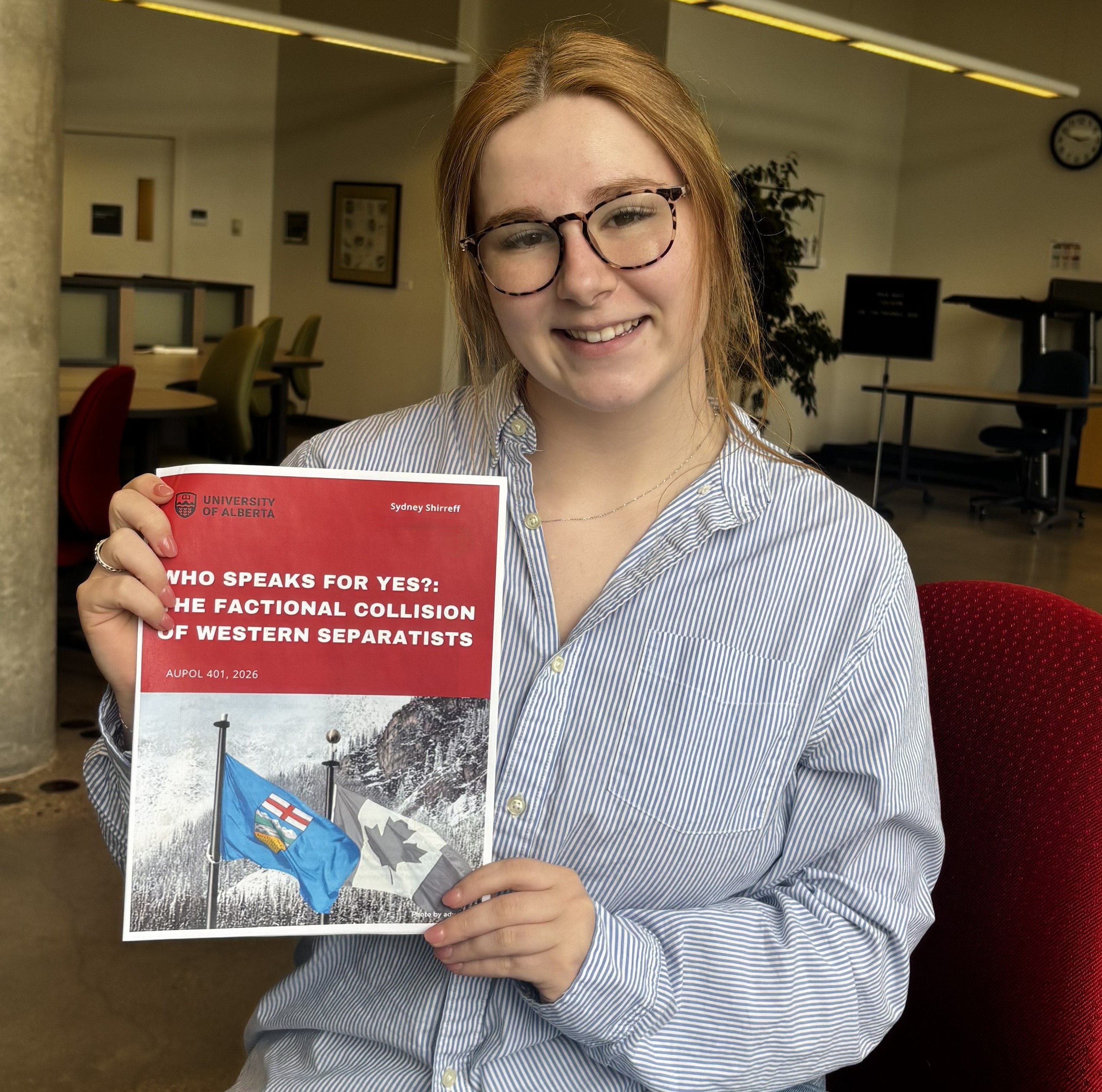
Over the winter semester, Sydney Shirreff (class of 2026), embarked on a directed reading under the supervision of Clark Banack, PhD., of the Alberta Centre for Sustainable Rural Communities located at the Augustana Campus. Her topic centered on the separatist movement and the potential post-referendum outcome of a “Yes” vote for separation. The work became a presentation that earned an honorable mention at the Augustana Student Academic Conference and was submitted for consideration at the Canadian Undergraduate Research Excellence (CURE) conference, hosted by Mount Royal University in Calgary. Her submission to CURE was successful, and she was invited to present in early May of 2026. Of the experience she shares, “It is always daunting, especially presenting on such a topical issue. But overall, it was very well received, and people were appreciative of my talk, which broke down elements of secession.”
As with most of the research at the ACSRC, the topics bridge into researchers' lives and communities. Rural researchers live and work in rural spaces, and the focus of the research themes is often not separate from their lived reality but integrated. It is no different for Sydney. She has seen the shift in real time from separation being a fringe grievance to a mainstream political talking point. The seed of the separatist conversation that started in small pockets of Alberta has taken root in her own community. “I frequently scroll through Facebook and see friends, family, and neighbours expressing genuine political grievances and casually swapping ideas for secession. However, much of what they are consuming is seemingly populist rhetoric.” Populist rhetoric is a political communication style that divides society into two antagonistic groups. Used across the political spectrum, it often employs emotional language, simplistic solutions, and nationalist themes to mobilize voters against established institutions. “With the separatist movement’s promises of zero income tax and unregulated resource extraction,” she explains, “it sounds incredibly inviting to an alienated voter.”
This is what got her interested: To what extent do the modern Alberta separatist movements possess the internal cohesion required to govern as a unified force in a post-referendum scenario? In order to explore this question, her research process involved scraping the digital rhetoric on social media channels and examining the policy frameworks of key figures in the separatist movement. She later analyzed the data through qualitative hand coding. What she found in her research exposed a stark reality: the movement’s internal incoherence. The results of the research project “showcased how populist rhetoric can weaponize community frustration without offering a viable logistical future,” she explains. In a post-referendum “Yes” outcome, the work of creating a functional state would require cohesive governance, an agreed-upon currency, and an immense bureaucratic infrastructure. The research highlighted that these are things this movement’s factions fundamentally disagree on.
Sydney acknowledges that the research is a ‘hot button’ topic and that what the data reveals is most likely not what folks who find the separatist movement inviting want to hear. “I consistently see folks gathering at highway corners to collect signatures for referendums, but I believe that there is a massive disconnect in public understanding.” With such a future-impacting referendum on the horizon for Albertans, it is important to be as informed as possible. This research adds nuance beyond the populist rhetoric.
The full report is available on UAlberta’s Education and Research Archive.