Into the Wild Curriculum: Notes from a Religion and Ecology Study Tour
Joseph R Wiebe - 4 May 2026
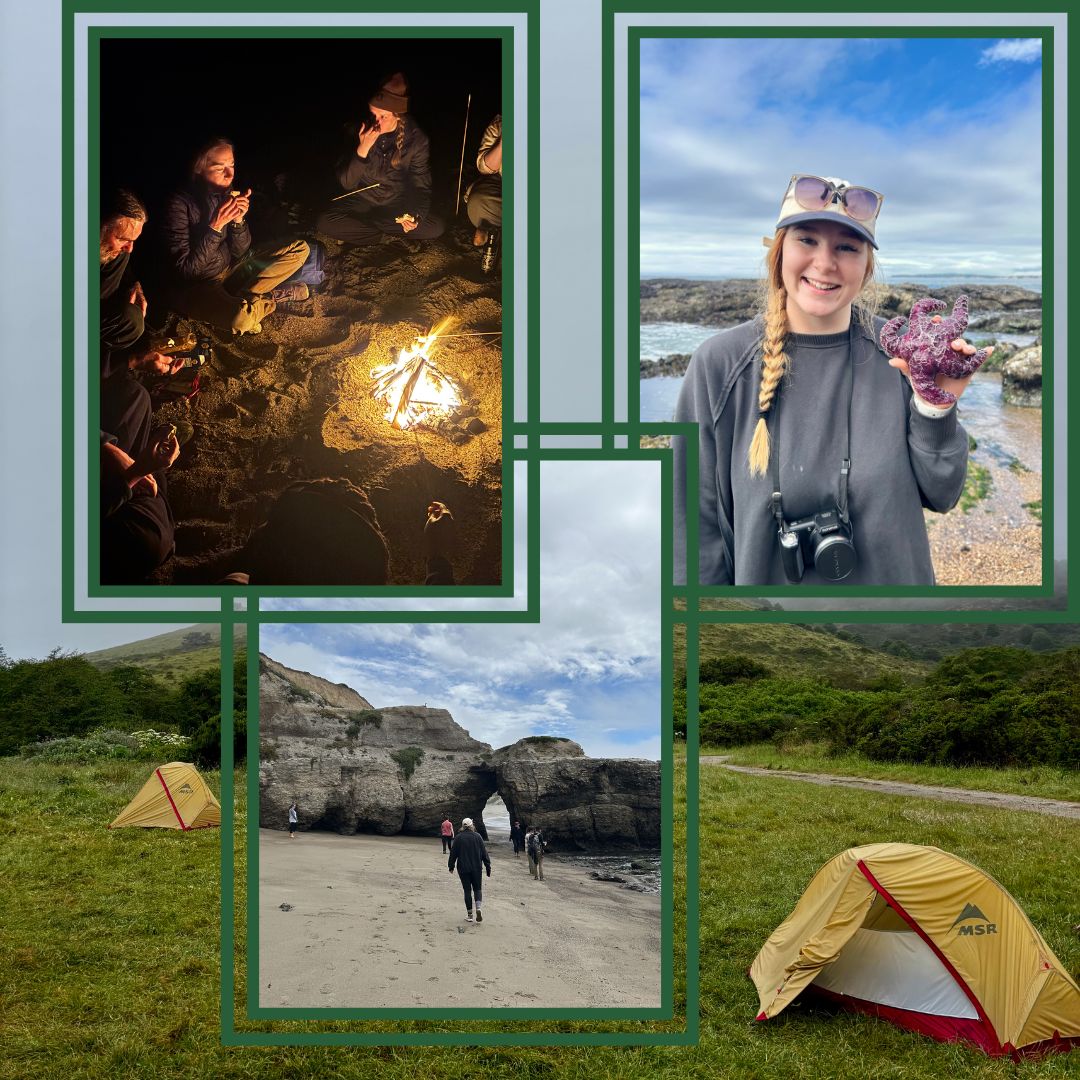
Point Reyes National Seashore, April 2026
In mid-April, I took a group of students from my class, REL 345 Religion and Ecology, to Point Reyes National Seashore in northern California for a three-day, two-night nature immersion. We traded our fluorescent-lit classroom for fog-laced coastal trails, tidal pools, and a campsite lulled to sleep by the sound of breaking waves.
The trip was led by Kim Carfore, an adjunct professor at the University of San Francisco where she teaches outdoor education, environmental studies, and theology and religious studies. Kim guided us through the layered ecology of Point Reyes with an expert's intimacy. Over the course of the immersion she taught us to make fire, led a plant walk through the coastal chaparral, brought us to tidepools alive with mussels and starfish, and helped us climb into sea caves hung with stalactites. Every activity was approached with a leave-no-trace ethic, which Kim introduced less as moral imperative than as a posture to inhabit.
In their reflection essays and presentations, students shared how the encounter was disorienting in the best possible sense.
One student arrived expecting redwood forest (admittedly because of my “false advertising.” My bad) and got beachside camping instead. Her phone died on day one. What followed, she wrote, was an unexpected immersion: "the quiet stillness of our campsite with the calming heartbeat of the ocean waves." The inconvenience turned out to be also a threshold.
Another described standing alone at the ocean's edge as the most transformative moment of the trip. The experience brought her into unexpected contact with theologian Timothy Eberhart's concept of Christian animist economics—not through argument, but through feeling. The ocean, she wrote, simply could not be cheapened. Its scale and indifference to human presence made that impossible.
A third student, someone who had wrestled all semester with how to situate herself within religious frameworks she didn't personally hold, found at the water's edge something she hadn't expected: a felt sense of what animotheism—the indwelling of the divine in living things—actually means. "What religion and spirituality offer to ecological thinking goes beyond thinking," she wrote. "It's feeling."
The course had spent eleven weeks examining how religion responds to ecological crises beyond cosmology through practice, ethics, embodied activism, and emotion. Point Reyes gave those concepts somewhere to land.
For one student, the most significant moment came during Kim's plant walk on the second day. Kim had described plants and the natural world as exuding a distinctly feminine energy—not as metaphor, but as orientation. That framing opened something up. The student reflected afterward that she had begun to understand nature not as "a place to see, but a place to be immersed in, as a place to understand." It was, she said, an "eye-opening experience."
The same student also named something unique for the group. As a Black person, she observed, moving through spaces coded as predominantly white carries its own weight. Drawing on a course reading by Christopher Carter about race and environmental belonging, she reflected that who gets to experience nature in a leisurely, unguarded way is itself a product of social ordering. Being at Point Reyes, and being able to connect with it fully, carried that awareness with it. It both complicated and deepened the experience.
Theological educator Lucas Johnston's notion of "inside-out education" came up repeatedly in student reflections. One student described the experience of the tidal pools forcing her out of what she called her "productivity loop"—a hyper-focused, anxiety-driven academic rhythm—and into the realization that when you are truly present in nature, there is nothing to optimize. "You simply exist," she wrote.
The peninsula itself seemed to provoke this kind of reflection. Situated on the meeting point of two tectonic plates, Point Reyes is a place of visible tension and transition between biomes, between geological epochs, between the human and the more-than-human. We noticed poison oak holding loose soil together on the hillsides, harbour seals cycling between feeding grounds and the Farallon Islands, mussels chemically adapting to rising ocean acidity. One student described the biosphere as "an intelligent, self-regulating system" and found in that observation a grounded theology.
The conversations were not without their tensions, which felt appropriate. We'd driven and flown to get there. Students wrestled openly with capitalism, consumerism, the politics of national park management, and what genuine stewardship might actually require of religious communities. I saw these tensions not as interruptions but as exactly where I wanted the course to go.
Kim's approach made that possible. Fire-making, plant knowledge, attentiveness to trace and presence weren't merely wilderness skills grafted onto a religious studies course. They made it tactile. Ecotheology has a way of remaining abstract until you're crouched in a tidepool watching a mussel do its slow chemical negotiation with an acidifying ocean. One student put it simply, in the opening line of their reflection: "There is no house of worship more beautiful than the wild."