“Community Archiving: Possibilities, Challenges, and Best Practices”
17 September 2026
Description of the event:
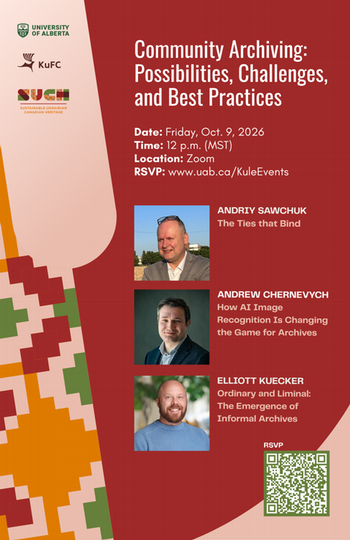
The SUCH online symposium “Community Archiving: Possibilities, Challenges, and Best Practices” brings together three distinctive perspectives on archiving, with a focus on its community dimension. Program subjects will span the range from national institutions to collections kept in a single person's home. Andriy Sawchuk (Library and Archives Canada) focuses on federal holdings, where a century’s worth of correspondence, meeting minutes, and photographs deposited by Canadian organizations and individuals allows researchers to trace how communities survived, thrived, and built futures in both Canada and Ukraine. He shows how those records gain their fullest meaning when read alongside private, provincial, and academic archives worldwide. Elliott Kuecker (University of North Carolina at Chapel Hill) draws on ethnographic fieldwork with three informal archives—collections of ordinary documents that fit neither institutional nor personal models—asking what conditions favour the emergence of such archives and how we can understand the liminal space they occupy. Andrew Chernevych (Galt Museum & Archives) examines how AI image recognition is revolutionizing archival search, description, provenance, and acquisition, using the Galt Museum & Archives as a case study.
Speakers’ bios and presentation descriptions:
Andrew Chernevych
Galt Museum & Archives
How AI Image Recognition Is Changing the Game for Archives
For the last 15 years, Andrew Chernevych has managed archival operations as Head Archivist at the Galt Museum & Archives and has helped community groups in and around Lethbridge, Alberta, preserve their documentary heritage.
Description of Presentation:
AI-powered image recognition is significantly impacting how archives operate and how researchers engage with archival records. The technology is revolutionizing how image searches are conducted, how archival descriptions are created, how provenance and authenticity are tracked, and even how archival acquisitions are done. Based on a case study of Galt, the presentation offers a perspective on the current implications and future projections of this technology.
Andriy Sawchuk
Library and Archives Canada
The Ties that Bind
Andriy Sawchuk holds a BA (Hons) in Art History and Archaeology from Brock University and an MA in Art History and Museum Studies from the State University of New York at Buffalo. He has worked at museums and galleries in Canada and the United States, including at the Niagara Falls Art Gallery's Kurelek Collection. Since 2018, he has served as an Archivist and Researcher at Library and Archives Canada in Ottawa, working with a variety of teams to preserve, manage, and provide access to Canada’s documentary heritage.
Description of Presentation:
Library and Archives Canada (LAC-BAC) is a federal entity that houses the institutional memory of our nation’s history. By piecing together correspondence, meeting minutes, photographs, and other documentary evidence, researchers can reconstruct how communities in Canada survived, thrived, and created a better future for people in both Canada and Ukraine. This presentation will bring attention to many personalities, some well-known and others who should be. LAC-BAC is only one piece of this puzzle. By combining the knowledge here with various other private, provincial, and academic archives from across the globe, a clearer picture can be formed of what was and what is Canada and Ukraine.
Elliott Kuecker
School of Data and Information Sciences, University of North Carolina at Chapel Hill
Ordinary and Liminal: The Emergence of Informal Archives
Elliott Kuecker is an Assistant Professor in the School of Data and Information Sciences at the University of North Carolina at Chapel Hill. His research focuses on how archives and historical consciousness are relevant to everyday people outside of formal archives, including K–-12 students and small organizations.
Description of Presentation:
Informal archives do not easily fit within our ideas of institutional collections, personal archives, or normative understandings of community archives. Yet such archives—often started by a single person and full of ordinary documents from everyday life—exist everywhere, all the time. By taking an ethnographic approach to studying three examples of such informal archives in North Carolina—including the materials collected, the spaces in which they are stored, and conversations with those who care for the collections—we can generate an understanding of why and how these archives exist, occupying a liminal space among more well-known types of archives.