Meet Our New Students at the Kule Folklore Centre
5 October 2026
This fall, the Kule Folklore Centre is pleased to welcome two new graduate students and support their research on Ukrainian communities, culture, and identity in Canada.

“Howdy, my name is Jonathan Grossman. You may remember me from the video that we produced for International Archives Week, or perhaps you have seen me at one of the many fantastic events organized by the Kule Folklore Centre.
I am thrilled to announce that, after volunteering and working at the centre through my undergraduate degree, I have begun a Master of Arts program in the Department of Modern Languages and Cultural Studies. While this represents a big change in my life, I am extremely grateful to have the opportunity to continue my work with the Kule Folklore Centre, which is supporting my graduate studies and research.
My current research interests include Ukrainian diaspora studies, expressions of culture and identity, and ethnographic research. My thesis project will investigate the lived experiences and identity expressions of newcomer Ukrainians in the Yukon Territory. Through ethnographic research, I aim to examine how displacement, Russia’s ongoing war against Ukraine, and settlement in the unique environment of the Canadian North have influenced cultural practices like music, art, and community organizing.”
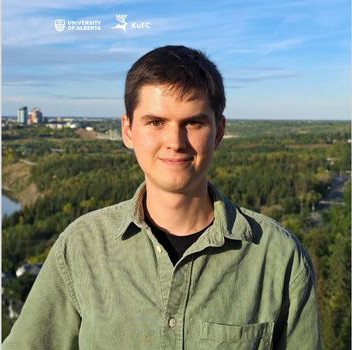 “Hello, my name is Illia Pokotylo. Originally from Kyiv, Ukraine, I came to Canada in 2022 and completed my master’s degree in the Department of Modern Languages and Cultural Studies. Almost immediately after my thesis defence, I knew that I wanted to continue my academic journey here in the same department, on a larger scale, in a PhD program. It goes without saying that my part-time employment at the Kule Folklore Centre played a pivotal role in my decision to become a doctoral student. The friendly, almost homelike work atmosphere of the centre helped me to find a sense of belonging in a new country.
Driven by my passion for choral singing, my doctoral research will examine the history and social role of Ukrainian community choirs in Canada, particularly as vital support networks for newcomers. My goal is to situate these ensembles within broader academic discourse by combining archival research (in the Medwidsky Archives, CIUS, and Oseredok, for example) with field interviews of conductors and singers. Crucially, the study will also analyze how these choir communities have evolved following Russia’s full-scale invasion of Ukraine.”