Misha Macwan, Award Winning Undergraduate Researcher
Marcie Whitecotton-Carroll - 9 April 2026
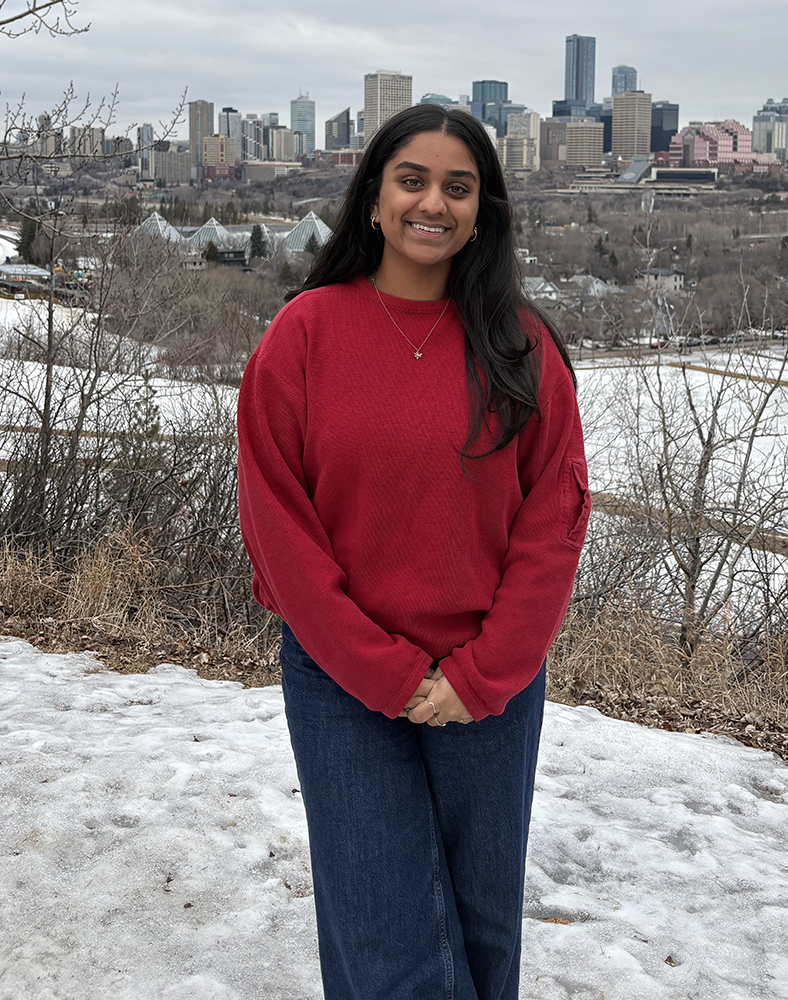
We caught up with Misha Macwan, a fourth year double major in Psychology and Linguistics in the Faculty of Arts who recently presented her research at FURCA. Here are her answers in our Q&A.
Describe your FURCA research project and what your goals are/were for your presentation?
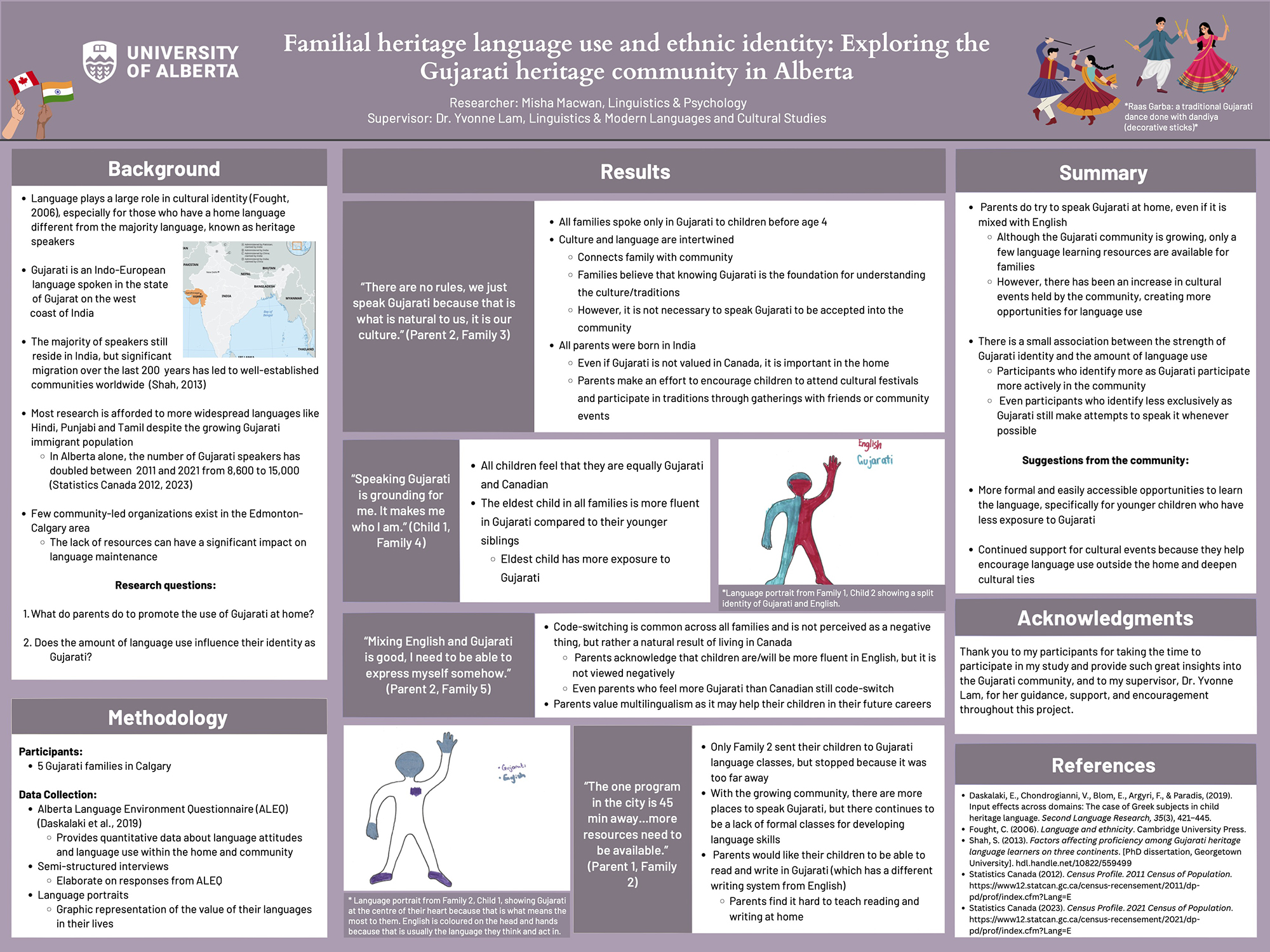
My research project explores how identity influences home language use among Gujarati-speaking families in Calgary. Specifically, I examine how parents maintain Gujarati in the home, whether a stronger cultural identification is associated with increased language use, and how language practices may, in turn, shape identity. Using a mixed-methods approach, I collected survey data through the Alberta Language Environment Questionnaire (ALEQ) and conducted interviews that included a “language portrait” activity to better understand participants’ linguistic identities.
I found a small association between the strength of Gujarati identity and the amount of language use, as participants who identify more as Gujarati participate more actively in the community and therefore use the language more. Nonetheless, participants who identify less exclusively as Gujarati still made attempts to speak it whenever possible. All of the families have strong cultural ties to the Gujarati community and believe that the Gujarati language acts as the foundation for understanding culture and traditions. With these strong cultural ties and values for speaking the language, there is still a lack of formal opportunities for language learning. Only one family sent their children to language classes, but stopped because it was too far away for them. The families all believe that more language classes should be available and easily accessible. Overall, they are proud to be Gujarati and want their children to pass down the language and traditions because it is who they are.
The goal of my presentation is to highlight the experiences of a smaller, underrepresented heritage language community and to demonstrate how limited community resources impact language maintenance. I also aim to show how identity and language are interconnected, and to bring attention to the importance of supporting heritage languages within immigrant communities.
Is this the first time presenting your research to an audience?
No, I presented this particular study in September at the Arts Celebration of Excellence night, with other recipients of the Roger S. Smith Award. I have had opportunities in my LING 321, 375, and 400 classes to present my research as well. I was also lucky enough to attend the Language and Power Conference in Kelowna last spring, where I presented on another research project I worked on with Dr. Yvonne Lam about Heritage Languages in Alberta.
Are you using any unusual mediums (like painting, etc) for your presentation?
Yes, I incorporated a visual method called “language portraits” into my research, where participants use colours on a body silhouette to represent the languages they use and their personal connections to them. This creative and visual medium provides insight into how individuals perceive their linguistic identities and adds a more personal, expressive dimension to the research beyond traditional survey and interview data.
What did you most looking forward to getting out of the event?
Presenting at FURCA was a great opportunity to practice my presentation skills and showcase my research to people who are unfamiliar with this subject. In my opinion, this topic is something that seems very intuitive, but examining heritage languages on a deeper level shows how important language maintenance is. It was also interesting to hear the stories of other heritage speakers who resonated with my poster and sparked many meaningful conversations.
Why are you interested in showcasing this project and, in general, what drew you to your program of study?
This project is very personal to me, as I am a Gujarati heritage speaker myself, and my family has instilled in me the importance of culture from a young age. My family has always been involved in the Gujarati community, and I have seen the lack of resources available for language learning/maintenance. This has fueled my interest and passion for understanding my community on a deeper level to promote the Gujarati language in Canada. There is also a large gap in research when it comes to Gujarati, particularly in this context, so I want to do what I can to add to it, and hopefully encourage other Gujarati researchers to do the same.
I wanted to pursue a double-major in both psychology and linguistics because it combines two of my favourite interests, the brain and language. More specifically, I am hoping to pursue a career in speech-language pathology because of my experiences as a multilingual speaker and my interest in how language shapes identity, communication, and access to opportunities. I have seen how language barriers can impact individuals in educational and community settings, and I am motivated to pursue a career where I can support diverse populations to promote more inclusive communication practices.
Below is Misha’s Roger S. Smith winning poster that also was the basis for her FURCA presentation.
Thanks for the great interview, Misha and all the best!