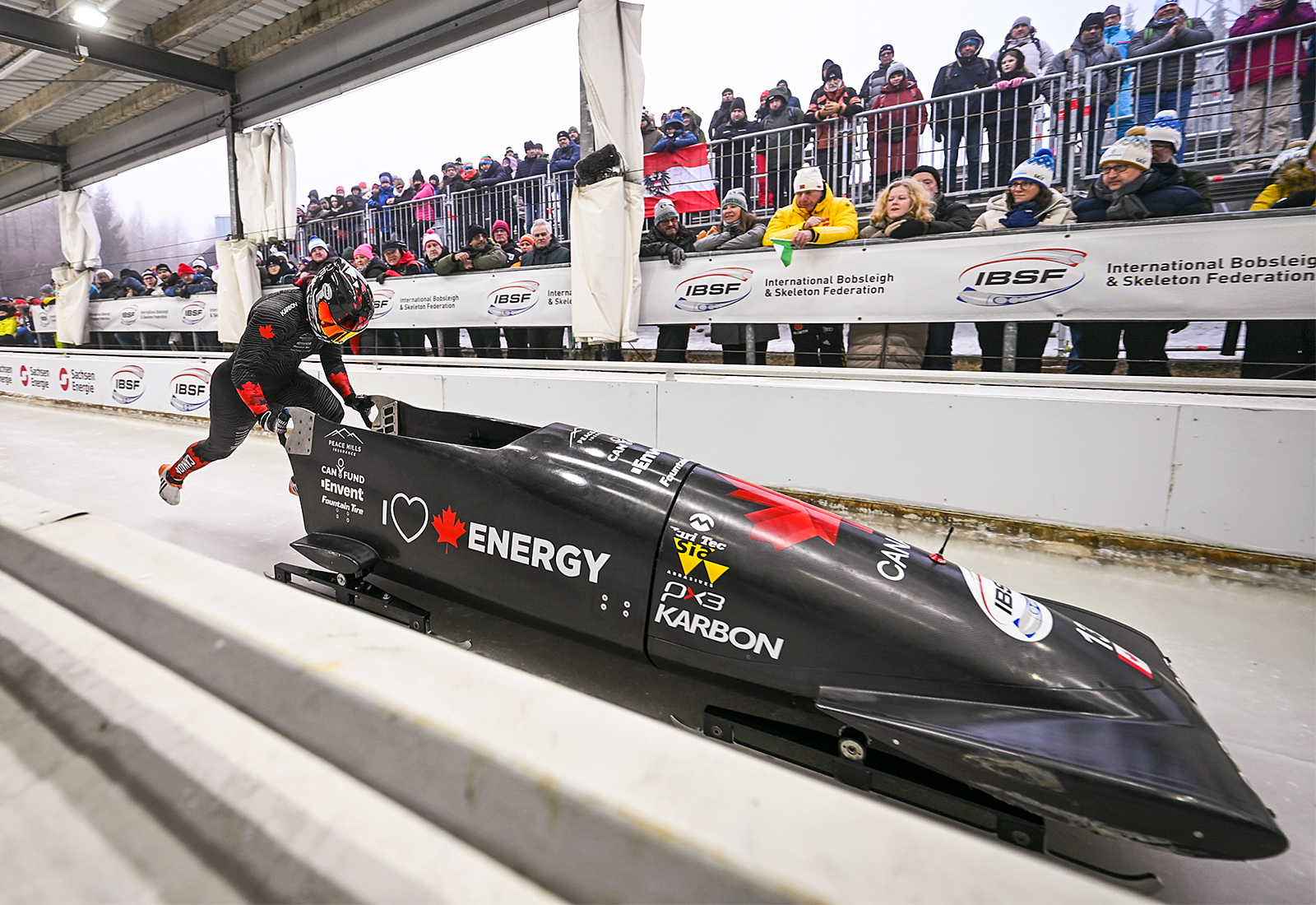
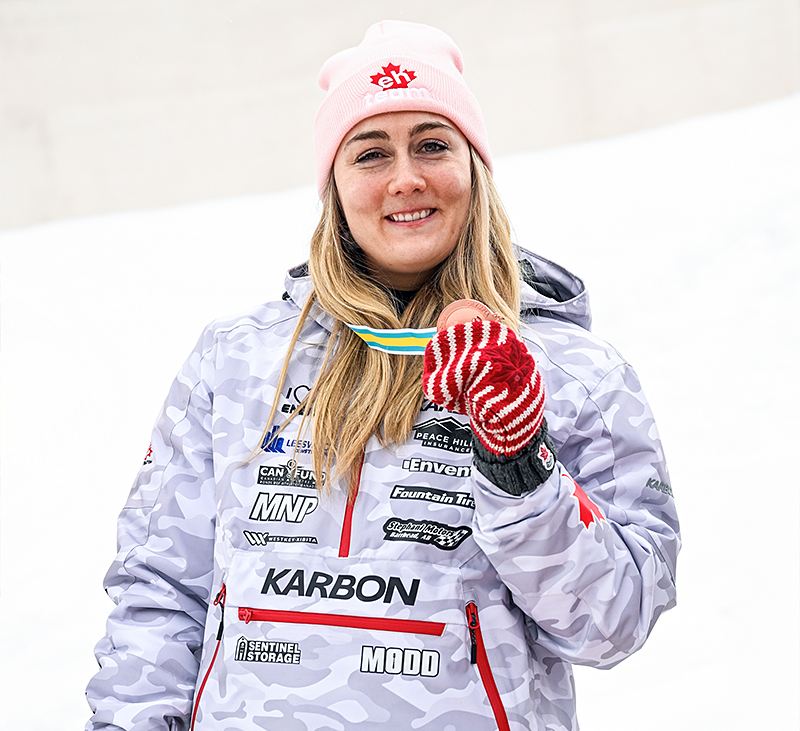
Melissa Lotholz, ’23 BSc(Nutr/Food), was studying for midterms in February 2014 when she watched Kaillie Humphries win her second Olympic gold in Sochi. By that November, she was racing beside her.
The former Golden Bears sprinter (who ran the 60 metre for U of A track and studied nutrition and food science through the Faculty of Agricultural, Life & Environmental Sciences) is now training for her third Olympic Games. She’s the only Canadian woman to compete at the Olympic level as both brakeman and pilot, and after 12 years in the sport, she’s still learning. In her very first journal, written at a church youth retreat when she was 12, she described the Olympics as a dream that felt almost out of reach at the time.
Here’s what bobsleigh has taught her since.
1. Stay curious.
“You can never have a perfect run. There’s always something in that kilometre where you’re thinking, I could have been two inches higher here. I think it’s that pursuit of mastery, and that curiosity, that really drives me.”
Lotholz describes her approach to piloting as “a game and a dance.” The ice changes year to year, the tracks demand constant adjustment, and she’s learned that the athletes who last are the ones who stay playful.
“I feel like I have a really curious approach to the sport, and I think that’s what keeps me coming back for more.”
2. Trust the process, even when you can’t see the harvest.
Growing up on a family farm near Barrhead, Lotholz watched her parents put hundreds of thousands of dollars of seed into the ground each year with no guarantee of return.
“You do what you can, you do the work, but then you just have to let it grow. You have to trust the process. You see storms come, and there’s that vulnerability: is this going to wipe out my crop, or produce a beautiful harvest?”
She didn’t fully understand that lesson until she was deep into sport. Now she sees the parallel everywhere: in the years it takes to become a medal-threat pilot, in the coaching she does with novice athletes, in the way progress often looks like nothing until suddenly it doesn’t.
3. The real gold medal is who you become.
“I have grown so much as a person, not just as an athlete, because of bobsleigh. That’s the greatest gift. That’s the gold medal I get to take away whether or not I ever stand on an Olympic podium.”
When Lotholz looks back at the hardships of elite sport, she’s honest: if her 21-year-old self had known what was coming, she might not have signed up.
“But on the flip side, you learn how strong you are. You learn how deep your faith can go, how deep your values can go.”
4. Take the risk. Get out of your comfort zone.
After her first Olympics in 2018, Lotholz made an unusual decision: she moved from the back of the sled to the front, transitioning from brakeman to pilot. It typically takes six to eight years for a pilot to become a medal threat. Lotholz set an ambitious goal: return to the Olympics in a brand new position within four years.
“When I made that jump, I had to take a big chance on myself. And I think jumping into a career is the same. You’re getting out of your comfort zone, taking risks, trying new things, and being willing to fail.”
She’s now the only Canadian woman to have competed at the Olympic level in both positions.
5. Bring people into the journey.
Here’s something Lotholz didn’t expect to learn from bobsleigh: how to run a business.
Her federal and provincial stipends total $30,000 a year. Her budget for this Olympic season is $70,000. The gap comes from corporate sponsors, private donors, fundraising events and even a collaboration with a Calgary microbrewery on a non-alcoholic beer.
“My advice to young athletes would be: embrace it, don’t fight it. Start having conversations about who can be part of your journey. It’s not one size fits all, but those connections can really help you get to the next level.”
Lotholz took a year off after the 2022 Beijing Games to return to Edmonton and finish her degree. She’s grateful to ALES for the flexibility for letting her leave, and for welcoming her back. Now, with the Milan Games weeks away , she’s exactly where that 12-year-old in her journal hoped she’d be.