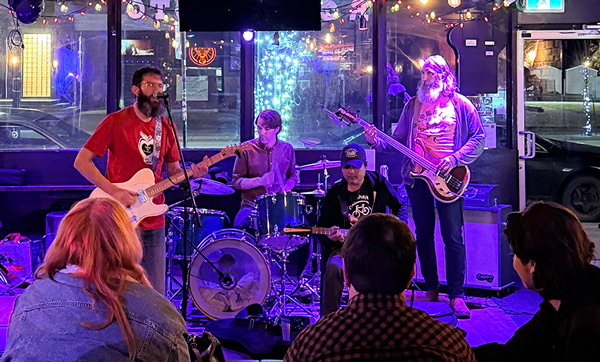
During a recent set at an Edmonton bar — a place where the stage is just a cleared section of floor — a young man wobbled up in front of us. He began moving like seaweed in a current, in undulations, some slow, some quick, none in time with what we played. Then he flopped prostrate onto the floor. Everyone in the room, including me and my three bandmates, watched the man remain motionless, as if his tide had gone out.
He was back up half a minute later, and stumbling toward the door. We played on. He’d be the only person among the subdued but polite audience that night to, um, “dance.” Strange as the episode was, it validated my decision to record a debut album, then perform it around town, at this stage of my life.
I recently turned 50. I have the merit badges to prove it: a loving family, steady employment, too many pets, a list of deferred home maintenance, new pain in old body parts. When I was younger, I had hopeful dreams. They weigh on me now like unfinished business. I’d felt that most heavily with respect to making music. Until recently.
Let’s rewind the tape a bit. Not so far as to when I was learning to play guitar as a teenager, trying to fit in or stand out. Let’s go back just a couple of tracks, stopping at the silence that was the pandemic. Before then, a couple of old friends and I would casually get together to play, writing songs we figured we’d record or perform someday. And, suddenly, we couldn’t.
I responded to the shutdown blues by not giving up. Maybe I was grappling with loneliness, like my teenage self. Music fills all kinds of emptiness, be it a room or a soul. So, kids in bed, I’d take my acoustic guitar into the garage. Some evenings were so cold the metal strings stung my fingertips. But time felt too precious to waste — who knew what tomorrow may bring? I soon had a set of songs that I would eventually take to my friends with a proposal for recording. They immediately agreed.
I want to think that’s what midlife is all about: finally understanding how best to use your time. There’s likely more of it behind you than ahead, so maybe you buy a sports car, or change careers, or spend months of Saturday afternoons in a studio playing take after take until, one happy day, your producer — a talented young sound engineer who wouldn’t quit because he knew what this meant to you — calls it a wrap.
We released Anomalies on Nov. 4, 2024. I wish I could say to great acclaim. It’s a collection of eight original, guitar-oriented rock songs that probably sounds too much like the music of our youth for the youth of today to enjoy. It received some airplay on CKUA, a generous review in a local zine, and no attention whatsoever by other media. As testament to their indifference, I have 250 CDs left of an order of 300, which, being a child of the ’90s, I couldn’t not press. We gig every few months, usually alongside bands with members half our age. Sometimes, out of kindness or irony, a fan of those young bands buys one of our discs.
All of that is fine with me.
Making an album has made each of us more appreciative of what music brings to our lives, which so far hasn’t been fortune and glory. We practise weekly. It’s never convenient, given kids, spouses and deferred home maintenance, but we make the time because we know it’s helping us work on other things, too.
For one thing, playing a song commandeers your consciousness, which has a cumulative effect of decluttering your view on life. For another, music is an inexhaustible source of newness. At an age when it’s hard to be surprised, I am every time a guitar line emerges during a jam, or by the many forms that appreciation may take at a gig. I’ve come to look forward to the unexpected, to be invigorated by possibility. It feels like optimism.
In any case, I return to my family improved.
Where will this all lead? We have no delusions (we’ve made a grand total of $20.37 via streaming). We likely should have debuted years — nay, decades — ago. But what did we know? We had nothing but time. Really, where this may lead doesn’t matter. The direction feels right. We’re putting our talents to use, being productive, and actually improving. If that gets us to the next stage, wherever that may be, it will be worth everything we give to it.
Scott Messenger is a writer, editor and musician whose band is called Daughters of England. He’s the author of Tapping the West, a book about craft beer in Alberta. Daughters of England also features Guy Tebay, ’02 BEd; Colin Damo, ’00 BSc; and Brock Stoyko, ’04 BA Native Studies.