APEGA’s Rock & Fossil Clinic inspires the next generation of geoscientists
Faustina Awafu and Alyssa Fraser - 21 November 2025
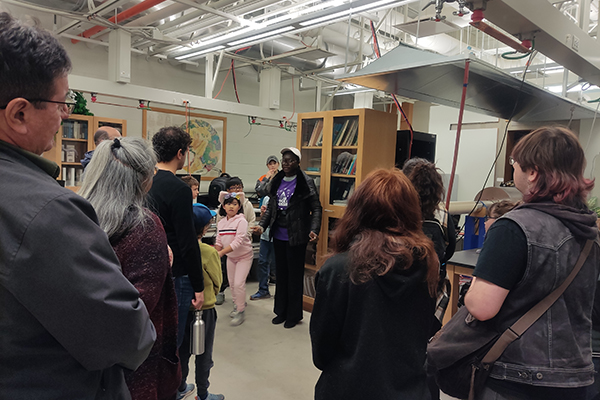
A geophysics graduate student explains an experiment to Rock & Fossil Clinic participants in the geophysics lab. Photo courtesy of APEGA.
On October 4, 2025, the University of Alberta’s Earth Sciences and CCIS Buildings buzzed with excitement as more than 650 visitors — including 282 students from kindergarten to Grade 12 — took part in the 32nd annual APEGA Rock & Fossil Clinic. Hosted by the Association of Professional Engineers and Geoscientists of Alberta (APEGA), the event turned the campus into a hands-on geoscience playground for families, educators and future scientists.
This year, as they have since 2022, the Geophysics group multipurpose geophysics laboratory and Professor Vadim Kravchinsky’s laboratory in the Department of Physics opened their doors for an inside look at how geophysicists “see” beneath the surface of the Earth. Because the subsurface is usually hidden from view — and from everyday understanding — the team designed interactive stations to make three core geophysical techniques tangible: magnetics, ground-penetrating radar (GPR) and seismics.
With guidance and training from Masoud Mirzaei, we, Faustina Awafu and Alyssa Fraser, joined fellow geophysics student volunteers Aram Moradi, Sepideh Alizadeh, Mengting Zhong, Sajad Rostami and Qinyu Cui, to take the lead in planning and running the activities in the Department of Physics. The Department of Earth and Atmospheric Sciences hosted parallel activities. Together, graduate and undergraduate volunteers, and geophysics alumnus Ryan Borowiecki and APEGA representative Elizabeth Tate, guided visitors, explained the science and shared their enthusiasm for the field.
Alyssa spoke for us all when she said, “As an undergraduate in geophysics at the University of Alberta, volunteering with the Rock & Fossil Clinic was an incredibly rewarding opportunity to share what I’m passionate about. I’m grateful for the University and APEGA’s continued support of students like me as we grow into future geoscientists, and I hope my contributions at the clinic inspire more young people to explore this field.”
At the seismic station, visitors learned how geophysicists use vibrations to image the deep subsurface — like taking an ultrasound of the Earth. Demonstrations showed how sound waves travel through the ground and reflect from buried layers, the same principles used to monitor earthquakes and explore for resources such as minerals, oil and gas. Children crowded around screens to see how simple taps at the surface could be transformed into pictures of what lies below.
The Ground Penetrating Radar (GPR) station focused on the shallow subsurface. Volunteers explained how high-frequency electromagnetic waves can reveal buried infrastructure, archaeological features and changes in soil and rock. Visitors saw how GPR profiles translate into maps of pipelines, utilities or hidden objects — a tool that connects geoscience directly to everyday problems in engineering, construction and heritage preservation.
At the magnetics station, participants experimented with magnets and learned how different rocks interact with Earth’s magnetic field. In the laboratory, they saw how tiny magnetic minerals preserved in rocks record the direction of the geomagnetic field at the time of their formation, providing clues to plate motions and long-term climate change. One guest summed up the experience as “something you don’t get to see normally” — a rare chance to connect abstract ideas about magnetism to real rocks in hand.
Outside the lab, the popular “Find the Ore” activity lets visitors run their own magnetic survey using the magnetometers built into their phones. With guidance from volunteers, children hunted for hidden magnets and then compared their results with data from a backpack-mounted magnetometer like those used in geophysics field school. Families are left with a magnetometer app to keep exploring at home. One parent later commented that their children “spent the next couple of days using the new app for all kinds of experiments … it really inspired them!”
Across the hallway, colleagues from the Department of Earth and Atmospheric Sciences led complementary activities, including rock and fossil identification, tours of the Mineralogy, Petrology and Paleontology Museum, a guided walk through the Geoscience Garden and presentations on Alberta’s hydrology and earthquake surveys. Together, the programs highlighted how geology, geophysics and environmental science work as interconnected pieces of the same story.
For many attendees, geophysics and geoscience are subjects encountered only briefly in school or in the news. The Rock & Fossil Clinic helped shift that perception by putting tools, data and specimens directly into visitors’ hands. Children asked questions about earthquakes, climate and natural resources; parents learned how the same methods used in research labs support safer infrastructure, better resource management and environmental monitoring.
The clinic also strengthened ties across the broader geoscience community. APEGA partnered with four key local groups: the Alberta Geological Survey, the Edmonton Geological Society, the Department of Earth and Atmospheric Sciences and the Department of Physics. Their combined efforts showcased the collaborative nature of geoscience — bringing together expertise from multiple disciplines to understand and protect our planet.
By the end of the day, the message was clear: geoscience is not distant or inaccessible. It is a dynamic, collaborative field that shapes how we build, live and adapt on a changing Earth. For the students who volunteered, the clinic was a chance to practice science communication and mentorship. For the children and families who visited, it may have been the spark that turns curiosity into a future career in geoscience.
About the authors
Faustina Awafu is an MSc student in the Department of Physics and Alyssa Fraser is a third-year geophysics major.