U of A physicists honoured to be part of Nobel winner Francis Halzen's IceCube Neutrino Observatory team
Suzette Chan - 14 October 2026
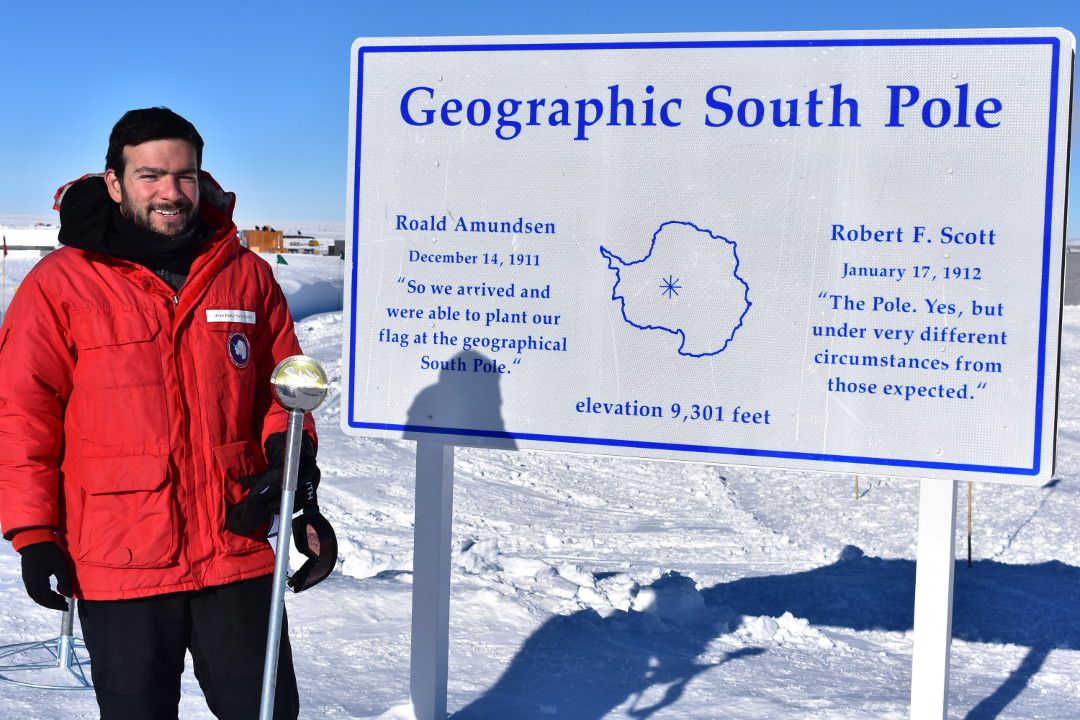
University of Alberta physicist Juan Pablo Yañez during a visit to the South Pole to work at the IceCube Neutrino Observatory.
University of Alberta members of the IceCube Neutrino Observatory collaboration welcomed news that the experiment's leader, Francis Halzen, received 2026 Nobel Prize in Physics.
"IceCube truly works as a collaboration, where all the researchers involved exchange ideas and explore research topics together," says Juan Pablo Yañez, Director of the Centre for Particle Physics at the University of Alberta. "We all are involved in operating the detector and help to improve the interpretation of the data."
Halzen, based at the University of Wisconsin, started as a theorist, but turned his attention to neutrino telescopes. He is the driving force behind the IceCube Neutrino Observatory, whose research led to the discovery of neutrinos from sources outside our galaxy.
The IceCube facility is built around a particle detector made of a cubic kilometer of ice in the Antarctic. Strings of sensors sunk into the ice detect neutrinos as they travel through the earth. IceCube detects the highest energy neutrinos emitted from the vicinity of black holes, allowing researchers to “see” an area of the universe that was previously obscured.
The University of Alberta formally joined IceCube shortly after the facility opened in 2011. Since then, a number of faculty members have played prominent roles in the collaboration. Yañez recently served as physics coordinator of the IceCube Upgrade, a new addition to the detector that was successfully installed in the polar glacier just last winter. Previously, he led the collaboration's physics working groups that focus on the "low-energy" data of the detector. The late Roger Moore, who was a professor and Chair of the Department of Physics, led the trigger management group of IceCube, and started efforts to explore searches for new physics with IceCube.
Students and postdocs travel to the South Pole to help improve and maintain the detector systems. They also gain knowledge and skills for future endeavours. Two former students are back at the University of Alberta as researchers: Tania Wood, now a professor of oncology, and Sarah Nowicki, project manager for the P-ONE neutrino experiment.
Halzen visited Edmonton in 2015, when he delivered a plenary presentation entitled “IceCube and the Discovery of High-Energy Cosmic Neutrinos” at that year's Canadian Association of Physicists congress.
Of Halzen, Yañez says, "Francis is very involved in the scientific discussions, and he engages with everyone, particularly during our in-person collaboration meetings. At some point, most people working in IceCube end up having intense scientific conversations with Francis. We are very honoured to be part of his team and will continue to pursue discoveries using the highest energy neutrinos in the future."