CBRF2-BRIF2 Viral Vector Vaccine Platforms (V3P) Retreat
6 November 2025
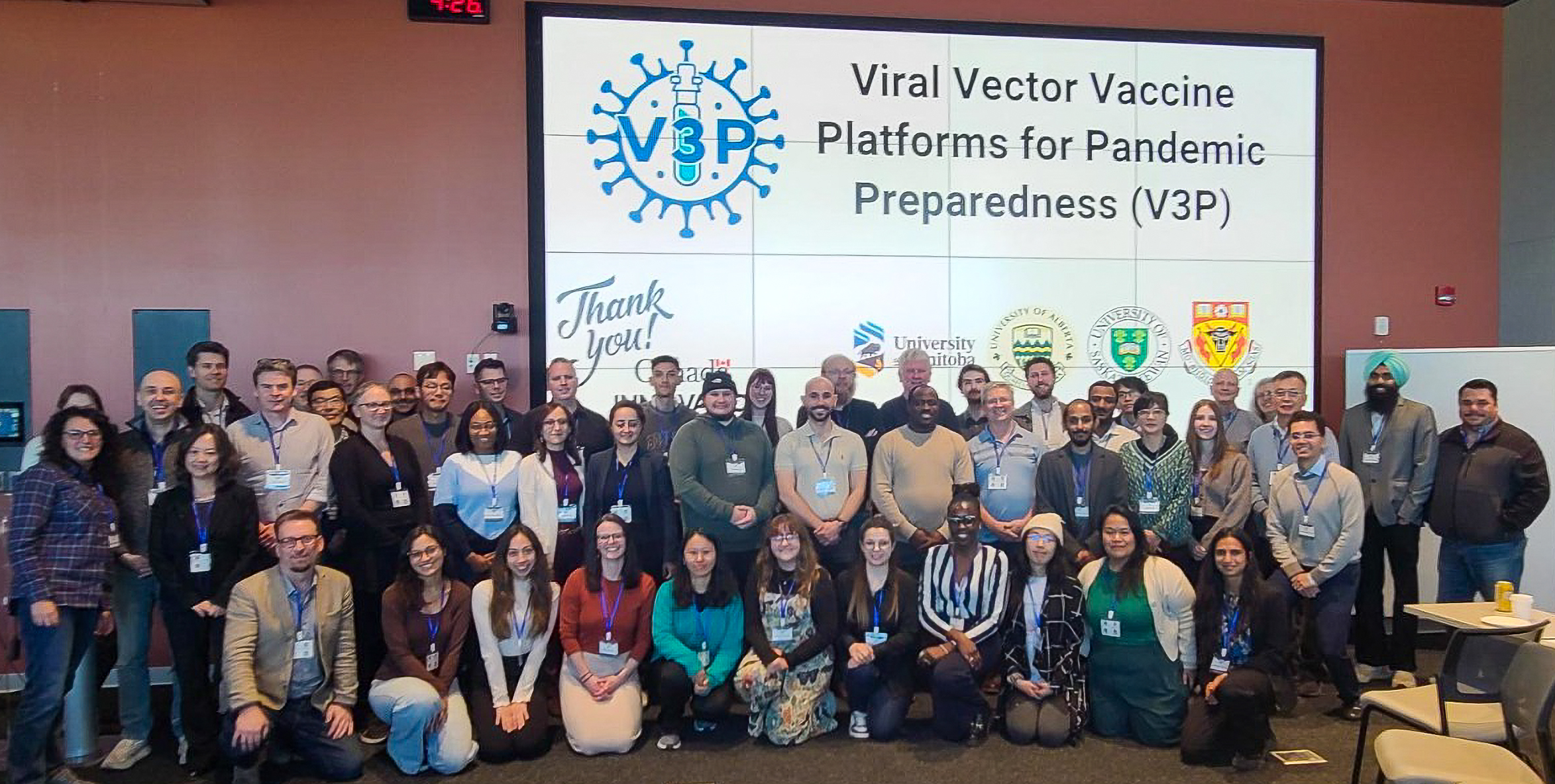
Researchers and trainees from the V3P team gather at the University of Manitoba on Oct. 23-24, 2025
Researchers and trainees from across the PRAIRIE Hub region gathered at the Smartpark Innovation Hub in Winnipeg on October 23-24, 2025 for the Viral Vector Vaccine Platform (V3P) Retreat. Teams from the Universities of Manitoba, Alberta, Saskatchewan, and Calgary were joined by partners from PHAC, CFIA, DRDC, and the Institute of Health Economics (IHE). Trainee travel was supported by the PRAIRIE Hub.
Co-Directors Dr. Maya Shmulevitz and Dr. Peter Pelka opened the retreat by emphasizing collaboration and shared purpose. They outlined the goal of building a national vaccine-development pipeline — eight “plug-and-play” platforms that can be compared and deployed rapidly to strengthen Canada’s biomanufacturing capacity.
Co-Directors Dr. Maya Shmulevitz (vaccinia virus vectors, molecular virology, University of Alberta) and Dr. Peter Pelka (adenovirus platforms, University of Manitoba) opened with a call for collaboration, emphasizing the V3P’s goal of developing eight “plug-and-play” vaccine platforms that can be compared and deployed rapidly to strengthen Canada’s biomanufacturing capacity. The initiative brings together a broad network of principal investigators. At the University of Manitoba, these include Drs. Brian Mark (protein chemistry and antigen purification), Elham Salimi (lab-on-a-chip bioprocessing), Barbara Porto (immunology and disease pathogenesis), Xian-Jian Yao (vesicular stomatitis virus vectors), Keith Fowke (cellular immunology), and Jörg Stetefeld (structural biology). The University of Alberta team includes Drs. Matthew Macauley (glycan biology and immunology), Hosna Jabbari (AI and machine learning), Vanessa Meier-Stephenson (bioprocessing and scale-up), Xavier Clemente-Casares (immunopathology), Troy Baldwin (flow cytometry and immunoregulation), and Sue Tsai (B-cell immunology). The University of Calgary is represented by Drs. Hector de la Hoz-Siegler (hydrogel vaccine delivery), Guido van Marle (disease pathogenesis), and Craig Jenne (intravital imaging and biodistribution), while Dr. Suresh Tikoo (porcine and fowl adenovirus vectors) leads the University of Saskatchewan team.
Day 1 – Innovation and Integration
The first day highlighted advances in vector design, protein engineering, and immunology. Trainees Zhujun Ao (rVSV vector vaccines), Janelle Nordin and Dirk Taal (vaccinia vector constructs), Adil Mohamed (H5N1/rabies-virus vectors), Wenjun Zhu (H5N1/adenovirus type 4 vaccines), Nausin Tasnim (complementing cell line for Ad4 vectors), Malcolm Walling (in vivo cytotoxicity assay for immune response to H5N1), and Niranjan Pathiranalage (H5N1/porcine adenovirus vectors) described new and improved vaccine platforms. Later, Michael Kim (making influenza hemagglutinin ectodomain to study where antibodies bind), Oliver Peters (making high quality H5N1 nucleoprotein for structure studies), and Aidan van den Driessche (using cell-penetrating peptides to prime efficient T cell responses to viral peptides) discussed structural and protein-based approaches to antigen design. The afternoon featured Simmone D’Souza (Sindbis virus like particle platform), Laxmi Gurung (H5N1/VSV vector immune responses), Juliette Bougon (H5N1 vaccine comparison pipeline), Sam Lin (B-cell glycan signalling), Paige Adams (biosensors for optimization), and Emerich Kovacs (single-cell biosensing).
Guest speakers placed these updates in national context: Dr. Darwyn Kobasa (Public Health Agency of Canada) shared findings on H5N1 avian influenza and emerging vaccine strategies; Dr. Tamiru Alkie (Canadian Food Inspection Agency) discussed avian-influenza animal models; Drs. Ellen Rafferty and Diepreye Ayabina (Institute of Health Economics) presented an economic-modelling framework for vaccine evaluation; and Dr. Andrew Tse (University of Manitoba Partnerships, Knowledge Mobilization & Innovation) led a Lunch & Learn on intellectual property and tech transfer. The day closed with reflections from the Co-Directors and a networking dinner.
Day 2 – Technology and Translation
The second day focused on how research discoveries can move toward scalable and applied settings. Dr. Josh Wu (Defense and Research Development Canada) opened with insights into defence-sector adenoviral vector vaccine research and broad-spectrum antivirals. The Technology Weigh-In showcased trainee work supporting process optimization and future scale-up: Stephani da Costa (AI-driven vaccine evaluation), Felix Meier-Stephenson (purification pipeline design), and Valentina Aguilera Duarte (temperature and pH-responsive hydrogel vaccine delivery). Yilan Zhang led a session on sustainability that featured a lively discussion on vaccine hesitancy, science communication, and public outreach. This was followed by a session with Luke Durr from Cytiva on industrial translation featuring modular bioreactors and virtual-reality GMP training.
Across two days, the retreat demonstrated how the V3P team is advancing vaccine design, manufacturing, and analytics in preparation for the next Disease X.
 |
Trainees from left to right: Simmone D'Souza, Emerich Kovacs, Paige Adams, Sam Lin, Laxmi Gurung, Juliette Bougon. |