2025 Speaker Series - Digging Digital Artifacts: the Archaeology of Early Videogame Implementation
13 November 2025
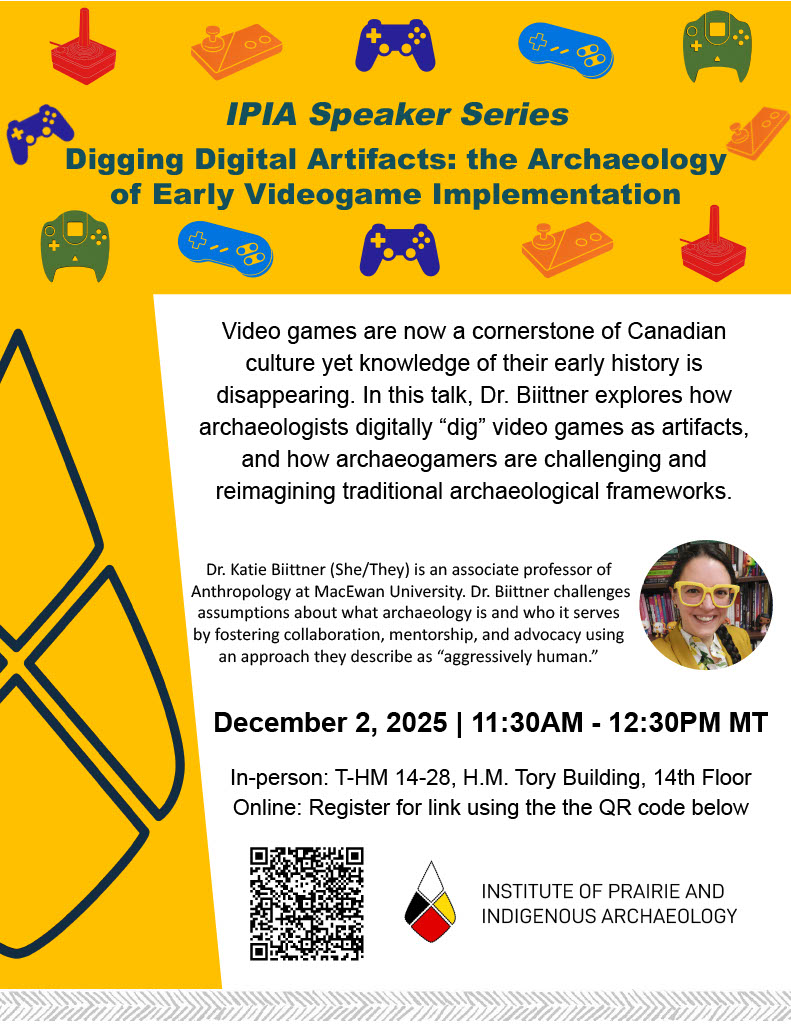
Digging Digital Artifacts: the Archaeology of Early Videogame Implementation
December 2, 2025
11:30 am - 12:30 pm (MT)
In-person: Tory 14-28
Online: Register at https://ualberta-ca.zoom.us/webinar/register/WN_PSh1R51LQ1edVVoLqGqFMg#/registration
Archaeogaming is a subfield that applies archaeological methods and theory to the analysis of a specific type of digital culture - videogames. Video games are a multi-billion-dollar industry in Canada alone, with over 20 million Canadians of all ages and genders playing them; thus they are an important part of the day-to-day lives of many individuals and as such are important cultural artifacts that must be studied. However, early videogames are distant enough from us in time that knowledge about them is already "lost". So what do we actually know about the early development of videogames? What are the opportunities and limitations of approaching videogames as archaeological sites and videogame code as artifacts? How can we capture the non-linear relationship between games, computers, and the people who play them? And how well equipped are archaeologists for documenting and analysing the enormous number of games and amount of largely digital data associated with them? In this presentation, Dr. Biittner will address these questions, and more, by sharing the approach her interdisciplinary research team is using to "dig" digital artifacts and understand their significance as culturally and technically significant artifacts of play. Further, by developing new ways of studying and understanding digital artifacts like videogames, archaeogamers like Dr. Biittner are also queering archaeology by challenging traditional archaeological concepts and frameworks.
 |
Dr. Katie Biittner (She/They) is an Associate Professor of Anthropology at MacEwan University in the Department of Anthropology, Economics, and Political Science. Dr. Biittner has over twenty years of archaeological field experience, including leading excavations, supervising graduate and undergraduate students, directing field schools, providing ethnographic and archaeological field training, and developing community outreach programs. Their research broadly focuses on what technologies tell us about what it means to be human; this has included the study of the Stone Age tools made and used by early humans in Tanzania, and the digital artifacts of early video games that spawned the global industry we know today. Their teaching focuses on interrogating what archaeology is, who archaeologists are, and what archaeology can contribute to our understanding of human technological behaviour. Dr. Biittner is focused on interdisciplinary and international collaboration, maintaining ongoing partnerships with colleagues and students locally and internationally, and is committed to providing mentorship and support grounded in advocacy for equity, diversity, accessibility, and inclusion. This approach to teaching, research, and service is one that she describes as “aggressively human”. |