Surgeons Perform Canada’s First Above-Elbow Osseointegration and Bionic Limb
10 September 2026
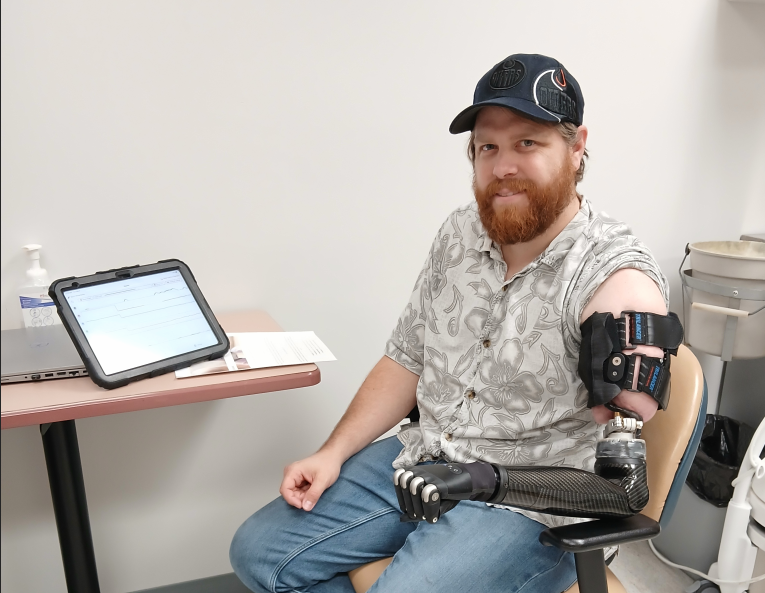
Chris Nielson, the first person in Canada to receive above-elbow osseointegration
n a historic milestone for Canadian medicine, University of Alberta surgeons Drs. Adil Ladak, Hollie Power and Robert Stiegelmar successfully performed Canada’s first above-elbow osseointegration surgery.
The procedure implants a titanium stem directly into the humerus, allowing a bionic limb to securely attach to the bone-anchored prosthetic and eliminating the need for a traditional socket. As part of the reconstruction, the team combined osseointegration with targeted muscle reinnervation (TMR) to optimize the interface between the patient and the prosthesis. By rerouting residual nerves to specific muscles, TMR generates meaningful muscle signals that can be detected by the prosthetic system. When paired with the direct skeletal connection provided by osseointegration, this approach creates an integrated neuromuscular and skeletal interface designed to allow more seamless and intuitive control of a myoelectric prosthetic limb.
Supported by a grant from the United States Department of Defense and led by Dr. Jacqueline S. Hebert, a rehabilitation physician who leads the rehab for the cases. and the BLINC Lab alongside Co-Investigators Dr. Ladak, Dr. Power and Dr. Stiegelmar, this initiative bridges surgical excellence with a multidisciplinary network spanning engineering, psychology, kinesiology, and rehabilitation. To optimize advanced prosthetic control for daily life, the team utilizes virtual reality environments and cutting-edge muscle-signal technology to train the patient and refine prosthetic control.
Clinically, the Alberta Amputation Reconstruction and Limb Osseointegration (ARLO) Program is unique in Canada and provides specialized care for individuals experiencing complex issues related to limb loss. Serving patients from across Canada, the program integrates expertise from physical medicine & rehabilitation, orthopedic surgery, plastic surgery, physical therapy, occupational therapy, and prosthetics.
The initiative highlights the strength of cross-institutional collaboration, bridging surgical excellence with a multidisciplinary research network spanning engineering, psychology, kinesiology, and rehabilitation medicine across the University of Alberta, UAH, and the Glenrose Rehabilitation Hospital.
Post-surgery, the patient has been undergoing specialized rehabilitation and functional training at the Glenrose Rehabilitation Hospital. Under the care of occupational therapist Glyn Murgatroyd and prosthetists Mike Stobbe and Petra Hossein, the patient is learning to use targeted muscle signals to operate an advanced myoelectric prosthetic limb.
Simultaneously, researchers at the BLINC Lab are using virtual reality platforms to train the patient, fine-tune control over the advanced prosthesis, and measure both quantitative and qualitative outcomes to evaluate how this life-changing intervention improves overall quality of life.
This first-in-Canada achievement underscores the transformative advances made possible when surgical innovation, advanced engineering, and comprehensive rehabilitation converge.